

On this page
Your Class 8 child sits down after school and is still at the desk at 9 pm. Is that normal? India has an official answer, and a week of honest timings is one of the most useful things you can bring to a teacher.
How long should Class 8 homework take each day?
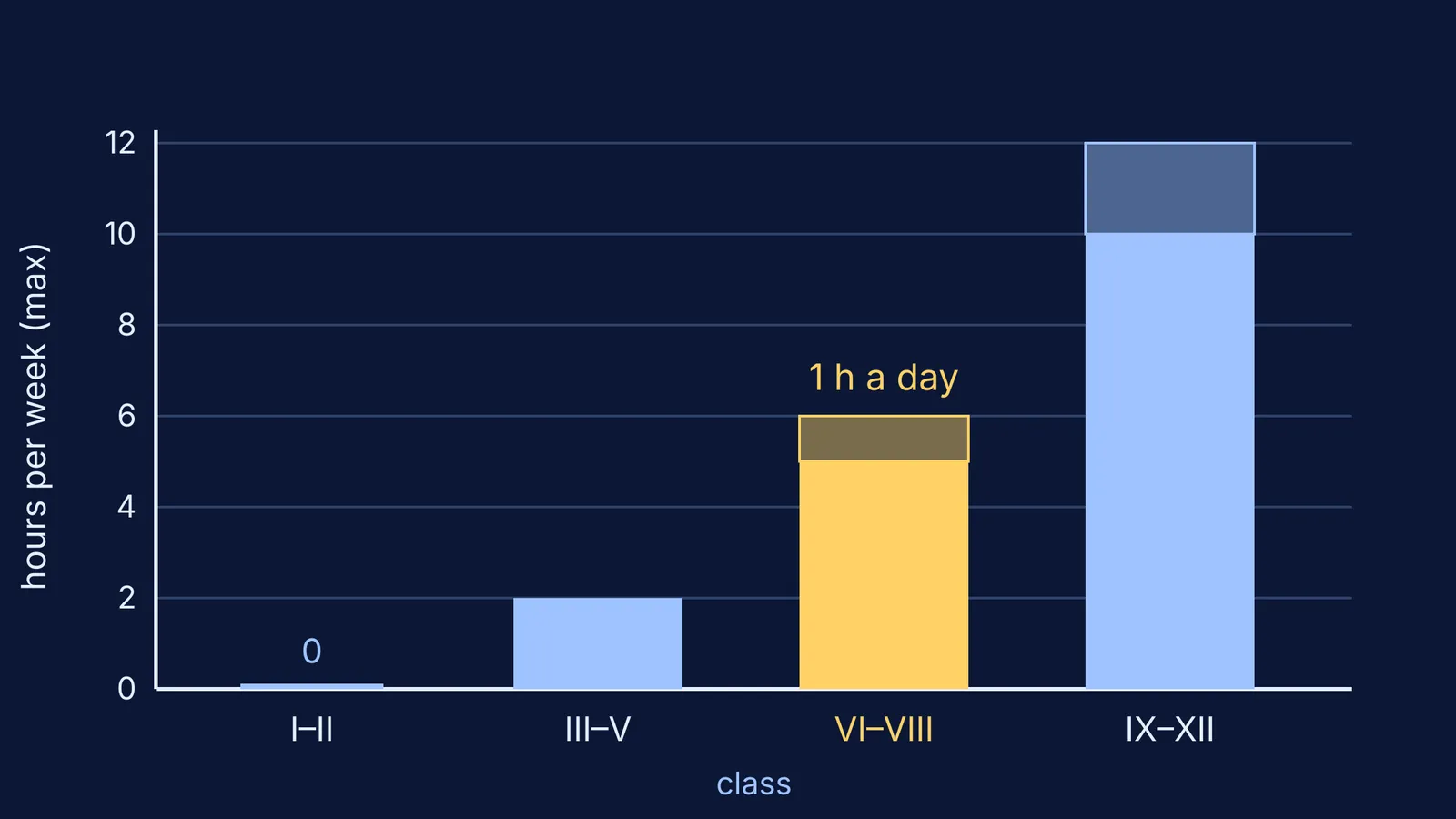
India's Policy on School Bag 2020, released by NCERT and sent to all states by the education ministry on 24 November 2020, recommends a maximum of one hour of homework a day for Classes VI to VIII, about five to six hours a week. It advises no homework up to Class II and up to two hours a day from Class IX.
Research supports the idea that around an hour is enough at this age. A study of maths and science results among 7,725 Spanish adolescents, average age about 14, found that "the optimum duration of homework was found to be 1 hr a day". The same study found that working independently mattered more than effort or time spent.
Homework also seems to matter more at this stage: a review of US research from 1987 to 2003 found a stronger link between homework and achievement in Grades 7 to 12 than in kindergarten to Grade 6. So the goal is about an hour of work your child can mostly do alone, not three hours of struggle. Realistic ranges for Class 8:
Ordinary school day: up to about 60 minutes in total, across all subjects.
The night before a test or a project deadline: it may go past an hour now and then.
The weekly check: add up all seven days, weekends included. If the total stays at or under about six hours, you are within the policy's guide.
Not counted: reading for pleasure. The policy itself says children should be encouraged to read books at home.
If your child also goes to tuition, see our evening routine for a child with tuition.
What are the signs homework is taking too long?
Watch for these over two or three weeks:
The weekly total keeps going above six hours, the most the School Bag Policy suggests for Classes VI to VIII.
Homework pushes bedtime late enough to cut into sleep. The American Academy of Sleep Medicine says teenagers aged 13 to 18 should sleep 8 to 10 hours every 24 hours.
One subject takes most of the time, night after night.
Much of the time is spent stuck: staring at the page, waiting for help, starting the same sum again.
The work is mostly copying. The policy criticises "mechanical" homework, such as copying answers from books.
Most evenings bring tears or dread before homework. Tele MANAS, the government's toll-free 24x7 mental health helpline, is on 14416.
How do you time a week of homework?
Log seven days in a row and let your child write it. For each subject, note:
Start and stop time.
Minutes spent stuck (a rough guess is fine).
Whether it was finished.
Who helped, if anyone.
A made-up example: Monday 70 minutes, Tuesday 95, Wednesday 60, Thursday 110, Friday 40, Saturday nothing, Sunday 90. That adds up to 465 minutes, or 7 hours 45 minutes, nearly two hours over the policy's weekly guide of about six hours. Maths took 200 of those minutes, and about 80 were spent stuck on word problems.
That last line turns "too much homework" into something a teacher can act on. If the stuck minutes come from one idea, the Fermi Concept Library has a lesson for every concept in physics, chemistry, biology, mathematics and computing, so your child can go over the idea before the next worksheet. If the problem is pace more than understanding, try our timer routine for shorter homework evenings.
How do you talk to the teacher about homework time?
Ask for a short meeting and bring the log. Stay curious, not accusing: each subject teacher sees only their own share of the evening. A script you can adapt:
"Thank you for making time. We timed homework for one week and wanted to share what we saw."
"The total was 7 hours 45 minutes. Maths took 200 minutes, and about 80 of those were spent stuck on word problems."
"Is that close to what you expect? Which part of the maths homework matters most to you?"
"Could my child stop after 30 minutes, mark where they got stuck, and bring it to you?"
"Can we check in again in two weeks?"
For Classes IX to XII, the School Bag Policy says teachers need to work together to plan how much homework they set, so it is fair to ask whether that happens in Class 8 too. If maths is also a daily fight at home, these four changes for a child who hates maths homework can help while you wait for the next check-in.
Start the log this Monday. By Sunday you will know whether you have a homework problem, a single-subject problem, or just one heavy week.


