

On this page
It is the last Sunday of the break, the science model has not been started, and the maths worksheet is "almost done" (it is not). If this happens every vacation, it is not a character flaw, and it can be fixed.
Why do children leave holiday homework till the last days?
There are two well-studied reasons. The first is that people tend to underestimate how long work will take. In the "planning fallacy" studies by Roger Buehler, Dale Griffin and Michael Ross (Journal of Personality and Social Psychology, 1994), 37 psychology students predicted on average that they would finish their final-year theses in 33.9 days. They took 55.5 days, which was longer than even their own worst-case estimate of 48.6 days. Only about 30% finished by the date they had predicted.
The second is that delay is closely tied to how a task feels. A meta-analysis of 691 correlations by Piers Steel (Psychological Bulletin, 2007) found that how unpleasant a task feels, low confidence about doing it, and impulsiveness were strong and consistent predictors of procrastination. A large, vague "do your project" is exactly that kind of task. More on this in our piece on why procrastination is about feelings, not laziness.
So the fix is to make tasks small and visible, with a safety margin.
How do you break vacation homework into weekly chunks?
Do this together in the first two days of the holiday.
List everything from the school diary or circular, including tasks that need supplies or printouts.
Cut each task into chunks. A chunk is one sitting with a clear finish line: "write the first two paragraphs of the book review", not "English".
Count the chunks and the weeks. Keep the last week empty as a buffer, because something will take longer than you both expect.
Divide. Spread the chunks evenly over the remaining weeks, and let your child choose which days they work.
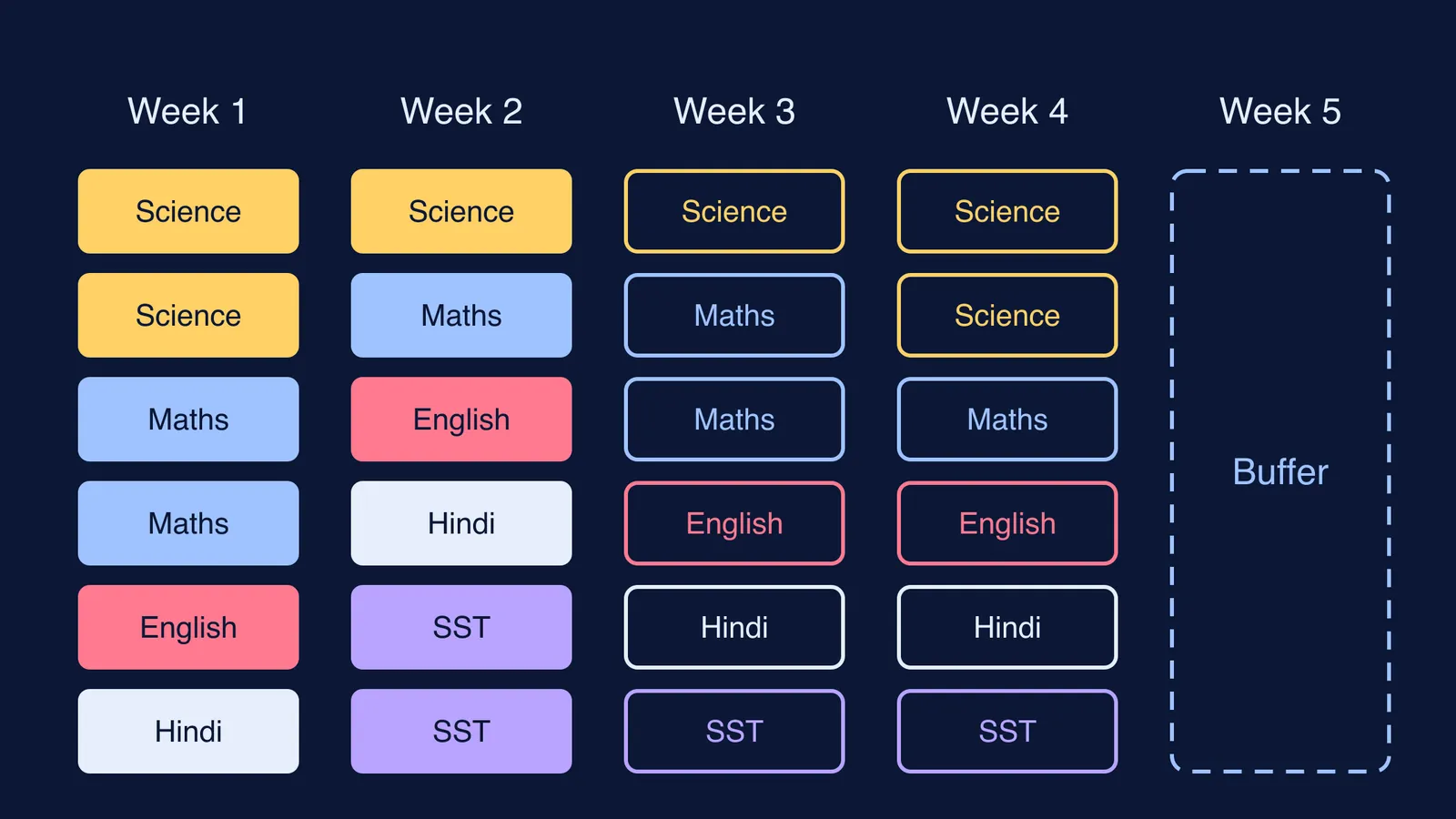
Here is a worked example. Take a five-week break and this list: maths worksheets (6 chunks), a science model (6), an English book review and handwriting (4), Hindi essays (4) and a social science project file (4). That is 24 chunks. Week 5 is the buffer, so 24 chunks over 4 weeks is 6 a week, or two chunks on three mornings. Put the science model's shopping trip in week 1, because everything else in that project depends on it.
If you are planning from the start of a long break, our guide to planning summer holiday homework week by week covers the set-up in more detail. For a short festival break, try this light seven-day study routine for Diwali holidays.
Does a wall chart actually help?
Tracking progress is one of the better-tested habits in psychology. A meta-analysis of 138 randomised studies with 19,951 participants by Benjamin Harkin and colleagues (Psychological Bulletin, 2016) found that getting people to monitor their progress helped them reach their goals. The effect was larger when progress was physically recorded, or reported to others.
A wall chart does both:
One column per week, one box per chunk, a few words in each ("Maths sheet 3").
Your child colours a box when the chunk is finished, not when it is started.
Put it where the family walks past it, such as the fridge.
Look at it together once a week. Praise the coloured boxes before asking about the empty ones.
What if it is already the final week?
Stay calm: panic uses up time you do not have. Tonight:
Write the full list. Mark each item as graded or not, and whether the teacher will check it on day one.
Do the supplies run tomorrow morning, so nothing gets stuck later.
Chunk everything and spread it over the days left, graded and day-one items first.
Put thinking work, such as maths or an essay draft, in the morning, and copying or colouring later.
Keep sleep and meals normal.
If a maths sheet stalls because your child does not know where to begin, the Fermi Problem Library has worked problems with a step-by-step solver that explains the reasoning rather than printing an answer, so they can go back and do their own sheet. Help with logistics, not answers.
If it truly cannot all be done, honesty beats rushed, copied work. A script your child can use: "Ma'am, I have finished my maths, Hindi and English work. My science model is half done because I started too late. Could I bring it on Friday?"
What can you say to your child tonight?
"Let's see the whole list. It usually feels smaller once it's written down."
"You don't have to finish everything today. Just today's boxes."
If deadline worry turns into lasting distress, sleeplessness or hopeless talk, speak to a school counsellor or doctor, or call Tele MANAS on 14416 or 1-800-891-4416, a free 24x7 helpline run by the Ministry of Health and Family Welfare (Tele MANAS).
On the first day of the next break, draw the chart together and leave the last week empty.


