

On this page
Your child knows v = u + at by heart and still gets the numerical wrong. That's common. In Class 9 a child must turn a paragraph about a scooter or a cricket ball into an equation, and the problem is often the method, not the formula. Below are a four-step routine, a worked example, and questions you can ask even if you've forgotten your own school physics.
Why does a Class 9 child struggle with physics numericals?
In a 1981 study in Cognitive Science, Michelene Chi, Paul Feltovich and Robert Glaser used sorting tasks to compare how experts and novices approach physics problems. Experts started from the physics principle a problem needed, while novices based their approach on the problem's literal features.
In plain terms: a struggling child looks at the words ("car", "brakes", "seconds") and hunts for a formula that has those things in it. A routine slows them down just enough to ask what is actually happening first.
What is the four-step routine for motion and force numericals?
Ask your child to write these four headings in the margin of every numerical until they become a habit.
Knowns and unknown. List every quantity with its symbol and unit: u, v, a, t, s, m, F. Write "starts from rest" as u = 0 and "comes to a stop" as v = 0. Circle the quantity the question wants.
Principle, then formula. Name what is going on in one line ("steady acceleration in a straight line" or "force causing acceleration"). Then choose the equation that links the knowns to the unknown and has no other unknown in it.
Units. Convert everything to SI units (metres, seconds, kilograms) before substituting. Keep the unit with every number in the working.
Does it make sense? Check the sign, the size and the unit of the answer. Then check it a second way if you can.
Step 3 matters outside school too. NASA lost its Mars Climate Orbiter in 1999 because its ground software used English units while the spacecraft's software worked in metric, which sent it too close to Mars.
What does the routine look like on a real question?
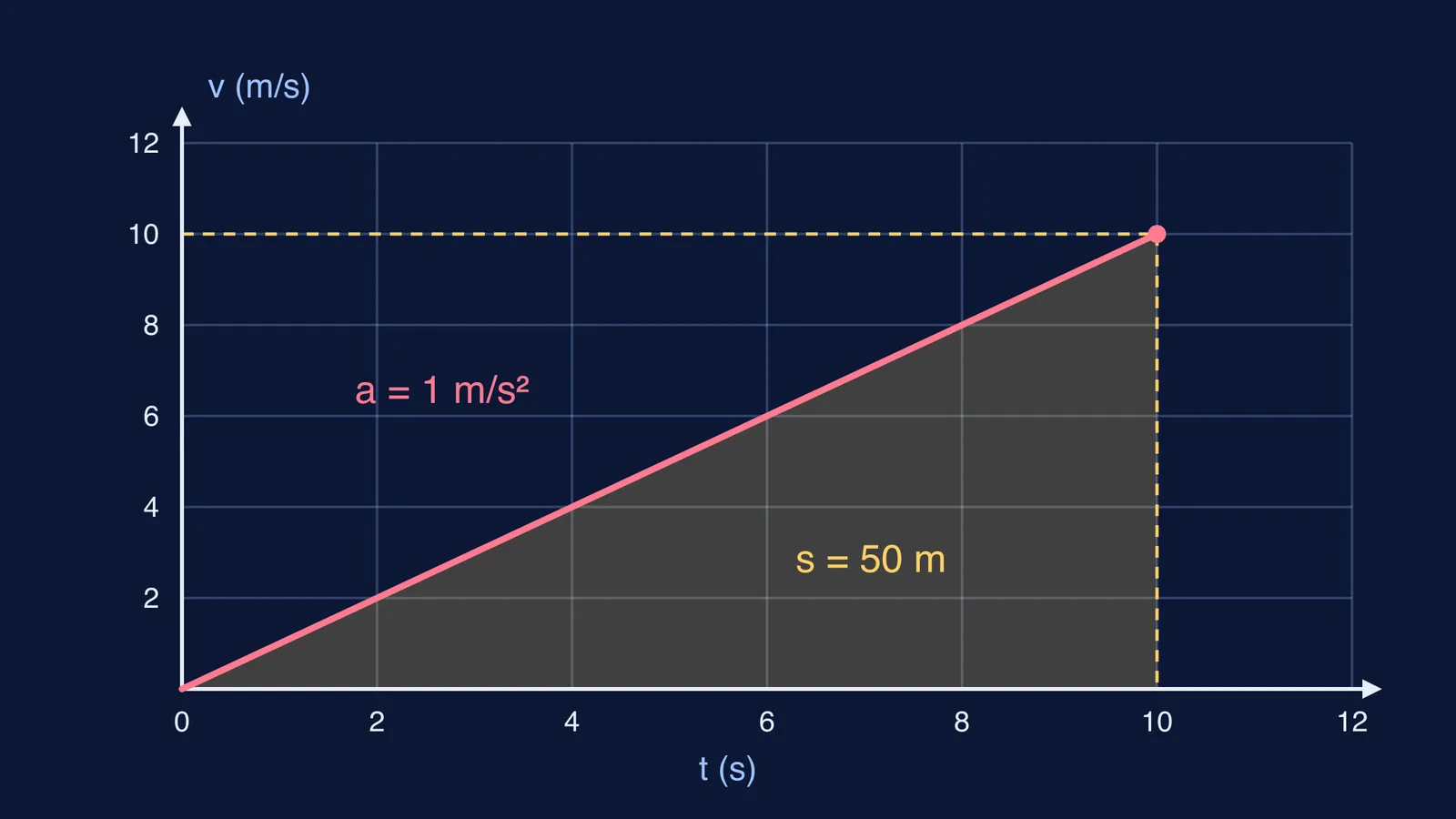
Here is a typical Class 9 question: a scooter starts from rest and reaches 36 km/h in 10 seconds. The scooter and rider together have a mass of 150 kg. Find the acceleration, the distance covered and the force needed.
Step 1, knowns: u = 0 m/s (from rest), v = 36 km/h, t = 10 s, m = 150 kg. Unknowns: a, s, F.
Step 2, principle: steady acceleration in a straight line, so use v = u + at for a and s = ut + ½at² for distance. A force causing acceleration means F = ma.
Step 3, units: v = 36 ÷ 3.6 = 10 m/s.
Now substitute. a = (v − u) ÷ t = (10 − 0) ÷ 10 = 1 m/s². Then s = 0 × 10 + ½ × 1 × 10² = 50 m. Finally F = ma = 150 × 1 = 150 N.
Step 4, does it make sense?
Sign: speeding up, so a should be positive. It is.
Size: 1 m/s² means the scooter gains 1 m/s every second, so after 10 seconds it is doing 10 m/s. That matches.
Second route: the average speed is (0 + 10) ÷ 2 = 5 m/s, and 5 m/s for 10 s is 50 m. Same answer.
Unit: kg × m/s² is a newton, so 150 N is the right kind of answer.
The usual mistake is skipping step 3. Put 36 straight into the formula and you get 3.6 m/s². That's a scooter reaching about 130 km/h in 10 seconds, which the size check catches immediately.
How can a parent help without knowing the physics?
You don't need to solve the problem. Your job is to ask the routine's questions in order and let your child do the thinking. A short script:
"Read it to me. What is moving, and what is it doing?"
"What do we know? Write each one with its unit."
"What are we asked to find? Circle it."
"Which formula has only one thing we don't know?"
"Is everything in metres, seconds and kilograms?"
"Does the answer sound real? Could a scooter do that?"
If your child gets stuck at step 2 on the same kind of problem again and again, the gap is likely the method, not effort. The Fermi Problem Library has worked problems with a step-by-step solver that explains the reasoning rather than printing an answer, so your child can compare their own steps with it line by line.
If the idea of motion itself still feels shaky, start with these everyday ways to explain Class 9 motion on walks and car rides. If your child uses AI for homework, here is how to check AI answers to equations of motion numericals.
Tonight, pick one motion numerical from your child's homework and ask only the six questions above.


