

On this page
Class 9 motion numericals look easy to hand to an AI chatbot: three formulas, five letters, one answer. That's why a wrong answer can look right, with neat working and the sign of the acceleration quietly wrong. Two habits help: ask the AI to list what is known and unknown before it picks an equation, and check the sign of acceleration whenever something slows down.
Which equations of motion are in Class 9?
The current NCERT Class 9 science textbook, Exploration, covers this in Chapter 4, Describing Motion Around Us. It gives three kinematic equations: v = u + at, s = ut + ½at² and v² = u² + 2as.
The same chapter notes that these equations are valid only when the acceleration is constant, and that in straight-line motion in both directions the signs of u, v, a and s tell you the direction of each quantity (NCERT, Chapter 4).
Each equation links four of the five quantities and leaves one out:
v = u + at has no s (displacement)
s = ut + ½at² has no v (final velocity)
v² = u² + 2as has no t (time)
So pick the equation that leaves out the quantity you neither know nor need. To see where the equations come from, read our post on deriving the equations of motion with a velocity-time graph.
Why list known and unknown quantities first?
When an AI jumps straight to a formula, you can't see why it chose it. A short list makes its reasoning something you can check line by line. Words like "starts from rest" (u = 0), "comes to a stop" (v = 0) and "brakes are applied" (slowing, so a is against the motion) hide values that are easy to miss.
Try this prompt before asking for any working:
"Before solving, list s, t, u, v and a. For each, write the value with its unit, or 'unknown', or 'not needed'."
"Say which direction you are taking as positive."
"Name the equation that leaves out the 'not needed' quantity, and explain why."
"Convert km/h to m/s before substituting."
If the list is wrong, stop there. A wrong list is quick to fix. A page of algebra built on it is not.
How do you check the sign when an object slows down?
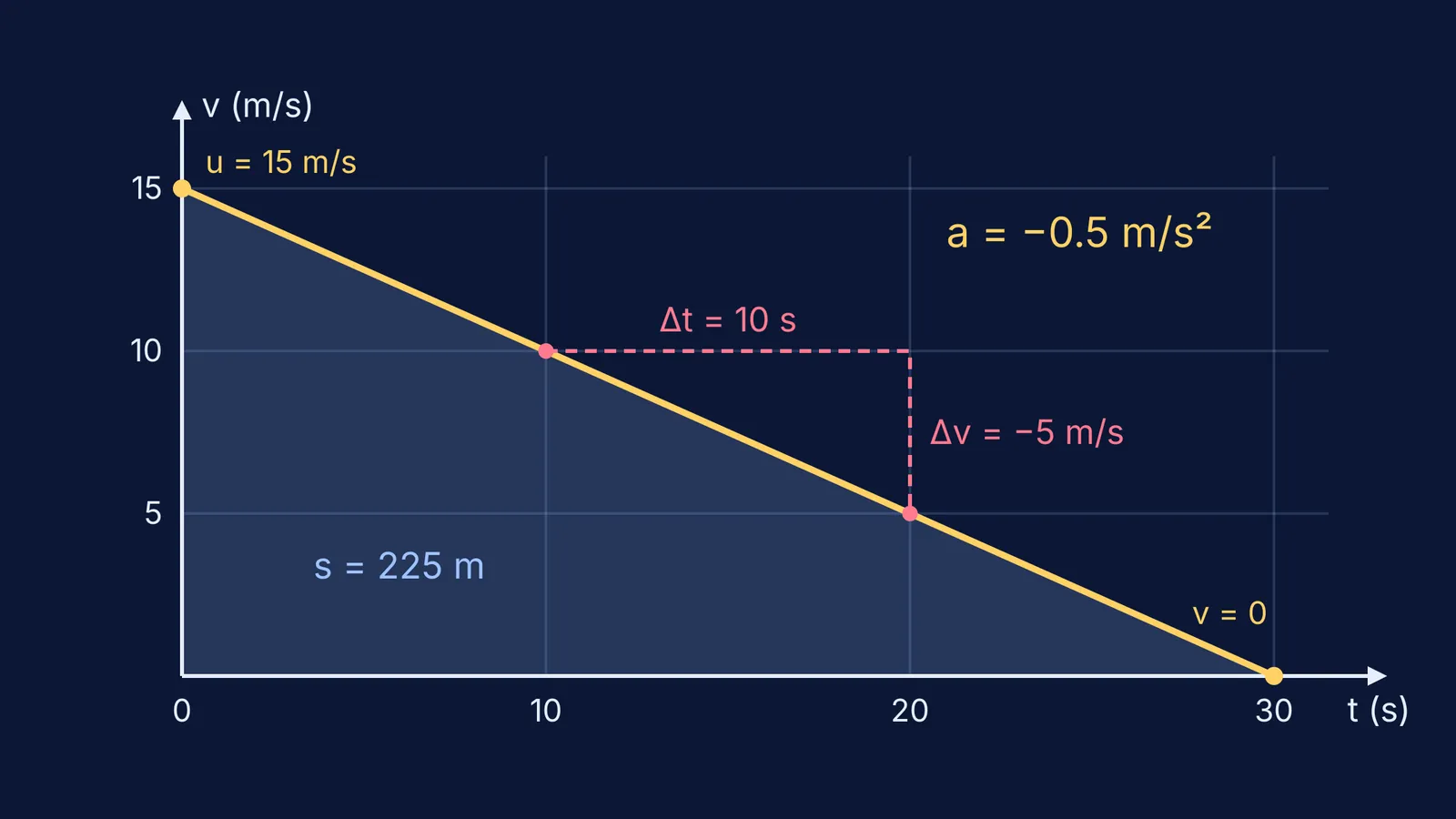
Take the direction of motion as positive. Then a slowing object has negative acceleration. NCERT's velocity-time graph for a car slowing steadily from 15 m/s to rest over 30 s gives an acceleration of −0.5 m/s², and the textbook says the minus sign shows the acceleration is opposite to the velocity (NCERT, Chapter 4).
The chapter's braking example uses a = −4 m/s² and v = 0. With v² = u² + 2as, the stopping distance is s = u²/8, which gives 28.1 m from 54 km/h (15 m/s) and 112.5 m from 108 km/h (30 m/s) (NCERT, Chapter 4). Doubling the speed made the stopping distance four times longer, which is also a quick check on an answer. For vertical motion, see our explainer on whether g should be positive or negative.
Worked example: catching a sign slip
A bus moving at 72 km/h brakes uniformly and stops in 50 m. Find its acceleration and stopping time.
List first: u = 72 km/h = 20 m/s, v = 0, s = 50 m, a = unknown, t = unknown. Take the direction of motion as positive.
You have u, v and s, so use NCERT's v² = u² + 2as: 0 = 400 + 100a, so a = −4 m/s². Then v = u + at gives 0 = 20 − 4t, so t = 5 s.
Now check it with the equation you haven't used yet: s = ut + ½at² = 20 × 5 + ½ × (−4) × 25 = 100 − 50 = 50 m. It matches.
A slip to watch for is writing only the magnitude, a = 4 m/s², and then using it in v = u + at. That gives t = (0 − 20) ÷ 4 = −5 s. A negative time is the red flag. The arithmetic is fine. The sign is wrong.
What should you do when the AI's answer doesn't match?
Don't just ask it to "try again". Point to the step: "Your a is positive but the bus is slowing. Redo it with the direction of motion as positive." For a general routine that works on any chapter, see our guide to solving physics problems step by step.
To practise with working you can follow, the Fermi Problem Library has worked problems with a step-by-step solver that explains the reasoning rather than printing an answer. Fermi's AI tutor notices where you are stuck and decides whether to explain, ask or show.
Tonight, write the s, t, u, v, a list for three exercise numericals yourself, then compare it with the AI's.


