

On this page
Brochures for "foundation courses" often start reaching families around Class 7 and 8, promising a head start for JEE, NEET and olympiads. The real question is narrower: will three more evenings a week in a coaching classroom teach your child more than the same hours spent sleeping, playing and going deeper into school maths?
What does a Class 8 foundation course actually offer?
Many foundation programmes run by coaching institutes teach school maths and science at a faster pace, add harder olympiad-style problems, and hold regular tests with ranks. A curious child who finishes school work quickly may enjoy that.
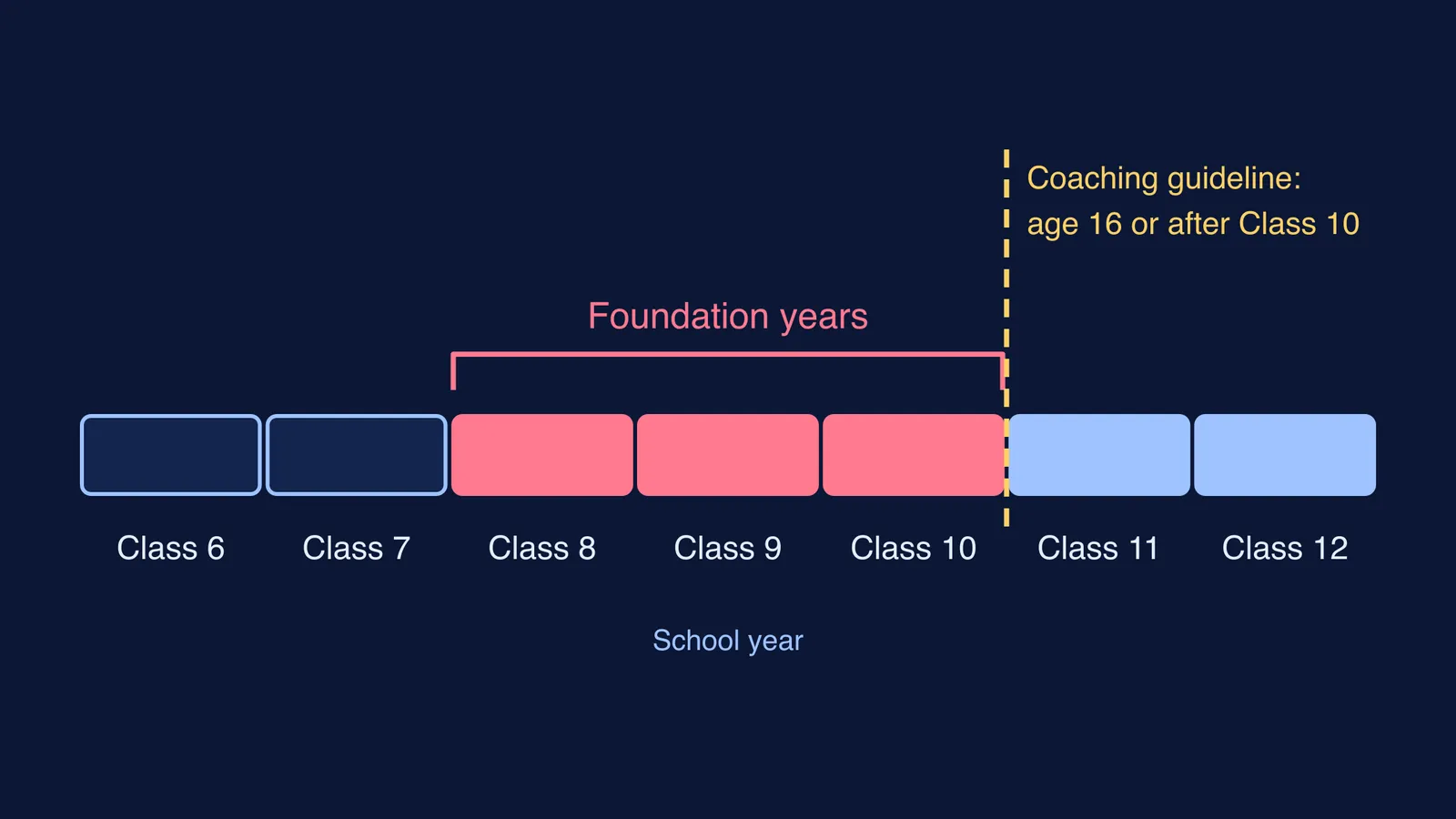
The Ministry of Education's Guidelines for Regulation of Coaching Center (January 2024) say a coaching centre "shall not enroll student below 16 years of age or the student enrolment should be only after secondary school examination." The same guidelines say coaching should not run for more than 5 hours in a day, should not start too early or end too late, and must give students a weekly off. They define coaching as teaching more than 50 students, so a small tuition class may fall outside them.
These are model guidelines for states, not a national law. A written reply in the Rajya Sabha in August 2026 names several states and union territories that have since brought out their own guidelines, rules or laws, so the rules vary by state.
What does a foundation course cost in time and childhood?
Beyond fees, the bigger cost is time. The American Academy of Sleep Medicine recommends 8 to 10 hours of sleep per 24 hours for teenagers aged 13 to 18, and 9 to 12 hours for children aged 6 to 12. It links regularly sleeping less than that with attention, behaviour and learning problems.
A worked example week (swap in your own numbers):
Foundation classes: 3 evenings of 2.5 hours = 7.5 hours
Travel to and from the centre: 3 trips of 1 hour = 3 hours
Sunday test: 3 hours
Institute homework: 4 hours
That adds up to 17.5 hours a week, or 2.5 hours a day, before any school homework. Those hours usually come out of sleep, play and slow thinking. Our guide on how much sleep teenagers need and how parents can help has a practical plan.
Is going deeper into school maths a better foundation?
The research points that way, though no study has compared the two paths directly. Robert Siegler and colleagues analysed large national data sets from the US and the UK (Siegler et al., 2012). Primary school students' knowledge of fractions and division predicted their algebra and overall maths achievement in high school, 5 or 6 years later, even after accounting for other maths knowledge, general intellectual ability, working memory, and family income and education.
For Class 8, the foundation that matters most is often what is already in the textbook, understood well: fractions, ratios, negative numbers, and why each step of an equation is allowed. A child who can explain why a method works is likely to be better placed for Class 11 than one who has memorised shortcuts for questions two years ahead. See how to help your Class 8 child with maths without solving it for them.
How do you decide? A four-question test
Is the wish theirs, not the friend group's or the brochure's?
Is school maths secure? Ask them to explain three recent textbook problems out loud. If they can do the steps but not say why, depth comes first.
Will sleep stay within the recommended range for their age on class days, counting travel? That is 8 to 10 hours from age 13, or 9 to 12 hours if they are still 12.
Can you leave easily? The 2024 guidelines ask centres to publish an easy exit policy and a fee refund policy, and say that a student who has paid in full and leaves mid-course should be refunded for the remaining period, on a pro-rata basis, within 10 days. Read the terms before paying.
If all four answers are yes, a single trial term is reasonable. If any answer is no, try a term of the cheaper path: the school textbook done deeply, one good problem book, a weekly maths chat at dinner, and plenty of free time. Then look again in Class 9.
When your child keeps getting stuck on the same idea, the Fermi Concept Library has every concept in physics, chemistry, biology, mathematics and computing, each with its own lesson, so they can go back to the gap. If they are not sure where to start, Fermi's AI tutor works out what a student already knows and builds a plan for the session.
If the pressure is showing as constant worry, low mood or poor sleep, talk to your family doctor or a school counsellor. Tele MANAS, the government's free 24x7 mental health helpline, is on 14416.
Thinking about this even earlier? Read our guide on whether coaching is needed in Class 6.


