On this page
Five minutes a day with a sudoku, a riddle or a KenKen costs nothing, needs no screen, and asks for what school work keeps asking for: stay with a problem you can't solve yet. Here is what research does and doesn't promise, and a plan you can start tonight.
What are the benefits of a daily puzzle habit for kids?
The clearest evidence is for young children and spatial skill. In a 2012 study in Developmental Psychology, Susan Levine and colleagues observed 53 children at home between the ages of 2 and 4. At four and a half, children who had played with puzzles did better at mentally moving and rotating shapes, even after accounting for parent education and income. It shows a link, not proof of cause.
For older children, keep expectations honest. A 2017 review by Giovanni Sala and Fernand Gobet of chess, music and working-memory training concluded that far transfer of learning rarely occurs, and the better designed the study, the smaller the effect. So expect a child who does sudoku daily to get better mainly at sudoku and the habits it practises (checking every option, spotting a contradiction, trying again after a wrong guess), not at unrelated subjects such as history.
KenKen adds arithmetic. Its makers say Japanese maths teacher Tetsuya Miyamoto developed it in 2004 to improve his students' maths and logic skills, with grids that run from 3 x 3 up to 9 x 9.
Why rotate sudoku, riddles and KenKen?
Each puzzle works a different muscle. Sudoku is pure elimination. KenKen adds arithmetic inside each cage. Riddles are about words and reframing the question. For younger children, tangram puzzles bring in shapes; for older ones, letters-for-digits puzzles are a good step up.
There is also a learning-science reason to mix. In a three-month study of 126 seventh graders, Doug Rohrer and colleagues found that interleaved maths practice, where different kinds of problems are mixed together, beat blocked practice on tests given both 1 day and 30 days after a review session. Mixing forces the student to choose a strategy instead of repeating the last one. That study used maths homework, not puzzles, so treat it as a guide rather than a proven puzzle effect.
How long does it take for a puzzle habit to stick?
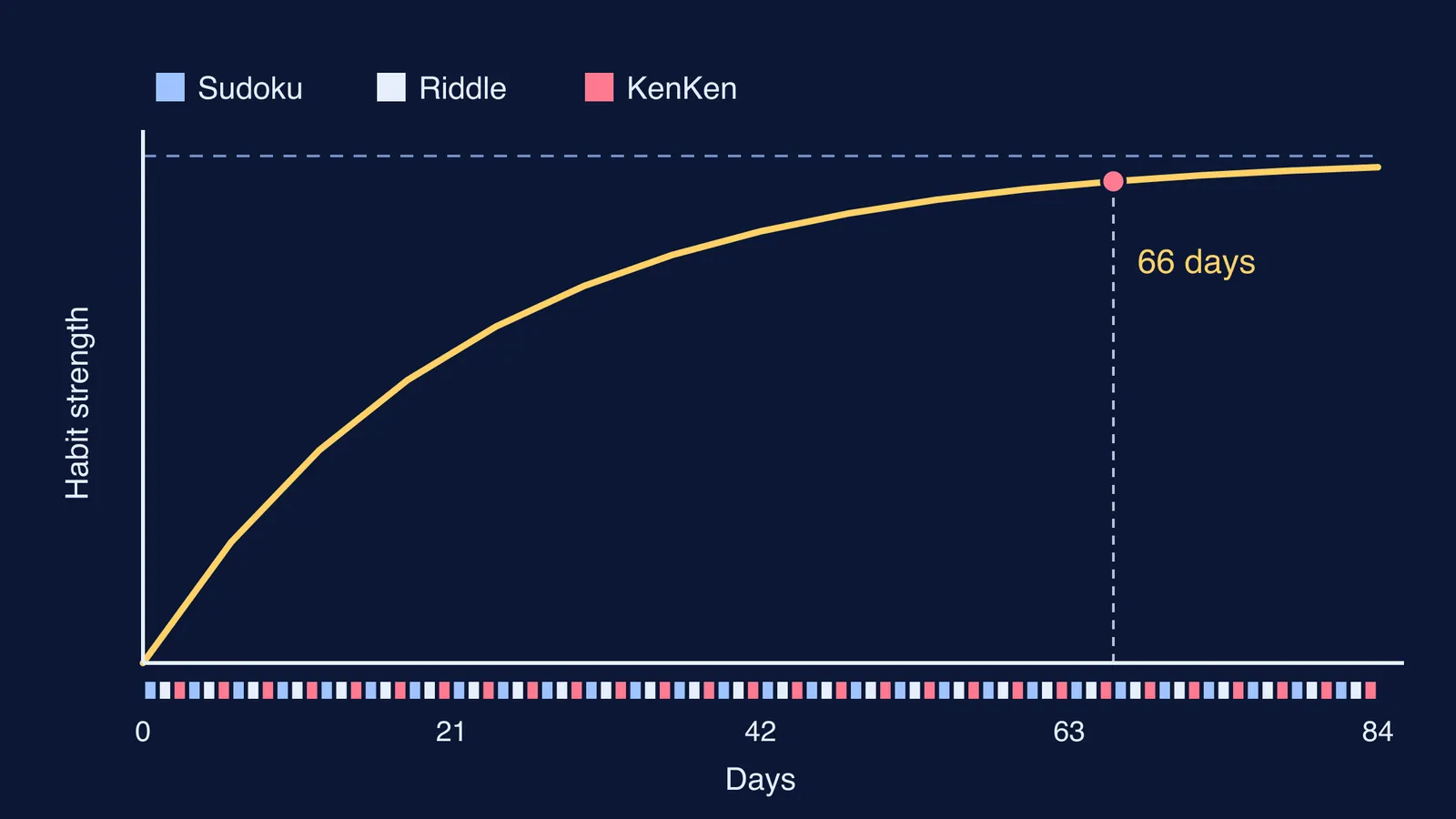
Longer than the popular 21 days. In Phillippa Lally's study at UCL, 96 volunteers repeated one daily behaviour in the same setting, such as after breakfast, for 12 weeks. Among the participants whose data fitted the model well, the median time to reach 95% of their peak automaticity was 66 days, with a range of 18 to 254 days.
Two points matter for parents. The study tied each habit to a consistent context, so attach puzzles to something that already happens daily. And missing one opportunity did not materially affect habit formation, so a skipped day is no reason to quit.
A five-minute weekly puzzle plan
Pick one anchor, for example straight after dinner and before any screen. Set a timer. Then rotate:
Monday: sudoku (4 x 4 for ages 6 to 8, 6 x 6 or 9 x 9 after that).
Tuesday: one riddle, read aloud; the child explains their answer.
Wednesday: KenKen, starting at 3 x 3.
Thursday: child's choice of the three.
Friday: riddle swap; the child brings one to stump you.
Saturday: a family puzzle, or the child makes a small sudoku for a sibling.
Sunday: rest, or a tangram for fun.
Adjust difficulty with one rule: finished in under two minutes three times running, step up a size; stuck at the timer twice in a row, step down.
A worked first KenKen move: in a 3 x 3 grid, each row and column holds 1, 2 and 3 once. A two-cell cage in a row marked "3+" must hold 1 and 2, since no other pair adds to 3. So the row's third cell is 3. One clue, one certain answer: that is the whole skill.
What should you say when your child gets stuck?
Praise the process, not the brain. In six studies with fifth graders, Claudia Mueller and Carol Dweck found that children praised for intelligence showed less persistence and less enjoyment after failure than children praised for effort.
Try lines like these:
"Which square do you know for sure? Start there."
"You ruled out two numbers. What does that leave?"
"That guess didn't work. What did it tell you?"
"You stayed with that for the whole five minutes."
Skip "You're so clever", and don't solve it for them. The same questions work on homework later. In later school maths and physics, being stuck is often about choosing the wrong method, not just a wrong guess. The Fermi Problem Library has worked problems with a step-by-step solver that explains the reasoning rather than printing an answer, so a teenager can see where their method went wrong.
If your child likes longer logic games, read whether chess helps children in their studies. Otherwise, pick tonight's anchor and print one 4 x 4 sudoku.