

On this page
Tangrams are cheap, quiet and screen-free. Can seven cardboard shapes help your child's maths? Probably a little, through spatial skills, if the play is regular and gets harder over time.
Do tangram puzzles help children with maths?
Spatial skill is the ability to picture shapes and move them in your head. A 2022 meta-analysis by Zachary Hawes, Katie Gilligan-Lee and Kelly Mix pooled 29 controlled studies with 3,765 participants and found that spatial training improved maths performance by an average effect size of 0.28, a small effect (Developmental Psychology). Training with concrete materials worked better than computerised training.
Tangrams have been tested inside such training. In one study, 258 children in grades 1 and 6 did six 30-minute sessions of spatial activities that included tangram puzzles (What Works Clearinghouse summary of Mix et al., 2021). Spatial skills improved. A broad maths score rose slightly in both grades, but the reviewers rated the overall maths effect as uncertain, and place value, word problems and number-line estimation did not change.
Susan Levine and colleagues observed 53 children at home between ages 2 and 4; those who played with puzzles did better on a shape-transformation task at 4½, even after accounting for family income and parent education (Levine et al., 2012). For girls, the quality of play, including parents' talk about space, also predicted scores.
A review of 217 training studies found that spatial gains lasted and carried over to spatial tasks that were not practised (Uttal et al., 2013).
What is a tangram, and what maths is hiding in it?
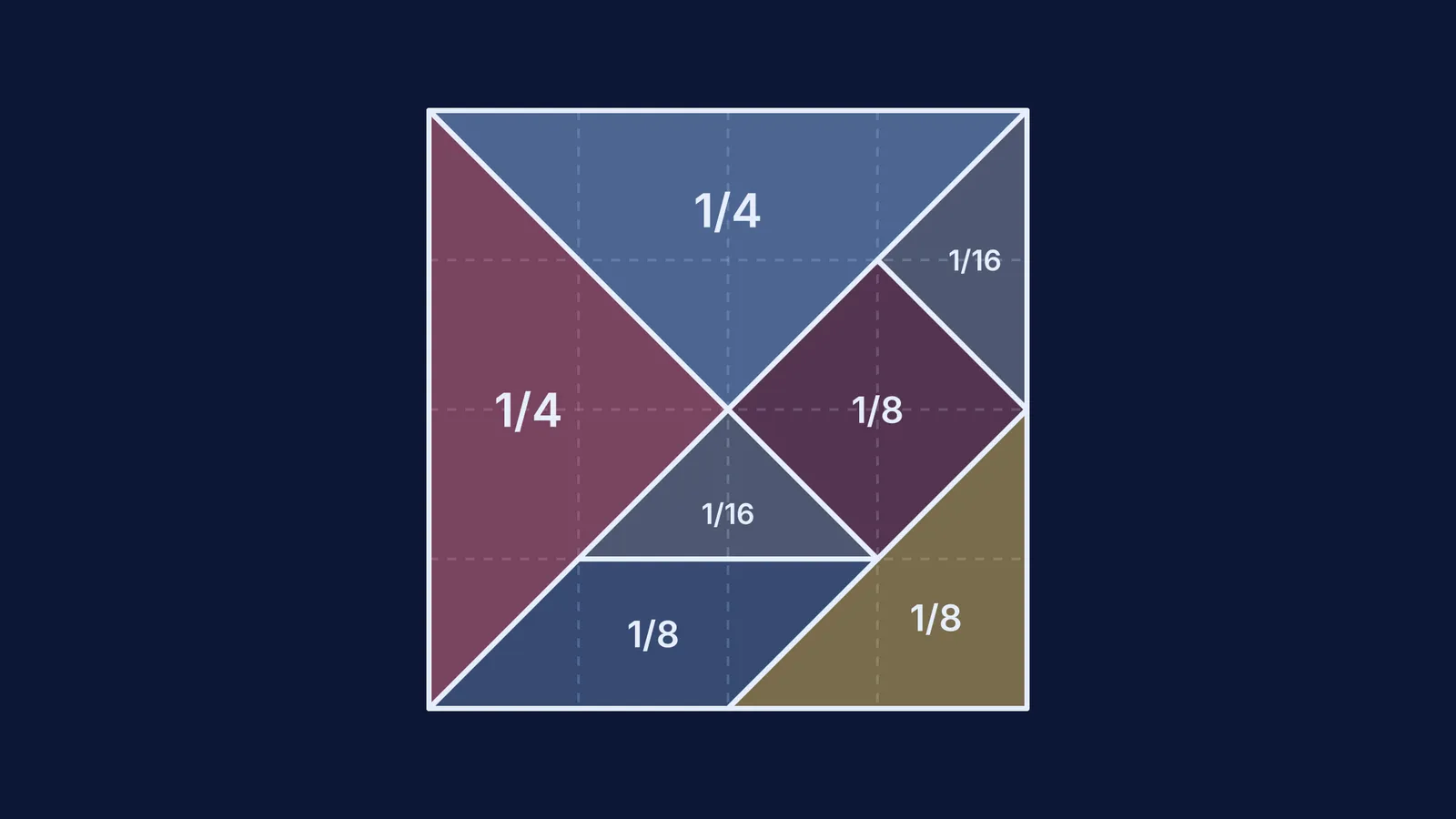
A tangram is a dissection puzzle of seven flat pieces that fit together into a square: five right-angled triangles in three sizes, one square and one parallelogram (Wikipedia: Tangram). India's school textbooks include this kind of play: the NCERT Class 3 textbook Maths Mela asks children to cut a cardboard square into four triangles and make as many shapes as they can by joining three of them (NCERT, Fun with Shapes).
Worked example: draw the square as 16 grid squares. Each large triangle covers 4 (a quarter); the medium triangle, square and parallelogram cover 2 each (an eighth); each small triangle covers 1 (a sixteenth). Ask your child to prove the eighths without counting: the two small triangles exactly cover the square, the medium triangle and the parallelogram. Same area, different shape.
How do you make a tangram set from cardboard?
You need a cereal-box panel, a ruler, a pencil and scissors. Measure across from the left edge and down from the top.
Cut a 16 cm square and draw a light grid of 4 cm squares on it.
Draw the diagonal from the bottom-left corner to the top-right corner.
From the top-left corner, draw along the other diagonal but stop at the point 12 cm across and 12 cm down.
Join the middle of the right side to the middle of the bottom side.
Join the point 12 cm across and 4 cm down to the middle of the right side.
Join the point 4 cm across and 12 cm down to the point 12 cm across and 12 cm down.
Cut along every line. Check that you have two large triangles, one medium, two small, a square and a parallelogram.
Colour both faces the same, since the parallelogram sometimes has to be flipped to fit. For more toys from waste material, read about Arvind Gupta's toys from trash.
What order should kids try tangram puzzles in?
Move up a level when your child solves most puzzles at the current one without help.
Full-size outlines with the inner lines drawn in.
Two-piece builds: make the square, the medium triangle and the parallelogram from the two small triangles.
Full-size silhouettes, such as a house or a boat, with no inner lines.
The same silhouettes drawn smaller, so pieces cannot be laid on top.
Rebuild the original square, then hunt for shapes with no dents. Wang and Hsiung proved in 1942 that the seven pieces form only 13 convex shapes (American Mathematical Monthly).
Design your own: build a figure, trace only its outline and swap it with a sibling.
What should you say while your child plays?
Talk about position and shape, but let your child place the pieces:
"Which piece could fit in that corner? Why that one?"
"Turn it. What changed, and what stayed the same?"
"Flip the parallelogram over. Does it fit now?"
"This side matches that side. Can you find another pair?"
When they are stuck: "Which are the biggest pieces? Where could they go?"
Tangrams pair well with kitchen maths for kids aged 5 to 11 and estimation games where you guess first, then measure. When fractions and area return in middle school, the Fermi Concept Library has a lesson for each concept in mathematics, so an older child can revisit the idea.
Tonight, cut one square and start at level 1.


