

On this page
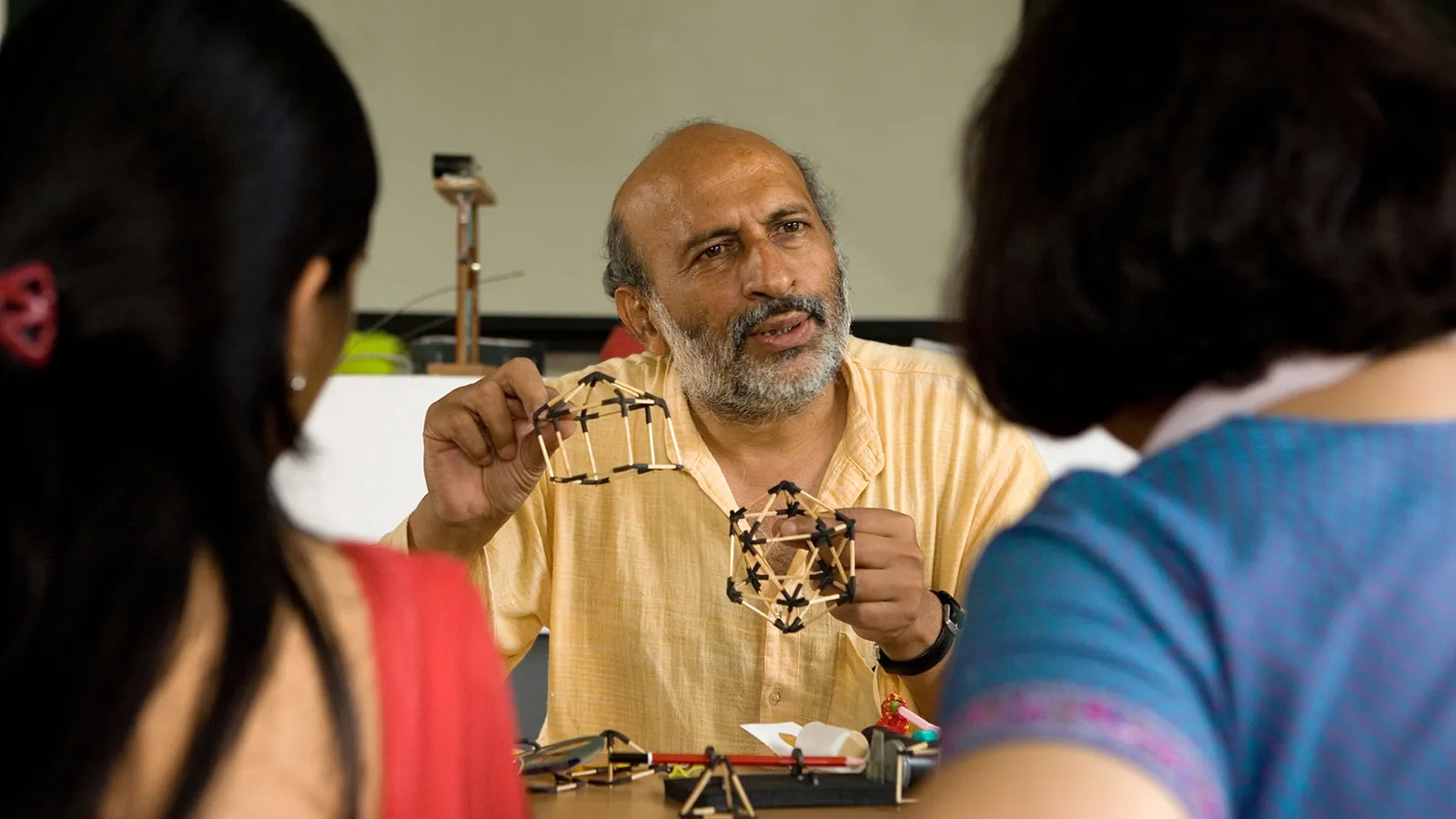
In 1978 a 24-year-old engineer named Arvind Gupta left a job making Tata trucks for a year in a village science programme, as he recalls in his TED talk. At the village's weekly market he found cycle valve tube, and saw that two matchsticks pushed into it make a flexible joint. That became a life's work: science models from matchsticks, straws and bottles that any child can build.
Who is Arvind Gupta?
Gupta graduated from IIT Kanpur in 1975 and in 1978 took study leave from TELCO to join the Hoshangabad Science Teaching Programme for village children, according to his Wikipedia biography). The same page records that his first book, Matchstick Models and other Science Experiments, was translated into 12 Indian languages and sold more than half a million copies.
In his TED talk at the INK Conference in 2010, Gupta said the programme he was describing "started with 16 schools and spread to 1,500 government schools", and that over 100,000 children learn science this way.
The Government of India awarded him the Padma Shri in 2018 for literature and education, as the full list of 2018 Padma awardees shows. His free site, Arvind Gupta Toys, sorts the toys into sections such as Pumps from the Dump, Simple Sounds and Motor and Generator.
How does Arvind Gupta teach science with toys from trash?
The method is simple: build first, name it after. In his TED talk Gupta recalls what he calls the defining slogan of the early 1970s:"Start from what they know. Build on what they have."
Take his matchstick polygons. Join three matchsticks with valve tube for a triangle, four for a square. Push the square and it becomes a rhombus. Push the triangle and nothing happens, "because triangles are the only rigid structures," he says. A child who has felt that knows why bridges and roofs use triangles. Push a third matchstick into each joint, bring the three legs together and you get a tetrahedron; put four marbles inside and, as Gupta shows, you have a model of methane, CH4.
"Children want to make things. Children want to do things," he says. His team also has a cheeky slogan: "the best thing a child can do with a toy is to break it."
Which toys teach which textbook ideas?
All of these appear in his TED talk.
Matchstick polygons and solids: angles, rigid and non-rigid shapes, the tetrahedral shape of methane.
Straw whistle: nip two corners of a straw and blow. Keep cutting it shorter while blowing and the pitch rises, because a shorter column of air vibrates at a higher frequency.
Simple motor: bicycle tube, two safety pins, a coil, a magnet and a battery. Current turns the coil into an electromagnet, and the two magnets push it round.
Crank generator: a pulley made from two old CDs spins two magnets; the changing magnetic field makes a current and an LED glows.
Spinning colour disc: the seven colours blend towards white, as Newton described.
Bottles are a large part of the collection too: a 2016 Canberra Times profile reported that his website documents around 1,300 toys and that the water bottle is the star of about 70 of his science experiments.
Does learning by building actually work?
Building is a form of active learning, which has strong evidence behind it in university science courses. A 2014 meta-analysis in PNAS by Scott Freeman and colleagues found that failure rates under traditional lecturing were 55% higher than under active learning, and that active learning raised exam performance enough to lift average grades by about half a letter grade (our explainer on the Freeman active learning study).
The idea is older than Gupta. John Dewey argued for learning by doing, and Seymour Papert built a theory around learning by making. One caveat: a toy alone does not teach. Learning happens when you ask why it works and link it to the chapter.
A weekend plan: four builds, four chapters
Use things already at home. After each build, write three lines: what I built, what I saw, which textbook idea explains it.
Saturday morning, matchstick shapes. Build a triangle, a square and a hexagon. Ask: which one holds its shape, and why does a bridge use triangles?
Saturday afternoon, straw whistle. Blow, then cut 1 cm off at a time. Ask: what happens to the pitch, and what is vibrating?
Sunday morning, simple motor. Ask: what happens if you flip the magnet or the battery?
Sunday afternoon, colour disc. Ask: why does the disc look pale, not pure white?
If a build fails, write down what you expected and what went wrong.
Some ideas, like the field around a coil, cannot be built from a straw. For those, the Fermi Simulation Lab has interactive simulations for ideas that are easier to see than to read. When the chapter still does not make sense, the Fermi Concept Library covers every concept in physics, chemistry, biology, mathematics and computing, each with its own lesson.
Pick one build this weekend, and start with the triangle.


