

On this page
In school mathematics, verbal arithmetic puzzles—frequently titled "Letters for Digits"—ask you to determine which numeral each letter represents in a calculation. In the Belgian journal Sphinx, puzzlist Simon Vatriquant coined "crypt-arithmétique" in May 1931, while Maurice Kraitchik introduced "cryptarithmetic" in 1942. Earlier, British puzzler H. E. Dudeney published the classic alphametic "SEND + MORE = MONEY" in the July 1924 issue of The Strand Magazine.
Under the curriculum framework established in NCERT Class 8 Mathematics Chapter 16, two non-negotiable principles govern these puzzles:
Each letter represents only one digit from 0 to 9, and distinct letters must represent distinct digits.
The leading digit of any multi-digit number cannot be zero (for example, the two-digit number AB cannot have A = 0).
Rather than serving as mere recreational games, these puzzles build essential algebraic intuition. In a study published in the Journal for Research in Mathematics Education, researchers Elisha Y. Babad and Joseph Bashi found that a structured 16-lesson cryptarithmetic curriculum focusing on systematic deduction successfully narrowed mathematical thinking gaps between different groups of students. When students understand how numbers are assembled, they can evaluate digits through structural properties rather than trial and error, just as they do when finding the sum of all numbers formed from given digits.
How does place-value algebra crack cryptarithms like AB + BA = CC?
The most frequent mistake beginners make is treating adjacent letters as variables multiplied together, reading AB as A × B. In positional notation, however, the position of a letter defines its decimal weight.
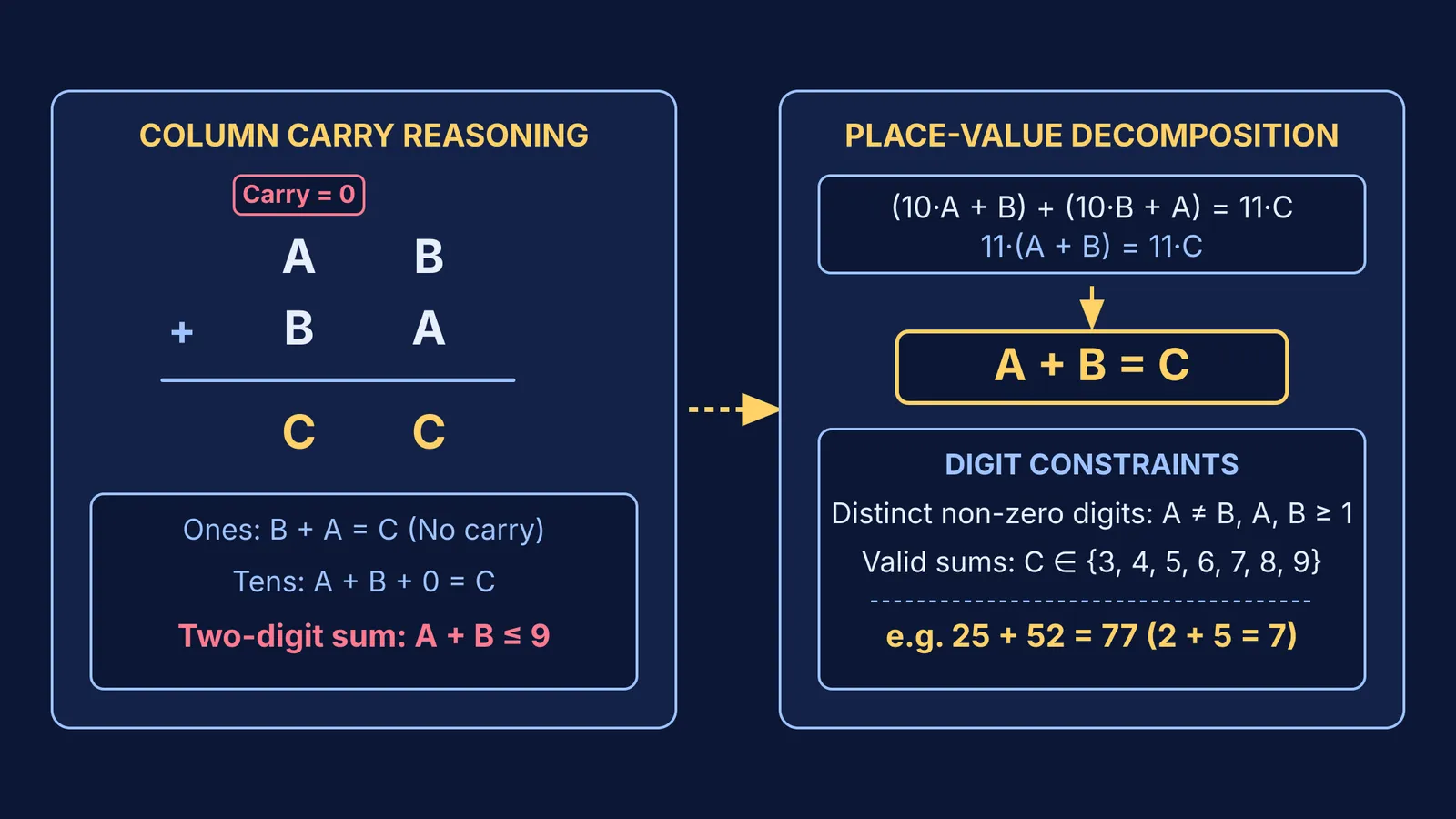
Consider the classic puzzle AB + BA = CC:
AB represents the two-digit value 10·A + B.
BA represents the two-digit value 10·B + A.
CC represents the two-digit value 10·C + C = 11·C.
Adding the two numbers algebraically gives (10·A + B) + (10·B + A) = 11·A + 11·B = 11·(A + B). Equating this expression to the right-hand side yields 11·(A + B) = 11·C. Dividing both sides by 11 gives the fundamental identity:
A + B = C.
Because A and B are leading digits, neither can be zero. Since all letters represent distinct digits, A ≠ B, and C must be greater than both A and B. With C taking integer values from 3 to 9, every unordered pair of distinct positive integers summing to C yields two valid solutions (A, B) and (B, A). For instance, C = 7 admits the pairs (1, 6), (2, 5), and (3, 4), producing valid additions such as 25 + 52 = 77. Across all possible values of C, there are exactly 32 valid ordered pairs. Exploring how positional numerals grew historically, as traced in the story of numbers in Class 8, helps students see why base-10 decomposition reveals these solutions.
Why is column carry analysis the key to eliminating guesses?
Place-value expansion explains the global structure of the equation, but column-by-column carry analysis eliminates guesswork in multi-step puzzles.
In their 1971 paper in American Psychologist, cognitive scientists Herbert A. Simon and Allen Newell demonstrated that skilled problem solvers do not search through the 3,628,800 possible digit permutations (10!) of an unfamiliar cryptarithm. Instead, they apply production rules that evaluate column constraints, dramatically pruning the problem space.
Carry analysis relies on a simple mathematical law: when adding two single-digit numbers in base 10, the maximum possible sum is 9 + 9 = 18 (or 19 if a carry of 1 is imported). Therefore, the carry into any adjacent column cannot exceed 1.
Applying this rule to AB + BA = CC:
In the ones column, B + A = C. If B + A generated a carry of 1, then B + A = 10 + C. The tens column would then sum to 1 (carry) + A + B = 1 + (10 + C) = 11 + C.
Because C is at least 0, 11 + C is at least 11. That would leave a tens digit of (1 + C) and generate a carry of 1 into the hundreds column, forcing the total to be a three-digit number. But because CC is explicitly a two-digit number, no hundreds column exists. Therefore, the carry must equal 0, proving that A + B < 10 and B + A = C without testing a single digit.
Contrast this with an addition producing an extra digit, such as AB + BA = CDC. The sum of two two-digit numbers cannot exceed 99 + 98 = 197, fixing C = 1. Substituting C = 1 into 11·(A + B) = 101 + 10·D forces D = 2, because 101 + 10·D must be divisible by 11. This immediately yields A + B = 11, producing valid additions such as 38 + 83 = 121 and 47 + 74 = 121.
What is a four-step framework for any cryptarithm?
To solve any letters-for-digits puzzle efficiently, follow this four-step deduction sequence:
Identify carry limits: If adding two numbers produces an extra column on the left, that leading digit must be 1.
Expand place-value polynomials: Convert multi-letter strings into base-10 forms (such as 100·A + 10·B + C) and factor out common multiples like 9 or 11.
Check units-column endings: In multiplication like 1A × A = 9A, the product A × A must end in A, which restricts candidate values to 0, 1, 5, or 6.
Track eliminated digits: Keep an explicit list of digits 0 through 9, crossing off assigned values so no two letters share the same numeral.
These systematic techniques form the bedrock of mathematical reasoning in competitive talent searches and maths olympiad preparation in India. When encountering complex numerical puzzles, the Fermi Problem Library provides worked problems with a step-by-step solver that explains the reasoning rather than printing an answer. To explore how place value, modular arithmetic, and polynomial representations connect across topics, the Fermi Concept Library covers every concept in physics, chemistry, biology, mathematics and computing, each with its own lesson and its place in the map.


