On this page
When a Class 12 student says "I'm not ready, I don't want to write JEE", it is often fear talking, not a plan. The fear deserves a hearing, but the rules matter too, because skipping can close a door that harder study cannot reopen. Here is what skipping costs, when sitting anyway makes sense, and a script for deciding together.
Does skipping JEE Main save an attempt?
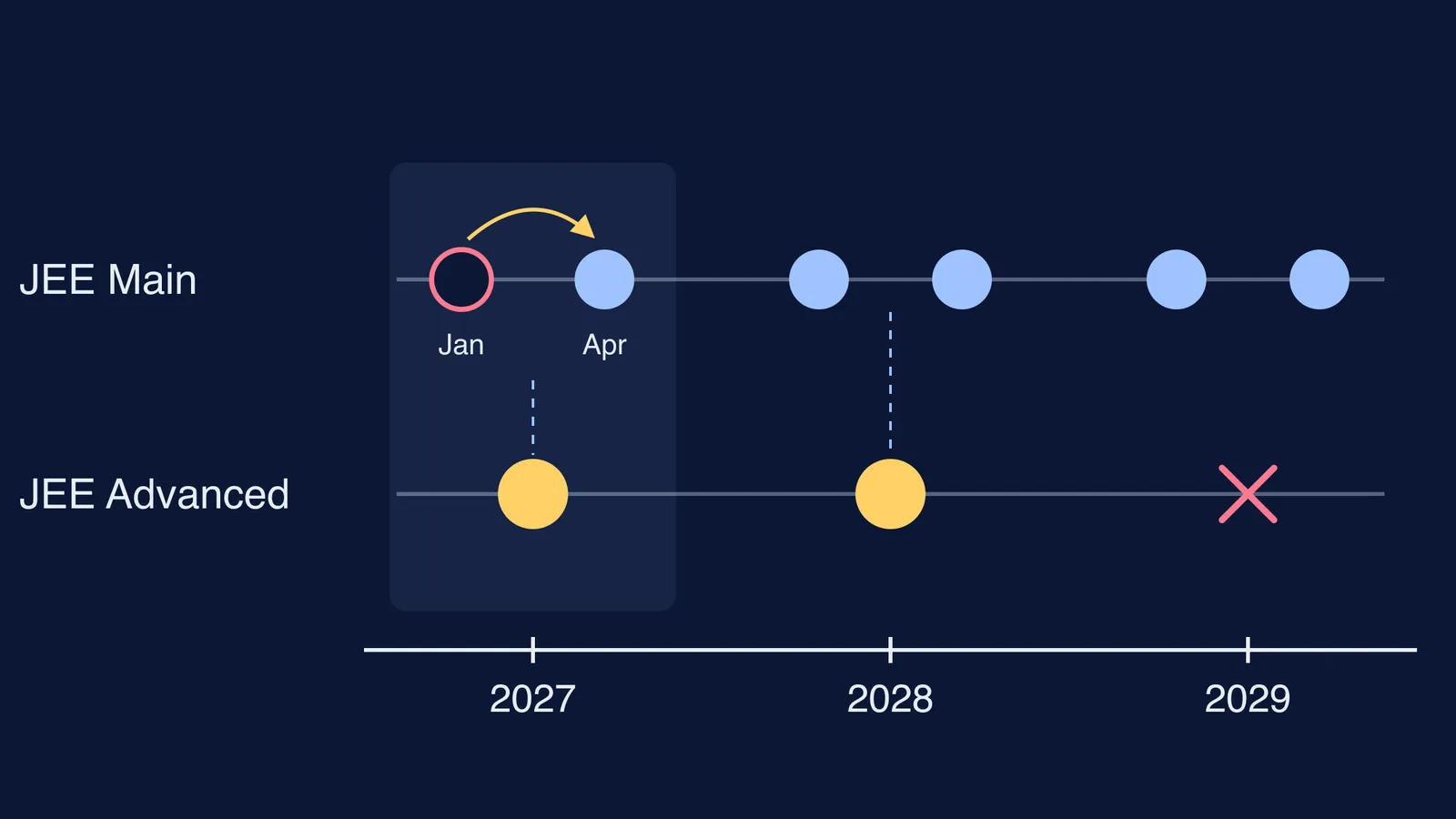
No. Under the JEE (Main) 2027 Information Bulletin, students who passed Class 12 in 2025 or 2026, or are appearing in 2027, are eligible. Eligibility follows the calendar, not the number of times you have sat. A session you skip is simply gone.
The same bulletin lists two sessions: January 2027 (exam days between 20 and 28 January) and April 2027 (2 to 7 April). For students who sit both, NTA uses the better of the two total scores.
JEE Advanced is stricter. The JEE (Advanced) 2026 eligibility page says a candidate can attempt it a "maximum of two times in two consecutive years". For 2026, candidates generally had to have first appeared for Class 12 in 2025 or 2026. The NTA bulletin adds that JEE Advanced 2027 is open only to the top 2,50,000 candidates in JEE Main 2027 Paper 1. So if these rules carry over, a Class 12 student who skips both JEE Main sessions also gives up one of their two JEE Advanced chances.
The rules are revised every year, so read the current bulletin on the NTA JEE Main website before you decide. NEET-UG and state exams have their own rules.
Is it worth writing JEE when you feel unprepared?
Usually, yes, if the goal changes. "Get a rank" becomes "learn from a real paper under real conditions".
There is good evidence that tests teach as well as measure. In a 2006 study in Psychological Science, Roediger and Karpicke found that students who took recall tests remembered prose passages better two days and one week later than students who reread the same material. Rereading also made students more confident. So feeling unready after going over your notes is not a reliable measure of what you know.
A real sitting gives you things no mock fully copies: the journey to the centre, the reporting rules, the computer-based interface and a full-length paper with real nerves. If January goes badly, you walk into April with that experience already behind you. Our guide to planning your year around JEE Main's two sessions shows how to use the gap between them.
What about the fee? For a centre in India, the JEE (Main) 2027 bulletin lists ₹1,000 per session for Paper 1 for a general-category male candidate and ₹800 for a general-category female candidate. Once paid, it is spent whether your teen sits or not, so don't let it decide.
When is skipping the right call?
Sometimes stepping back is the right decision:
The student is ill on the exam day or still recovering.
Anxiety has gone beyond ordinary nerves: days of poor sleep or eating, panic, or talk of hopelessness. Speak to a doctor or counsellor first. India's Tele MANAS toll-free number, 14416, offers 24 x 7 tele-mental health counselling, according to the Press Information Bureau.
The student has firmly decided against engineering, and the exam no longer serves any plan.
On its own, "I haven't finished the syllabus" is a weak reason to skip. Almost everyone sits with gaps.
How do you decide together? A script
Pick a calm time, not the night before a form deadline. The parent opens the conversation, then mostly listens.
Open: "I'm not going to decide for you. I want to understand what's worrying you."
Name the fear: "Is it the result, what people will say, or one subject?" Write the answer down.
Share the facts: "Skipping doesn't save an attempt. If you sit both sessions, only your better score counts."
Change the goal: "What if January is a practice run? Your only target is to attempt every section and notice where the time went."
Agree on a way out: "If you're unwell or panicking on the day, we stop. No argument."
Decide, write it down, and set a date to look at it again.
Then ask your teen to explain the decision in their own words, so it is theirs.
What should the next few weeks look like?
Once NTA displays the attempted question paper and answer keys, run a 60-minute review routine like the one for mock tests. Sort every lost mark into a concept gap, a method error or lost time.
For method errors, the Fermi Problem Library has worked problems with a step-by-step solver that explains the reasoning rather than printing an answer. If the trouble is not knowing where to start, Fermi's AI tutor works out what you already know and builds a plan for the session.
On the morning of the exam, a parent's few calm words before the paper do more good than any last-minute lecture.