On this page
Your child has seen a cousin swim on holiday and now wants to learn. That's a good moment to act on. Before you sign up for the nearest summer batch, it helps to know when children are ready, how to tell a safe class from a risky one, and how to keep a nervous beginner coming back.
What is the right age for a child to learn swimming?
The American Academy of Pediatrics says swim lessons can begin for many children at age 1, and that most children are ready by their 4th birthday (AAP, HealthyChildren.org). It suggests judging readiness by your child's emotional maturity, physical and developmental abilities, and comfort in water, not by age alone.
The early years matter for safety. The highest drowning rates in the world are among children aged 0 to 4, and drowning kills around 300,000 people a year (WHO drowning fact sheet). WHO lists teaching school-age children basic swimming, water safety and safe rescue skills as one way to prevent it.
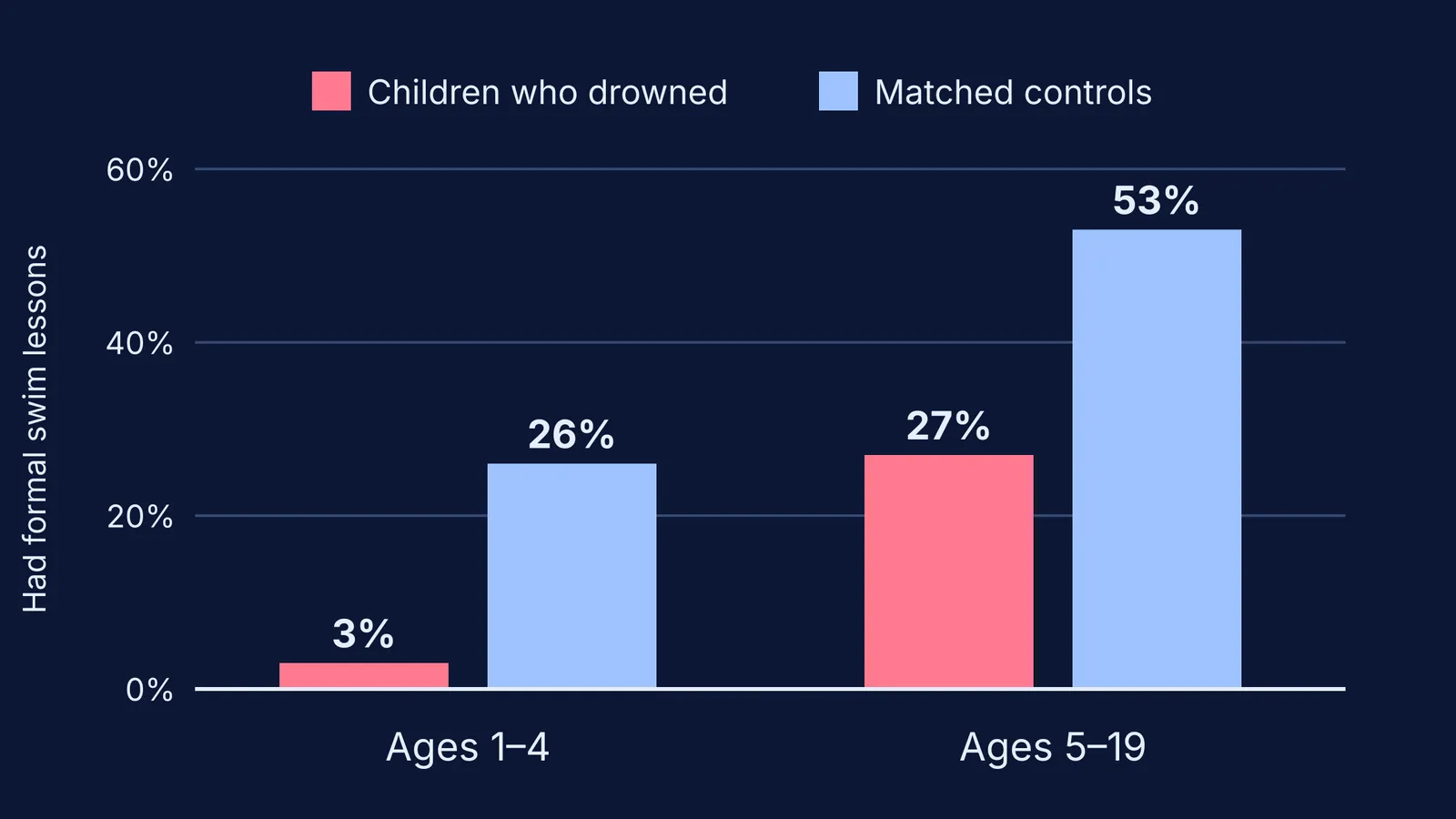
Evidence on lessons themselves comes from a US case-control study by Ruth Brenner and colleagues (Archives of Pediatrics & Adolescent Medicine, 2009). Among children aged 1 to 4 who drowned, 3% had taken formal swimming lessons, against 26% of matched children who did not drown. The authors linked formal lessons to an 88% reduction in drowning risk at those ages, though the estimate was imprecise: the 95% confidence interval ran from a 3% to a 99% reduction. For ages 5 to 19, the gap (27% against 53%) was not statistically significant.
Is my child too old to start swimming lessons?
No. Lessons are not only for small children, and the AAP says older children should also learn what to do if they see someone else struggling in the water, and how to get help. An older beginner may feel shy among small children, so ask whether the pool groups batches by age.
How do you find a qualified coach and a safe pool?
Watch one class before you pay. The AAP's advice for parents works well as a checklist at an Indian club, school or municipal pool:
Ask what certification the instructor holds and which learn-to-swim curriculum it comes from.
Check that a lifeguard with current CPR and First Aid certification is on duty.
Notice how long children wait at the edge. In a good class they spend most of the time swimming.
For under-4s, an adult stays within arm's reach ("touch supervision"), and the water should be heated to 87 to 94°F, about 31 to 34°C.
Ask what your child will be able to do by the end: get back to the surface from underwater, swim at least 25 yards (about 23 metres) and climb out alone.
Check that safety habits are taught: never swim alone, and ask before getting in.
If a coach can't answer the first two questions, keep looking. Our checklist for choosing an after-school class through a trial session has more questions to bring.
How do you fit swimming lessons into a busy week?
The AAP advises choosing a programme with multiple sessions, where you can see gradual but consistent progress. A steady weekly slot beats a crash course squeezed into the last week of the holidays.
A sample week for a Class 4 child:
Tuesday and Saturday: swimming. Tuesday's lesson replaces outdoor play, not homework.
Monday, Wednesday and Thursday: homework, then free play.
Friday: nothing scheduled. Rest counts.
Sunday: family time, plus short revision if a test is coming.
If the week already feels full, run our weekly after-school time audit first, and drop something else rather than cut sleep.
How do you build a nervous child's confidence in water?
The AAP says children should feel safe and secure during lessons while also developing a healthy respect for water. Some children cling to the rail for weeks. Try this:
Let them watch a lesson from the side, then sit on the edge with their feet in.
Name small wins: "You put your face in today. Last week you didn't."
Tell the coach on day one that your child must never be pushed, dunked or surprised.
A script for the night before: "Tomorrow you only have to try one new thing, and you choose it. If you feel scared, tell Coach and hold the wall."
If dread continues after several weeks, read our guide on when to let a child quit a sports class. If the fear seems intense or spills into daily life, talk to your paediatrician.
When an older child asks why some things float and others sink, that is a real physics question. The Fermi Concept Library has a lesson for every concept in physics, so the question can turn into a little learning after the pool.