

On this page
Most families pick an after-school class from a pamphlet, a neighbour's tip or a free demo. Below is a checklist for a robotics, chess, coding or music trial, a quick sum for how much teacher time your child will really get, and a fair way to decide when to stop.
What does a good after-school class look like?
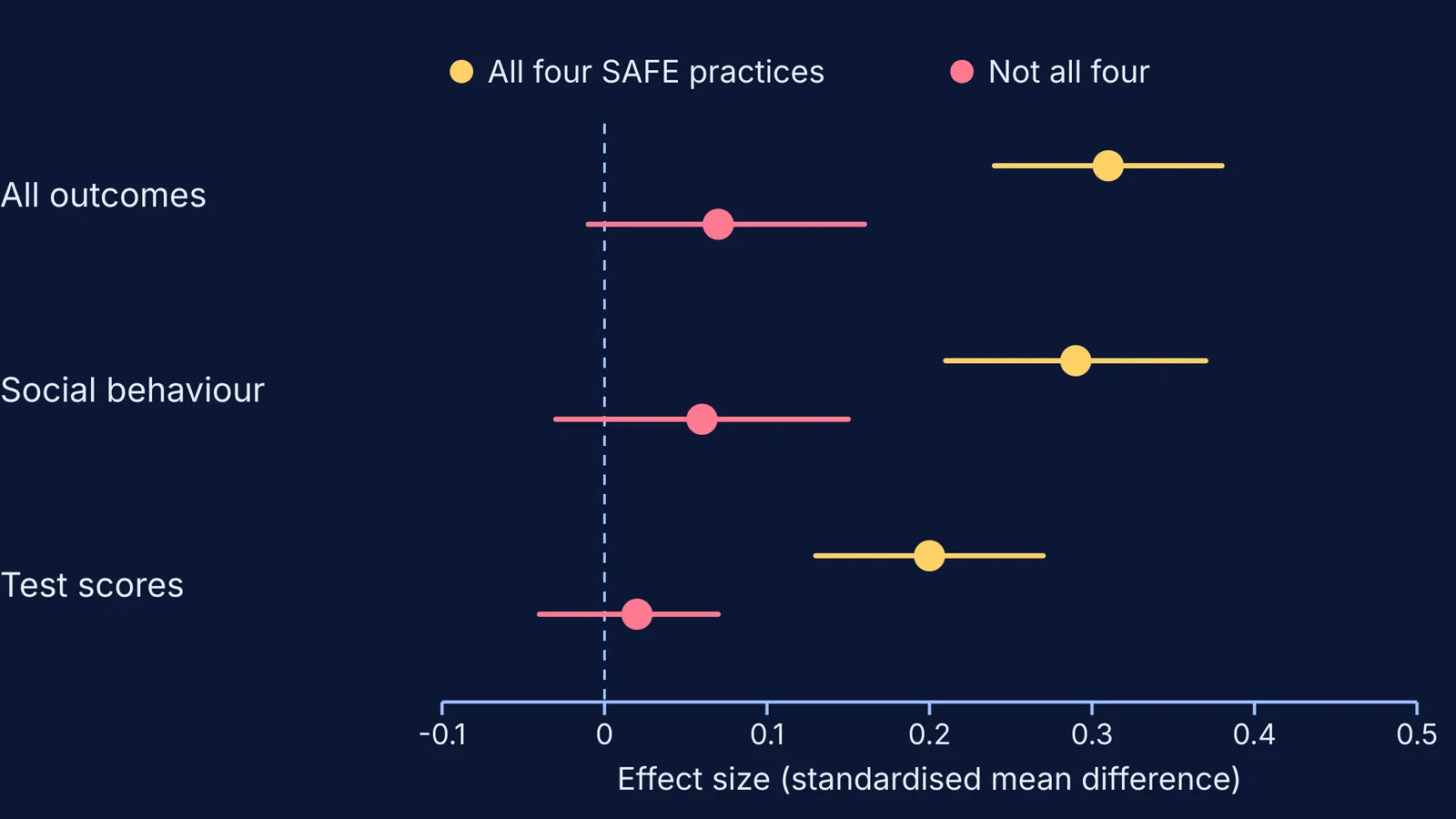
The most useful evidence comes from a meta-analysis by Joseph Durlak, Roger Weissberg and Molly Pachan in the American Journal of Community Psychology. It pooled 68 evaluated after-school programmes, all in the United States, that aimed to build personal and social skills. Programmes that used all four SAFE practices had a mean effect size of 0.31; programmes that did not had a mean of 0.07, which was not significantly different from zero.
SAFE stands for:
Sequenced: a connected series of activities, each step building on the last.
Active: children practise the skill and get feedback, rather than only listening.
Focused: real time set aside for the skill itself.
Explicit: a specific skill is named as the goal.
Those programmes were not robotics or chess classes, so treat SAFE as a lens for the trial rather than a guarantee.
Will chess, music or coding make my child smarter?
A 2016 meta-analysis of chess instruction by Giovanni Sala and Fernand Gobet pooled 24 studies and found a moderate overall effect on maths, reading and cognitive skills (g = 0.338), larger with longer instruction, but noted that no study used an ideal design. Their meta-analysis of music training found a small overall effect (d = 0.16) that shrank as study quality rose, and concluded that music training does not reliably improve children's cognitive or academic skills.
Coding looks a little better. A meta-analysis of 105 studies by Ronny Scherer and colleagues found a strong effect on programming skills themselves (g = 0.75) and a moderate effect on other skills such as creative thinking and maths (g = 0.47), with smaller effects when the comparison group also did some other activity.
So choose a class for the skill and the enjoyment, not as a back door to better marks. Our piece on whether sports and hobbies hurt marks covers the other half of that worry.
What should I watch for in a trial class?
Watch your child, not the teacher, and check:
Hands-on time. Roughly how long was your child building, playing, typing or practising, and how long listening? (Active)
Today's goal. Can the teacher name it in one sentence, such as 'make the robot stop at a black line'? (Explicit)
The plan. Ask to see what the next eight weeks cover and how today fits. (Sequenced)
Feedback. Did your child get at least one specific correction, by name?
Mistakes. Did the teacher ask a question or just fix the error?
Kit and screens. In robotics or coding, count children per kit or computer.
Afterwards. Ask 'What did you make or figure out?' rather than 'Did you like it?'
How do I check the teacher-to-child ratio?
Ask three numbers: children per batch, adults per batch, and kits or instruments per batch. Then do this sum.
Worked example: a 60-minute robotics class has 15 children and one teacher. If 20 minutes go on explaining to the whole group, 40 minutes are left for individual help. Shared across 15 children, that is under 3 minutes each. If three children share one kit, your child has their hands on it for about a third of the building time.
The same questions work when you evaluate a coaching institute before paying the fee.
When is it okay to let my child stop?
Early enthusiasm is not yet a settled interest. Suzanne Hidi and K. Ann Renninger's four-phase model of interest development describes interest moving from 'triggered situational interest' to 'maintained situational interest', then to emerging and finally well-developed individual interest. So one dull week early on does not mean the interest is gone.
Agree a trial period up front, such as one term, and decide together at the end. Signs it is time to stop:
the class fails most of the checklist above after the first month
your child dreads it every week for several weeks, not just on tired days
it is squeezing out sleep, homework or free play
your child can say clearly what they would rather do instead
A script for the end-of-term talk: 'You gave it a fair go. What was the best part? What was the worst? Do you want another term, a different class, or a break?' Letting them choose builds the motivation described in our guide to autonomy-supportive parenting. If the dread seems to spread beyond one class, talk to the school counsellor or your doctor.
If a coding or robotics class leaves your child asking how a sensor or a loop actually works, the Fermi Concept Library has a lesson for every concept in physics, chemistry, biology, mathematics and computing.


