On this page
Your child wants music lessons and the choice is down to keyboard or guitar. Both are good first instruments. The real question is which one fits this child, and how to keep it going past the first month.
Keyboard or guitar: which is easier for a child to start?
Keyboard often gives faster early wins. Every note sits in a line, one finger makes a clean sound, and a child can often play a tune they recognise in the first lesson.
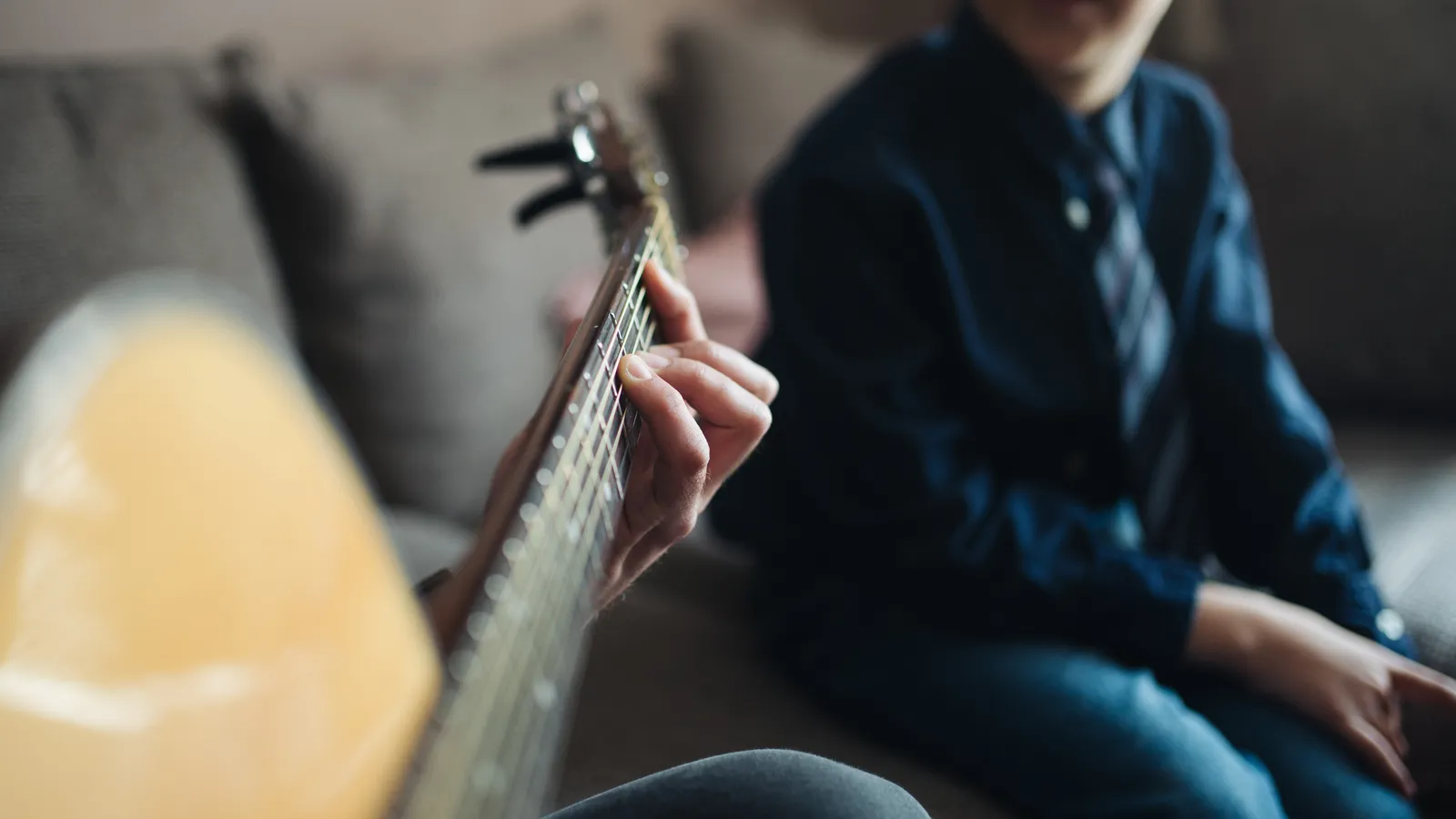
Guitar asks more of the hands at the start. Your child has to press the strings firmly enough to stop them buzzing while the other hand strums. A guide from the music school Da Capo Academy of Music says nylon-string guitars are "recommended and preferred by most for learning as they are easier on the fingers". In return, a handful of chords is enough to accompany songs, which is what many children actually want to do.
A quick way to decide:
Choose keyboard if your child is younger, likes spotting patterns, or wants to play film and game tunes as melodies.
Choose guitar if your child sings along to everything, wants to play with friends, and does not mind a few weeks of effort before it sounds good.
If they are torn, let the music they listen to decide. Wanting to play a particular song is often a stronger reason to keep practising than an instrument that is supposed to be easier.
What size of guitar or keyboard should you buy?
A full-size guitar is too big for most children. The Da Capo guitar size chart suggests a 1/2 size guitar (about 34 inches) for ages 5 to 8, a 3/4 size (about 36 inches) for ages 8 to 12, and full size from about 12. Height and arm length matter as well as age, so let your child hold the guitar in the shop before you pay.
For keyboard, buy one your child will not outgrow in a year. Trinity College London's electronic keyboard exams require an instrument "of 5 octaves size", which a standard 61-key keyboard covers. Trinity also runs Rock & Pop exams for guitar and keyboards, with grades "from Initial to Grade 8", but grades are optional, not the point of the first year.
How much practice does a beginner really need?
Less than many parents fear, as long as it is regular and thoughtful. Music psychologist Gary McPherson followed 157 children aged 7 to 9 for three years after they began an instrument in school music programmes (Psychology of Music, 2005). He concluded that the amount of practice alone was not enough to understand early progress; the sophistication of the mental strategies children used while playing helped explain why some moved ahead easily and others struggled.
So plan for good practice, not long practice. A suggested starting routine for the first six weeks:
Practise on five days a week for 10 to 15 minutes, at the same time each day.
Warm up with something your child can already play.
Pick one hard spot, two bars at most, and play it slowly until it is clean, then at speed.
Ask one question before moving on: "What went wrong there, and what will you change?"
Finish with a song they love, played just for fun.
Our guide to getting your child to practise an instrument daily has more on building the habit without nagging.
Will learning music help my child do better at school?
Choose music for its own sake. A meta-analysis by Giovanni Sala and Fernand Gobet in Educational Research Review (2017) found a small overall effect of music training on children's cognitive and academic skills (d = 0.16), with smaller effects in better-designed studies. The authors concluded that music training does not reliably improve those skills, so pick the instrument your child is excited about, not one you hope will raise marks.
Teacher or online course: how do you choose?
For the first few months, a teacher who watches your child play can fix posture, wrist position and strumming habits before they set. Online courses suit a motivated older child, or work alongside a teacher. Book a trial class first; our trial-class checklist for after-school classes covers what to watch for.
Questions to ask any teacher or course:
What will my child be able to play after the first month?
How do you set practice for the week, and how do you check it?
Do you push graded exams, or are they optional?
Can I sit in on one class, or see a sample lesson?
If interest fades after a fair try, read whether to let your child quit a music class before deciding. And if your child starts asking why pressing a string further up the neck raises the note, that is the physics of waves; the Fermi Simulation Lab has interactive simulations for ideas that are easier to see than to read.