

On this page
When a child starts learning a musical instrument, the initial excitement of holding a violin or sitting at a piano often fades into a daily struggle over practice time. You might find yourself arguing over long practice blocks, or watching them mindlessly play through a piece from start to finish while staring at the clock.
The science of learning offers a different approach to building this habit. Rather than fighting for long, exhausting sessions, the evidence points towards shorter periods, spaced out evenly, with a clear and deliberate goal for every sitting.
Why does daily practice work better?
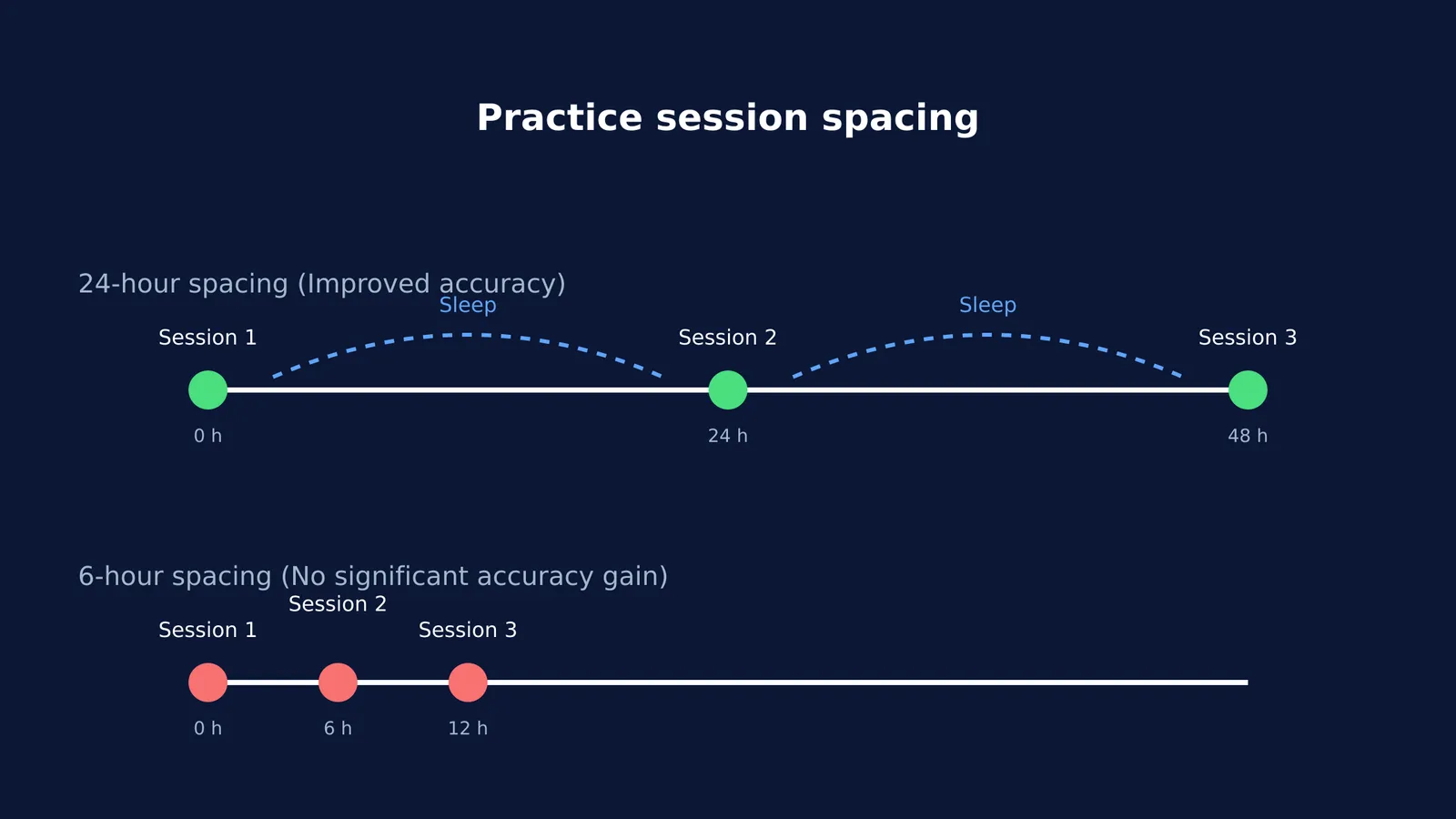
Spacing out practice, rather than cramming it into a weekend session, gives the brain time to consolidate new motor skills during sleep. When a child learns a new chord or a difficult fingering, the physical memory of that movement is fragile.
A 2011 study by Amy L. Simmons published in the *Journal of Research in Music Education* tracked musicians learning a new piano sequence across sessions spaced 5 minutes, 6 hours, and 24 hours apart. Significant improvements in performance accuracy were observed only in the group whose sessions were separated by 24 hours.
This means playing for a short time every day is far more effective for your child's fingers and memory than playing for a long block on Sunday. The sleep between sessions is where the actual learning takes hold. Every time they sleep, their brain strengthens the neural pathways used during practice, making the movement feel more natural the next day.
How to get your child to practise an instrument daily?
When you ask how to get your child to practise an instrument daily, the answer usually involves changing what the practice looks like. Quantity is not enough. Sitting at an instrument for a long time means very little if the student is just playing through their pieces on autopilot, hoping not to make a mistake.
A 2014 study in the *Psychology of Music* by Arielle Bonneville-Roussy and Thérèse Bouffard showed that formal practice time only predicts musical achievement if associated with self-regulation and deliberate practice.
Deliberate practice means isolating a specific problem and fixing it. Self-regulation means noticing when a mistake happens and choosing to correct it, rather than ignoring it. A 2017 study by Pamela D. Pike in the same journal observed teenaged pianists practising at home, finding that students regularly practiced under less-than-ideal circumstances and had limited attention spans, but some students demonstrated a motivation to use deliberate practice strategies.
This applies to their schoolwork just as much as their music. When children struggle with abstract ideas in their science classes, parents often look for better tools. If you want them to build an effective study routine, Fermi's AI tutor can work out what you already know and build a plan for the session, so you sit down to a clear next step.
What is the parent's role in musical development?
Your attitude towards their practice shapes how long they will stick with it. If practice is treated as a punishment or a chore, a child will naturally resist it.
A 2009 study by Gary E. McPherson in *Psychology of Music* found that parents play a pivotal role in their children's musical development.
The research suggests a feedback loop: a parent's goals and styles of interaction directly shape a child's continuing desire to participate, exert effort, overcome obstacles and succeed musically. By showing genuine interest in what they are learning, rather than just monitoring their time, you help them build a musical identity.
A framework for short practice sessions
To make daily practice manageable, ditch the timer and use a goal-directed structure. Try this framework for a beginner to encourage spacing out study sessions without overwhelming them:
Warm-up: Play a familiar scale or a song they already know well. This builds confidence and gets their fingers moving.
The target: Pick one tiny, specific problem. Do not let them play the whole piece. Focus on getting a tricky transition smooth, or fixing the fingering on a difficult chord. Stop as soon as it sounds right several consecutive times.
The run-through: Play the whole section, including the newly fixed part, without stopping to correct mistakes.
Cool-down: Let them play whatever they want, experiment with sounds, or just make noise.
If they finish the target early, let them finish the practice session early. Rewarding focused, deliberate practice with free time teaches them that efficiency matters more than clock-watching. You can support this habit by establishing a family quiet hour or changing where you study and practice, making focused learning a normal part of the household routine.


