

On this page
Your teen wants to grow something on the terrace or balcony. You can buy a few pots and hope, or you can treat it as a 12-week project with a sunlight survey, a budget your teen manages and a weekly growth record. The second version teaches more biology, more maths and more about money, and it is the one we plan here.
Why make a terrace garden a project, not a hobby?
Structure turns watering into evidence. A 2013 synthesis in Review of Educational Research screened 152 articles and kept 48 studies of garden-based learning; most showed positive effects on academic outcomes, strongest for science, then maths and language arts (Williams and Dixon, 2013). The authors also flagged weak research rigour in many of those studies, so read this as promising, not proven.
There may be a wellbeing bonus too. A meta-analysis of 22 studies linked gardening to outcomes such as lower anxiety and higher life satisfaction (Soga, Gaston and Yamaura, 2017). A garden is not a treatment, though: if your teen is struggling, talk to a professional or call Tele MANAS on 14416.
If your child is younger, our two-week seed germination experiment is a gentler start.
What should you check before buying anything?
Three checks, all done by your teen in week 1:
Sunlight. On a weekend day, note every hour which spots get direct sun. Iowa State University Extension says edible gardens should get at least 6 hours of direct sunlight daily, and spots with 4 to 6 hours can grow some edibles with moderate success (Iowa State University Extension). Fruiting crops such as tomatoes and peppers need 6 to 8 hours (Oregon State University Extension).
Load and leaks. Wet soil is heavy, and your terrace is someone's ceiling. Before you put up more than a few pots, ask your building society or a structural engineer what the roof can carry, and check that rainwater drains freely.
Drainage and water. Every pot needs holes. Oregon State suggests raising pots on bricks or slats so they do not sit in water, and notes that daily watering is often necessary for containers (same Oregon State page). Decide now who waters when the family travels.
How do you set a budget with a teenager?
Give a fixed sum for the term and let your teen keep a ledger: date, item, quantity, price, running balance. The point is not saving money; it is making trade-offs visible.
Here is a worked example. A Tamil Nadu government do-it-yourself rooftop garden kit for Chennai and Coimbatore, listed on Tamil Nadu Agricultural University's Agritech portal, cost Rs 1,325 and included 20 grow bags (24 x 18 inches) with coco peat, plus seeds, fertilisers and hand tools. That works out to about Rs 66 per bag, with the extras thrown in. Prices and schemes change, so your teen's first budget task is to check your state horticulture department's current offer and compare it with two local nursery quotes. Then ask:
Is a kit cheaper per bag than buying bags, potting mix and seeds separately?
What happens to the budget if half the seedlings die?
How much would the same harvest cost at the sabzi market?
If the money conversation goes well, our guide to teaching the value of money by age has next steps.
What should go in a growth record?
One page per bag, one line per week:
Date and days since sowing.
Height of the tallest plant in cm, and leaf count.
Hours of direct sun that week and water given.
One photo, taken from the same spot each time.
One observation in a sentence, such as "lower leaves turning yellow".
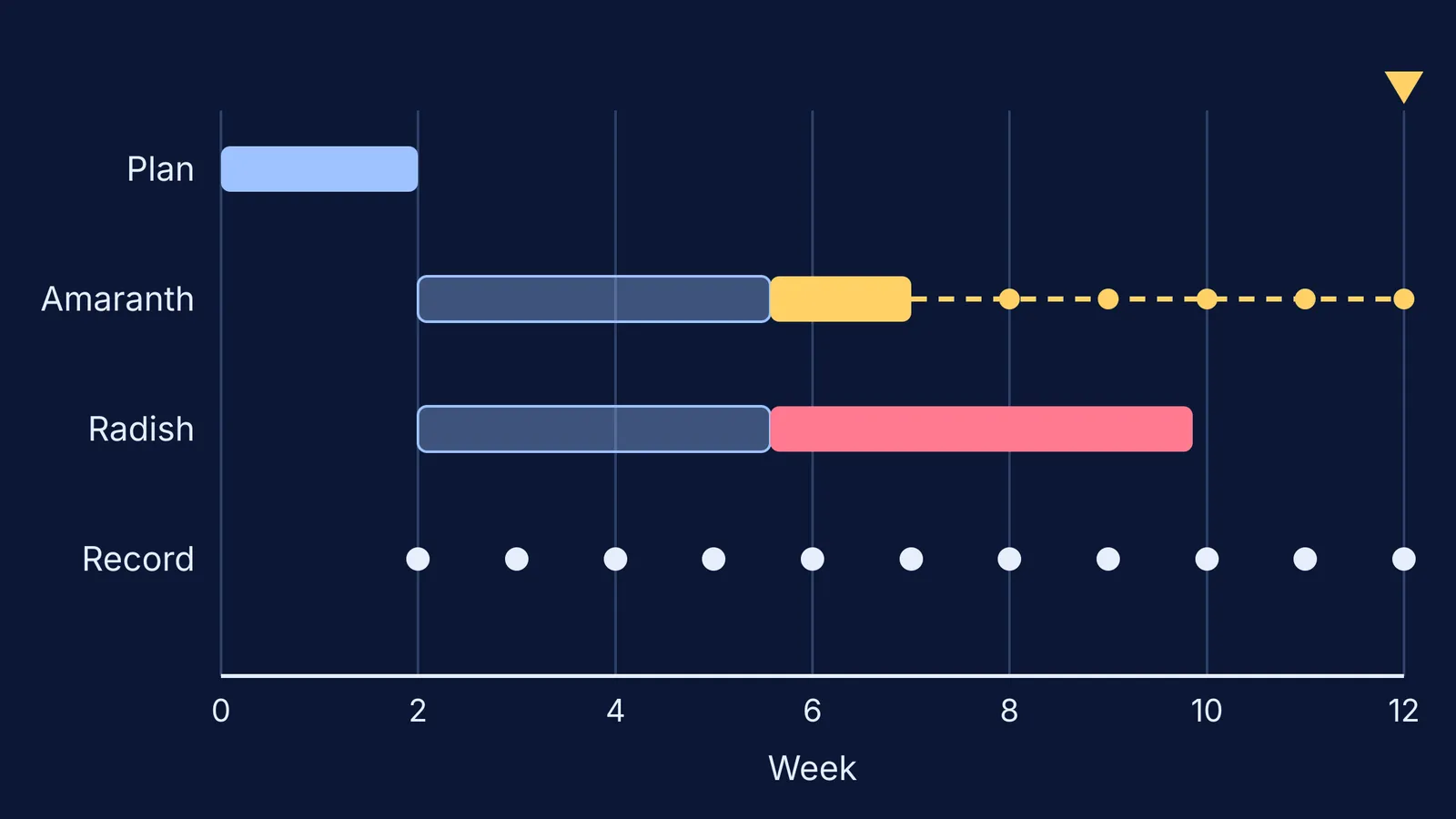
Fast crops keep the record interesting. Kerala Agricultural University says radish roots are ready 25 to 55 days after sowing, depending on the cultivar (KAU Centre for e-Learning). For amaranth (cheera or chaulai), the first cut comes 25 to 35 days after sowing, with further cuts at weekly intervals (KAU Centre for e-Learning).
When the record raises a question your teen cannot answer, such as what a plant does with light, the Fermi Concept Library has a lesson on each concept in biology.
What does a 12-week terrace garden plan look like?
Weeks 1-2: sun survey, roof and drainage check, budget and shopping list.
Week 2: fill the bags, sow amaranth and radish, start the record.
Weeks 3-5: weekly measurements, thin crowded seedlings, track water.
Weeks 6-8: first amaranth cuts and first radish harvests; weigh what you pick and add it to the ledger.
Weeks 9-11: resow empty bags and test one change, such as a sunnier spot, against an unchanged bag.
Week 12: your teen presents a one-page review with total spent, total harvested, a graph of one plant's height and what they would change.
Cook the harvest together; our weekend cooking plan for teens fits neatly here.
Throughout, your role is the client, not the manager: approve the budget, ask good questions at the review and leave the record in your teen's hands.


