On this page
A cricket academy often means several sessions a week, with travel on top. Whether that fits with school is mostly arithmetic: how many hours are left for homework and sleep. Here is how to work it out, what injury research says about young fast bowlers, and what to ask the coach.
Is a cricket academy bad for studies?
The evidence leans towards sport, not against it. The WHO's 2020 guidelines say children and adolescents aged 5 to 17 should do at least an average of 60 minutes a day of moderate-to-vigorous physical activity across the week, with vigorous and muscle- and bone-strengthening activity on at least 3 days (Chaput et al., 2020, summary of the WHO guideline evidence). The same evidence summary reports that physical activity has positive effects on cognitive function and academic outcomes such as school performance, memory and executive function.
The real question is whether study and sleep get squeezed. The American Academy of Sleep Medicine says teenagers aged 13 to 18 should sleep 8 to 10 hours per 24 hours on a regular basis (AASM health advisory). It links regularly sleeping less with learning problems and a higher risk of injuries.
How many hours a week does academy cricket take?
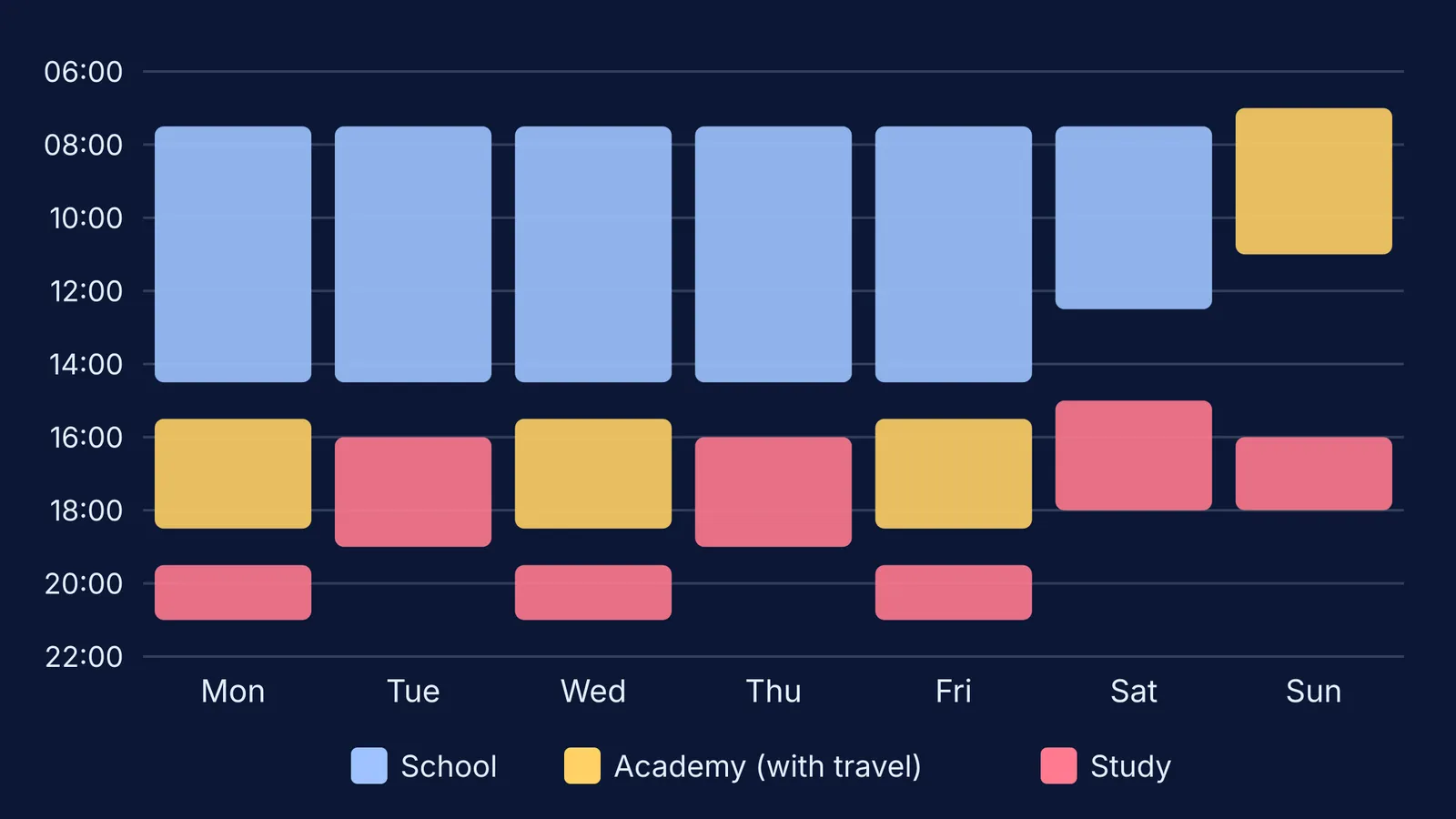
Ask for the actual timetable, then add travel. A worked example for a Class 9 student, as in the diagram above:
School: 7:30 to 14:30 on weekdays, 7:30 to 12:30 on Saturday.
Academy: Monday, Wednesday and Friday, 15:30 to 18:30 including travel, plus Sunday 7:00 to 11:00. That is 13 hours a week.
Study: 1.5 hours on academy evenings, 3 hours each on Tuesday and Thursday, 3 hours on Saturday and 2 on Sunday. That is 15.5 hours.
Sleep: lights out at 22:00, up at 6:00. That is 8 hours, the bottom of the AASM's recommended range for teenagers.
This week works, but only just. A unit-test week or a weekend tournament will bend it, so agree in advance which block gives way. In exam months, drop to two sessions and keep the study blocks.
What should parents know about fast bowling and injuries?
If your child bowls fast, ask how the academy manages bowling load. In a study of 44 male junior fast bowlers in Australia with an average age of 14.7, 11 (25%) reported an overuse injury during the 2002-03 season, seven of them to the back (Dennis, Finch and Farhart, British Journal of Sports Medicine, 2005). Bowlers who averaged fewer than 3.5 rest days between bowling days had about three times the injury risk of those with more rest (risk ratio 3.1).
Cricket Australia's junior pace bowling guidelines recommend that under-17 bowlers in training bowl at most 5 overs per spell, on at most 3 days a week, with at least one rest day after a bowling day (Cricket Australia junior pace bowling guidelines). In matches, its recommended maximum for 13- to 15-year-olds is 5 overs per spell and 12 overs per day.
In the sample week, bowling at all four sessions, with Sunday and Monday back to back, would break both training guidelines. The fix: bowl on Wednesday, Friday and Sunday, and keep Monday for batting and fielding. Back pain that does not settle in a young bowler is a reason to see a sports doctor or physiotherapist, not to bowl through it.
How do you check a cricket coach's credentials?
The BCCI runs coach education through its Centre of Excellence in Bengaluru, including Level A, B and C coaching programmes (BCCI, November 2025). An academy should be able to tell you which level each coach holds. Questions for a trial session:
Which coach will work with my child, and what BCCI level or other accreditation do they hold? Can we see the certificate?
How many children does one coach handle in a net session?
How do you track overs for under-17 fast bowlers?
Is there first aid at the ground?
What is your child-protection policy? Can parents watch?
What happens to practice and fees during board exams?
Then watch one full session before paying, and check that children spend it batting and bowling rather than queuing.
What should you say to your child?
Try this: "We love that you want this. Let's fill in the week together. If the plan keeps 8 hours of sleep and your study blocks, we'll try it for one term and review after the first unit test." A fixed review date keeps the deal about the plan.
Shorter study evenings go further when your child sits down to a clear next step. Fermi's AI tutor works out what your child already knows and builds a plan for the session, so the 90 minutes after nets go on the right chapter.
If your teen is heading into JEE or NEET years, read how to keep a sport going during JEE or NEET preparation. For a wider checklist, see how to choose an after-school class, and if cricket becomes a serious path, open schooling for sports or arts kids.