

On this page
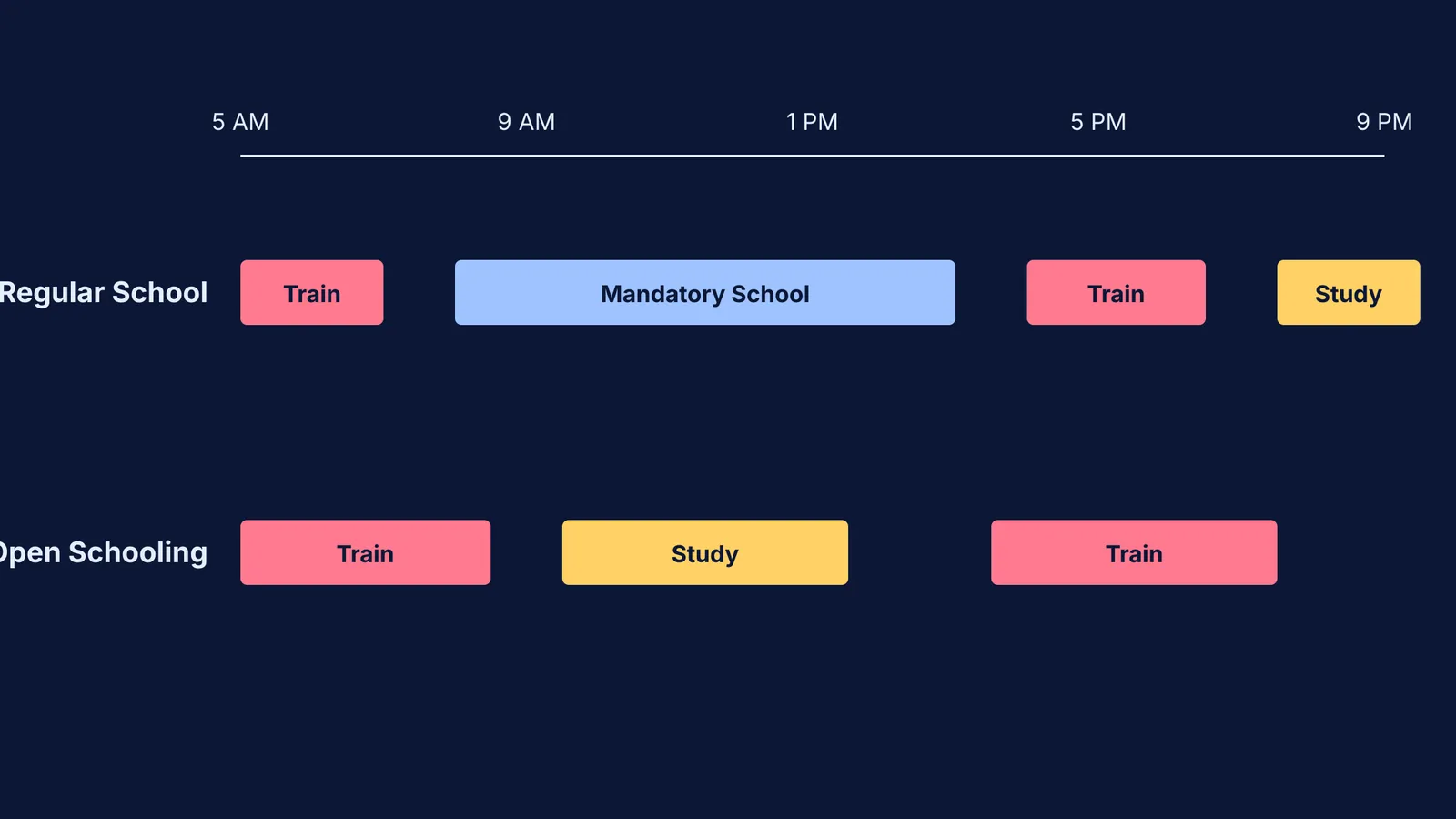
When a child trains for a competitive sport or a classical art form, time is the tightest resource. Elite junior athletes and performing artists often need many hours of practice a day to remain competitive at the national level. When you drop this load into a standard academic week, traditional schooling breaks.
The Central Board of Secondary Education (CBSE) mandates a minimum of 75% attendance for students to appear in the Class 10 and 12 board examinations. While short condonations (up to a 15% relaxation) exist for medical cases or national sports representation, the rigid Monday-to-Friday schedule limits the hours a student can physically spend on a court or in a studio. This is why many families transition to the National Institute of Open Schooling (NIOS).
Is NIOS recognized for the sports quota and higher education?
A common worry for parents is whether an open schooling certificate holds the same weight as a traditional board. NIOS is an autonomous institution under the Ministry of Education, Government of India.
The certificates issued by NIOS for Secondary (Class 10) and Senior Secondary (Class 12) carry the same legal validity as those from the CBSE or CISCE. This means a student who completes their schooling through NIOS is eligible for:
Professional entrance exams like JEE Main, JEE Advanced, and NEET-UG.
Admission to all central and state universities.
Recruitment under the sports quota for government jobs (including Defense, Railways, and Banking), provided their sport is recognized by the Ministry of Youth Affairs and Sports.
How do NIOS On-Demand Examinations work?
The biggest advantage of NIOS for athletes is its examination system. Traditional boards test all subjects simultaneously in March or April, which frequently clashes with the spring tournament season.
NIOS offers On-Demand Examinations (ODE). Under this system, a student decides when they are ready to sit for a test.
You can register for an exam any month of the year, except during the fixed public exam windows in April/May and October/November.
You choose the date based on your training and competition calendar.
To pass Class 10 or 12, a student must clear a minimum of five subjects, which must include at least one language.
If a student transfers from another board, NIOS allows a Transfer of Credit (TOC) for up to two passed subjects, so they only need to clear the remaining ones.
Preparing for the transition
When you pull a student out of a physical classroom, you remove the daily structure that keeps them moving forward. The biggest hurdle in open schooling is not the syllabus, but the lack of teaching.
Without a teacher explaining the concepts on a blackboard, a student is often left staring at a textbook, which is an inefficient way to learn complex topics. This is where Fermi's AI tutor fits in. When a student sits down to study at night or during the day, the tutor builds a plan for the session. Rather than answering questions, it teaches — it holds a line of reasoning, writes on a board, and checks understanding as it goes. For students studying independently, having a tutor that notices where they are stuck ensures they do not stay stuck on a single difficult problem.
You should also plan out a weekly schedule to ensure academics are not completely forgotten. Reading about Time blocking for students juggling school and coaching can help you construct a routine that balances intense physical training with intellectual focus.
A checklist before you switch
Open schooling requires self-discipline. Before withdrawing your child from a regular school, weigh your options—such as Coaching, online classes or self-study for JEE: how to decide—and check these three things:
Track the training volume: If your child trains a moderate amount, a flexible regular school might still work. NIOS is best for students whose physical recovery time is compromised by school attendance.
Set up a study system: An open schooling student needs a daily routine. Block out a few hours of focused study time and stick to it. Use the Fermi Concept Library to close concept gaps with its lessons, and consider establishing A family quiet hour: setting up shared study and reading time to keep them accountable.
Verify the sporting pathway: If you are aiming for government sports quotas, ensure your child's sport is on the recognized list by the Ministry of Youth Affairs and Sports.
Open schooling is not an easy way out of studying. It is a structural tool that lets dedicated students reallocate their hours toward mastery in their chosen field, without abandoning their academic future.


