On this page
Your teenager wants to earn, perhaps by tutoring a neighbour's child or making posters for a cousin's bakery. The real questions are what's allowed, how many hours are safe, and how to protect study and sleep.
Is it legal for a teenager to work part-time in India?
For most small jobs, yes. Under the Child Labour (Prohibition and Regulation) Amendment Act, 2016, an "adolescent" is anyone who has turned 14 but not yet 18. The same Act says no adolescent may be employed in any of the hazardous occupations or processes listed in its Schedule.
Below 14, the rules are much stricter. Children may not be employed in any occupation or process, with two exceptions in the same 2016 Gazette text: helping the family or a family enterprise in non-hazardous work "after his school hours or during vacations", and working as an artist in entertainment or sports under conditions the government sets.
So a 15-year-old who tutors a Class 5 student or designs a birthday invitation is doing ordinary, non-hazardous work. Anything on the Schedule's hazardous list is off limits until 18.
How many hours of part-time work is too many for a teenager?
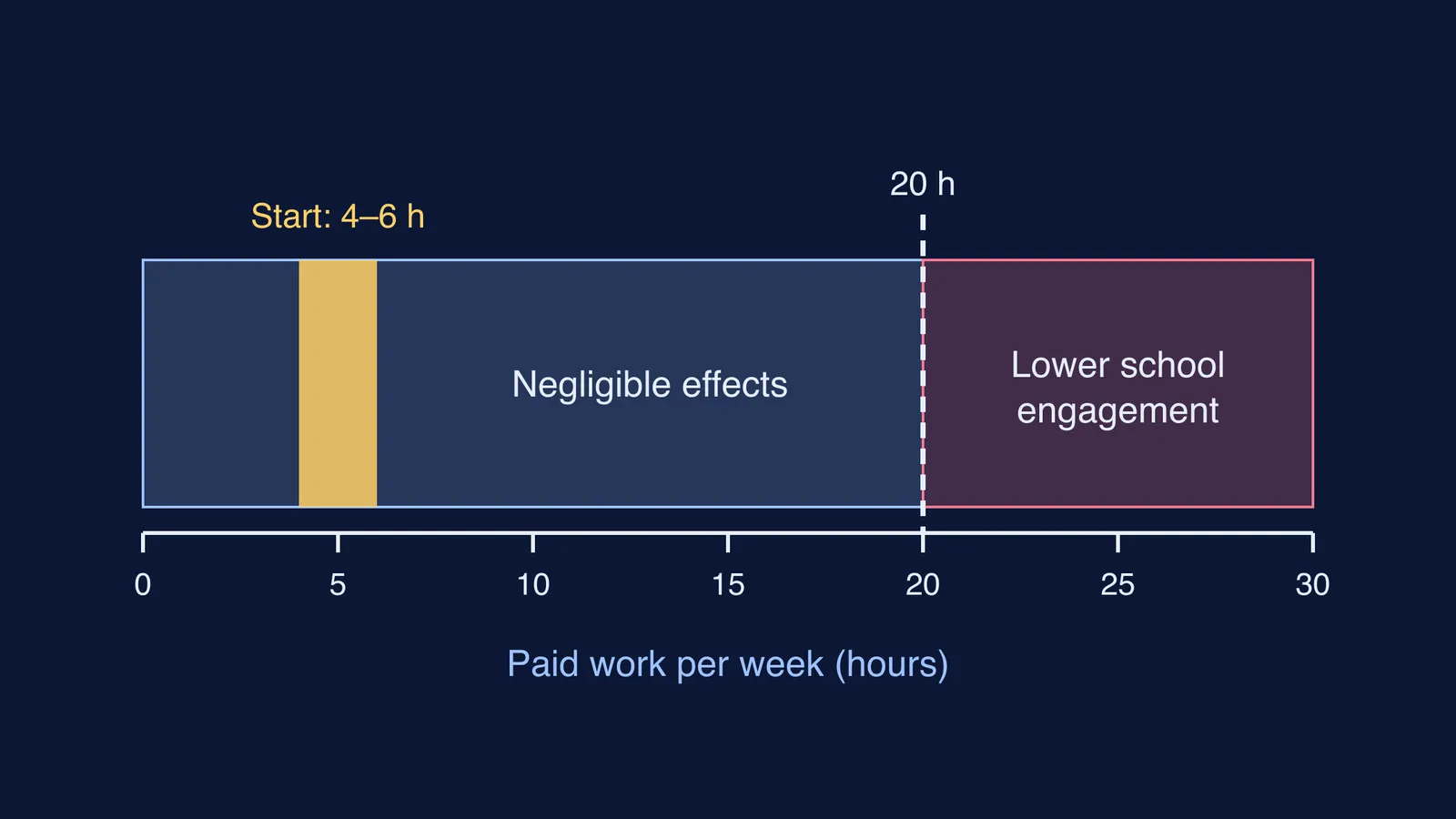
The most useful study here reanalysed data on 1,792 US students in Grades 10 and 11, first published in 1993. Monahan, Lee and Steinberg (2011, Child Development) found that teens who started working more than 20 hours a week showed declines in school engagement and increases in substance use and delinquency, compared with teens who stayed out of work. Working 20 hours or less had negligible effects, good or bad, on academic, psychological or behavioural outcomes.
Sleep is the other limit. The American Academy of Sleep Medicine recommends 8 to 10 hours of sleep every 24 hours for teenagers aged 13 to 18.
Now do the arithmetic for a Class 11 student. A week has 168 hours. Nine hours of sleep a night uses 63 of them. Add school, coaching, travel, homework and meals, and very little is left. So we suggest starting at 4 to 6 hours of paid work a week: our rule of thumb, not a research finding, and well below the 20-hour line.
What small jobs can a teenager do while studying?
Look for flexible, skill-building work close to home:
Tutoring younger students in maths, science or English, one or two children at a time
Design work: posters, invitations, menus or social media graphics for local shops and family businesses
Video editing for relatives' events or small creators
Teaching a hobby such as music, chess, drawing or coding to children in the building
Teaching can help the teacher learn, too. A review chapter by Logan Fiorella, published in a 2023 e-book from Division 2 of the American Psychological Association, describes a meta-analysis by Kobayashi of 28 studies. On average, students who prepared to teach learned more than students who prepared for a test, a small-to-medium effect. The benefit depends on how well students prepare, and can shrink when teaching makes them anxious.
A four-week trial plan for your family
Treat the job as an experiment with a fixed review date:
Agree on the limits before the first rupee. Set a weekly cap of 4 to 6 hours, well under the 20-hour line from the Monahan study. No new work in exam months; keep a fixed bedtime.
Start with one client. Tutoring two evenings a week for an hour each, plus up to 2 hours of weekend design work, adds up to 4 hours.
Prepare, don't wing it. Before a tutoring session, your teen can revise the topic in the Fermi Concept Library, which covers every concept in physics, chemistry, biology, mathematics and computing, each with its own lesson. That way they explain from a lesson they have just reviewed rather than from memory.
Keep a simple log. Note the date, the hours, the money earned and whether homework got done that day.
Review at week four. Is your teen still getting the recommended 8 to 10 hours of sleep? Are marks and homework holding up? Does your teen still want to do it?
Three yeses: carry on. Otherwise, cut back or pause until after exams.
For safety, meet any new client together the first time. Online, keep phone numbers and home addresses private, and ask for payments to go through a parent's account. If your teen seems persistently stressed or can't sleep, talk to a doctor or call the government's free, 24-hour Tele MANAS helpline on 14416.
Where to go from here
Before agreeing, run a weekly time audit of after-school activities to see where the hours will come from. Once the money starts coming in, use our guide on teaching your child the value of money by age to talk about saving and spending. For older students ready for real clients, read how to start freelancing as a student.