On this page
If your teenager has announced they want to go pro in BGMI, Valorant or another competitive game, a flat "no" usually ends the conversation but not the dream. A better move: look at the real numbers together, then agree a time-boxed trial with written study conditions.
How much do esports players in India actually earn?
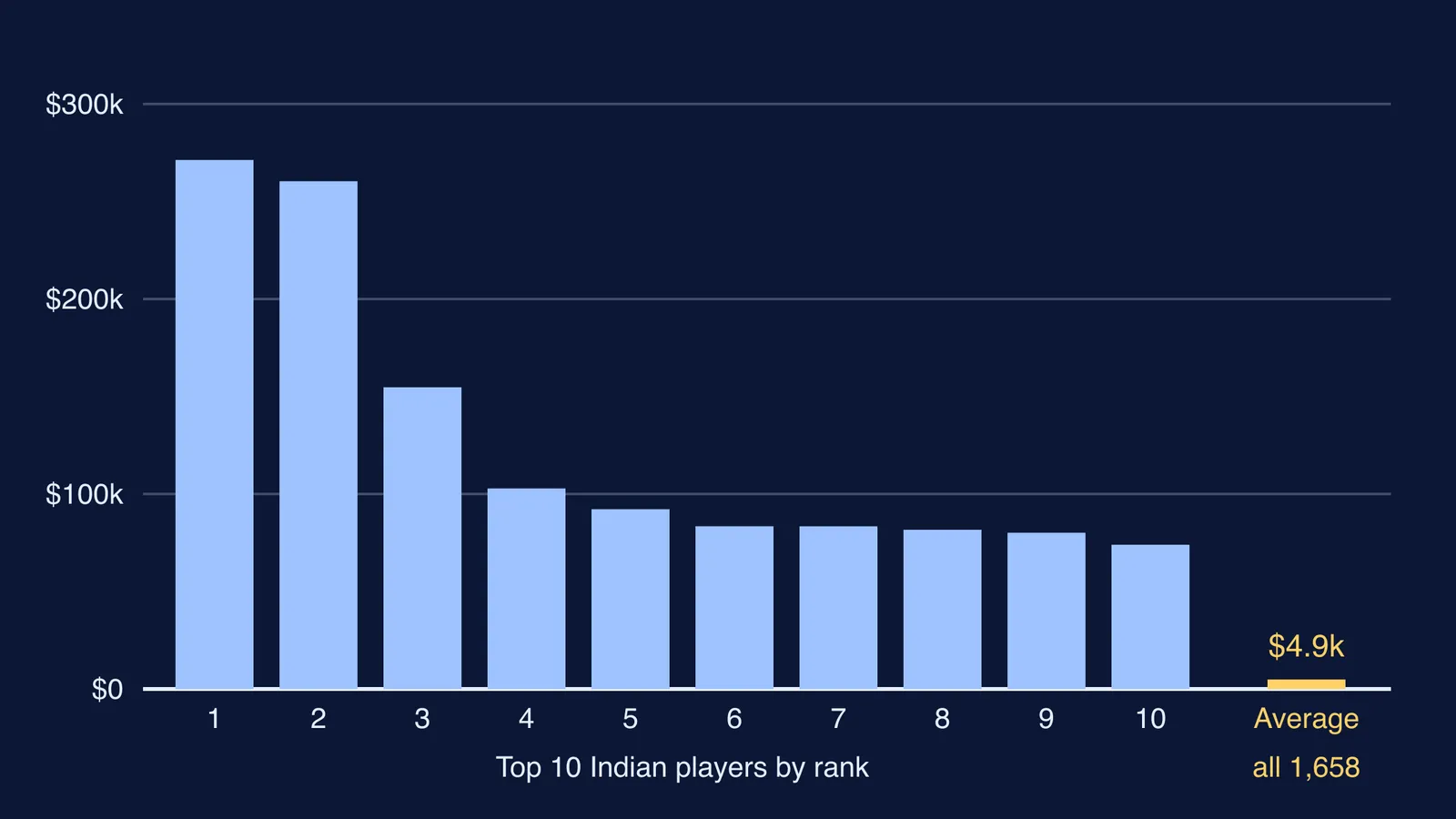
The only public record is prize money. Esports Earnings, a database of tournament payouts, lists $8,083,202 in lifetime prize money across 1,658 Indian players and 1,252 tournaments. Spread evenly, that is under $4,900 per player across their whole career so far, not per year.
It is not spread evenly. The top 10 Indian players on the same list have won about $1.28 million between them, roughly 16% of the total, and the player ranked 25th has won $55,464 in their career. Four of the top 10 are chess grandmasters (Arjun Erigaisi, Nihal Sarin, R Praggnanandhaa and Vidit Gujrathi), whose online chess winnings the site counts.
Prize money is not the whole income: team salaries, streaming and sponsorship deals are mostly private. But the shape is clear: a handful of players at the top and a long tail earning very little.
How long does a pro esports career last?
Short. A 2020 article in Frontiers in Psychology by Smithies and colleagues, Life After Esports, citing earlier research, notes that only about one in five professional esports careers lasts two years or longer. It also points to burnout and injury, and to adolescents giving up education to chase the career.
Age matters too. In a 2014 PLoS ONE study of 3,305 StarCraft 2 players aged 16 to 44, Thompson, Blair and Henrey found that in-game response times begin slowing at 24. That is one reason to plan for a second career early.
Is esports a recognised career in India now?
Partly. The Promotion and Regulation of Online Gaming Act, passed by Parliament in August 2025, defines e-sports as organised multiplayer competitions decided by skill and lets the central government take steps to recognise and develop e-sports, issue guidelines for events and set up training academies, according to PRS Legislative Research. That makes the path more legitimate. It does not change the odds above.
What careers sit around competitive gaming?
Most people who earn a living from esports are not the players. Jobs around the game include:
Game development and design, which runs on programming and maths (see our guide to game development careers in India)
Coaching and performance analysis, which is mostly data and video review
Shoutcasting, content and production for tournaments and streams
Event management, marketing and community roles for teams and publishers
Quality assurance and game testing
These jobs usually outlast a playing career, and they need school subjects: maths, computing, English, business. If the bigger issue is a move away from the path the family expected, read our piece on when a child chooses a different career.
What trial plan can parents and children agree on?
Treat it like a sports academy trial: a fixed period, a clear goal, clear conditions and a review date. Here is a six-month version.
Pick one game and one goal. Write down a measurable target for month six, such as a rank on the game's official ladder or a placing in a named open tournament. "Get better" does not count.
Protect sleep. The CDC recommends 8 to 10 hours of sleep a night for teens aged 13 to 17, so set a devices-off time that makes that possible. Our post on teens who play mobile games after midnight can help.
Fix practice hours. For example, 2 hours on school days and 4 on weekend days, logged in a shared sheet with what was practised, not just played.
Agree study conditions. Homework and revision come before practice. Marks stay within an agreed band of the last report card. Attendance does not drop.
Check in monthly for 20 minutes: the log, the rank, the marks.
Decide together at month six. Goal met and conditions kept: extend for another six months. Goal missed: gaming continues as a hobby, and you explore one of the related careers above.
A way to open the conversation: "I'm not saying no. I'm saying let's test it the way a coach would. Six months, one game, one goal we both write down. If your marks and sleep hold up and you hit the goal, we keep going."
If the study block before practice is where things stall, Fermi's AI tutor can work out what your child already knows and build a plan for the session, so that hour starts with a clear next step.
When is gaming a problem rather than a plan?
Most young gamers never develop a problem: the WHO says gaming disorder affects only a small proportion of people who play. It describes the condition as impaired control over gaming, with gaming taking priority over other activities despite harm, usually evident for at least 12 months.
This week, write the plan on one page, and both of you sign it.