On this page
You finish a chapter, reread your notes, and it all feels clear. A week later, half of it has gone. The gap between feeling you know something and actually knowing it explains why the study methods that feel worst often work best.
What are desirable difficulties?
Desirable difficulties are study conditions that slow down how fast you seem to learn but improve how well you remember and use the material later, an idea from UCLA psychologists Elizabeth Bjork and Robert Bjork (Bjork and Bjork, 2014). Their examples are spacing study sessions instead of cramming them together, interleaving topics instead of blocking them, varying the conditions of practice, and using tests instead of rereading as study events.
The Bjorks separate performance, what you can do during a study session, from learning, the lasting change that shows up later. Rereading a chapter, they write, can give "a sense of familiarity or perceptual fluency that we interpret as understanding" without much learning behind it.
The word desirable matters. In the same chapter they warn that a difficulty turns undesirable if you lack the background knowledge to respond to it. Struggling with a problem from a chapter you have never studied is not the useful kind.
Why does harder studying work better?
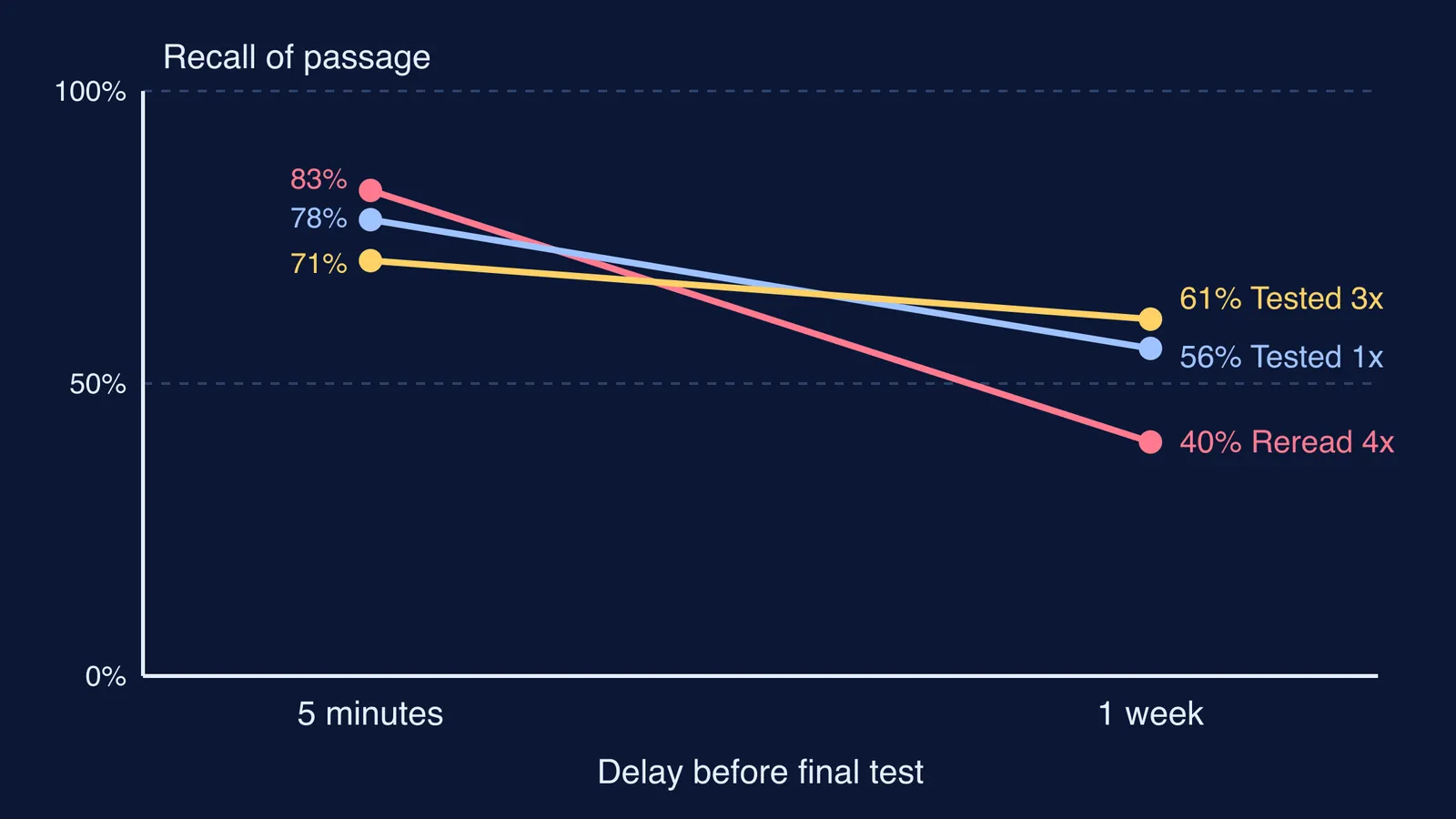
Testing. In Roediger and Karpicke (2006), college students learned a prose passage. One group spent four 5-minute periods reading it; another read it for one period and then took three recall tests with no feedback. Five minutes later the rereaders recalled more, 83% against 71%. One week later the tested group recalled 61% and the rereaders 40%, even though the tested group had read through the passage 3.4 times on average against 14.2 times for the rereaders.
Mixing. In Rohrer and Taylor (2007), 18 college students learned to find the volumes of four unfamiliar solids. Some practised in blocks of one shape at a time; others got the same problems shuffled. In practice, the blocked group scored 89% and the mixed group 60%. On a test a week later, the mixed group scored 63% and the blocked group 20%. Almost every test error was choosing the wrong formula: blocked practice taught students how to use each formula, but not which one to pick.
Spacing. In the first experiment of the same paper, students who split four practice problems across two sessions a week apart scored 74% on a test a week later. Students who did all four in one sitting scored 49%.
The authors note the limits: college students, procedural tasks, a lab rather than a classroom.
Why does effortful study feel like it is not working?
Because easy practice feels fluent, and fluency feels like learning. In Roediger and Karpicke (2006), the rereaders predicted they would remember the passage better than the tested students did. In Kornell and Bjork (2008), people learned painters' styles better when paintings by different artists were interleaved, yet participants rated massed study as more effective, even after their own test results showed the opposite.
A randomised classroom study in PNAS (Deslauriers and colleagues, 2019) found that students in an active-learning class learned more but felt they learned less, partly because of the extra mental effort.
So a hard session is not a sign that you are failing. Judge your methods by a test a few days later, not by how smooth the session felt.
How do I add desirable difficulties to a revision week?
Make three swaps.
Swap the second read for a blank-page test. Read once, close the book, write everything you remember, then fill the gaps in a different colour.
Swap blocked exercises for a shuffled set. Mix problems from several chapters without chapter headings, so you must decide which method each needs.
Swap one long session for short returns. Come back to each topic after a gap of a day or more.
A worked example for a Class 12 student revising three physics chapters: current electricity, magnetism and electromagnetic induction.
Day 1: Current electricity, then a 10-minute blank-page test.
Day 2: Magnetism, blank-page test, four problems from Day 1.
Day 3: Induction, blank-page test, six shuffled problems from Days 1 and 2.
Day 4: No new reading. Twelve shuffled problems; write the law you would use before solving each.
Day 5: Blank-page test on all three. Reread only the gaps.
Day 6: Another subject. The gap is part of the plan.
Day 7: A timed mixed set of 15 problems. Mark each mistake as wrong-method or careless.
If the Day 4 set shows you keep picking the wrong method, the Fermi Problem Library has worked problems with a step-by-step solver that explains the reasoning rather than printing an answer. If you are not sure which chapters to start with, Fermi's AI tutor works out what you already know and builds a plan for the session.
Parents can ask "What did you test yourself on today?" instead of counting hours. If revision stress starts affecting sleep or mood, talk to a doctor or counsellor, or call Tele MANAS on 14416.
Try one swap this week, then check yourself on Day 7.