On this page
It is 9 pm, the maths homework is “done”, and it took eleven minutes. Your child pointed the phone at each question and an app sent back a neat, complete solution. But homework is meant to be practice, and the practice never happened.
Is it bad if my child scans questions for answers?
It depends on when the scan happens. Scanning before trying swaps the work that builds skill for a finished page. Scanning after a real attempt can be a useful way to check.
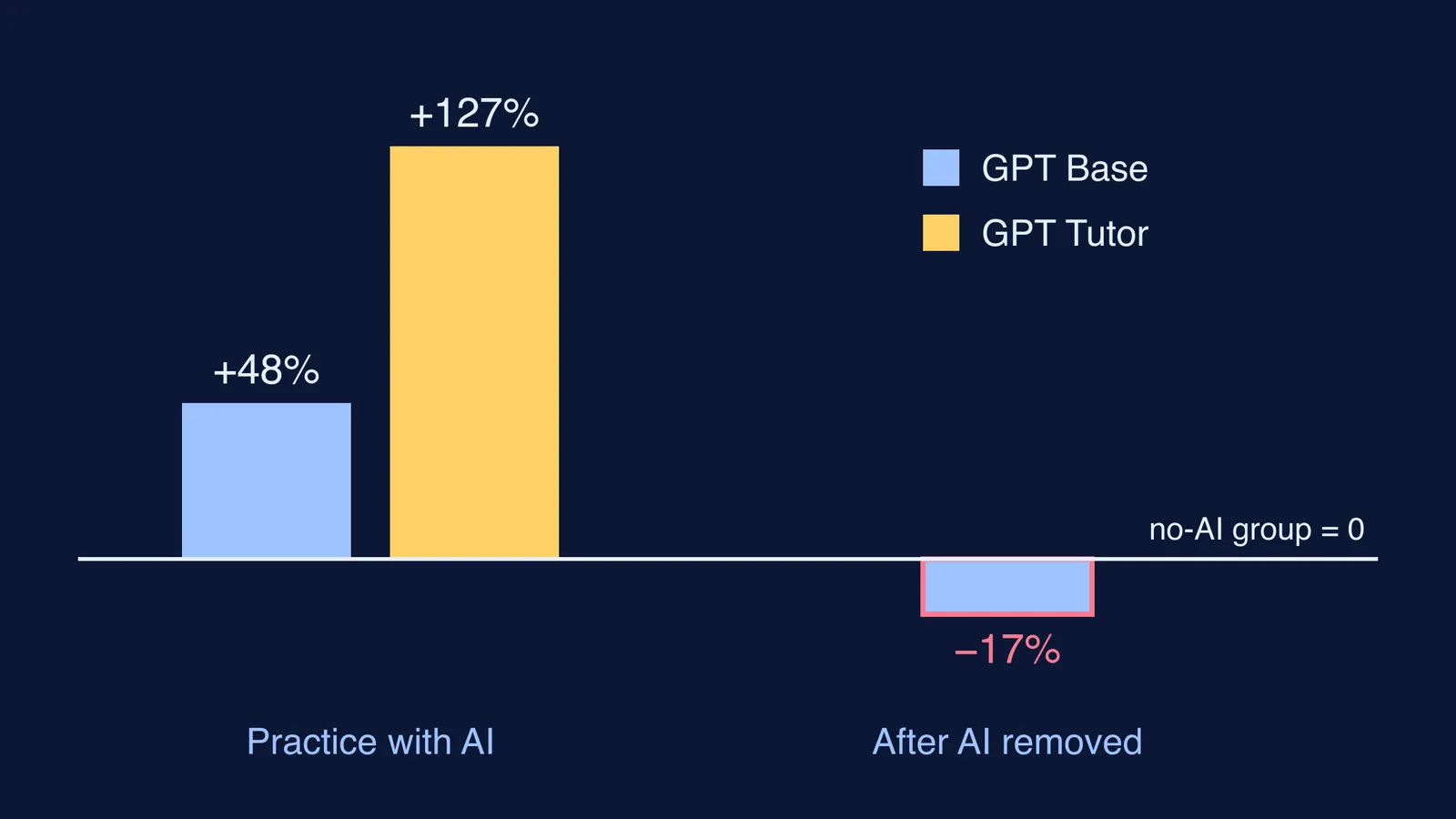
The clearest evidence comes from a field experiment in high-school maths published in PNAS in 2025 by Hamsa Bastani and colleagues. Nearly a thousand students got GPT-4 during practice sessions, either through a plain chat interface (“GPT Base”) or a version with prompts designed to protect learning (“GPT Tutor”).
With the plain chatbot, practice grades rose by 48%; with the tutor version, by 127%.
When access was taken away, students who had used the plain chatbot scored 17% lower than students who never had AI at all.
The safeguards in the tutor version largely removed that harm.
The authors write that, without guardrails, students used the tool as a “crutch” during practice and then did worse on their own. The study did not test photo-solve apps, but one that prints the full solution the moment it sees a question is closer to the plain chatbot than the tutor.
Why does copying the answer feel like learning?
Reading a correct solution feels smooth, and smooth feels like understanding. Memory research says otherwise. In Roediger and Karpicke's 2006 study in Psychological Science, students who restudied a passage did better on a test 5 minutes later, but students who practised recalling it remembered substantially more after 2 days and after 1 week. Restudying also made them feel more confident.
Even failing first helps. In lab experiments by Nate Kornell, Matthew Hays and Robert Bjork (2009), people who tried to answer a question before being shown the answer learned it better than people shown the question and answer together, even when their attempt was wrong. A scanned answer with no attempt skips that step entirely.
When does a photo-solve app actually help?
After an honest attempt, these apps can be good checkers:
Checking a final answer once the working is on paper.
Finding the step that went wrong, by comparing their working line by line with the app's.
Getting unstuck after a real attempt, by reading only the first line of the solution and then closing it.
They hurt when the scan comes first, when the solution is copied straight into the notebook, or when the same type of question gets scanned again and again. That last pattern points to a concept gap rather than a homework habit; our guide for when a child understands in class but can't solve alone has a routine for it. Apps also make mistakes, so it helps to know what to say when an AI tool gives a wrong answer.
If you want a tool for the checking step, the Fermi Problem Library has worked problems with a step-by-step solver that explains the reasoning rather than printing an answer.
How do you set try-first rules at home?
A try-first rule turns the Kornell, Hays and Bjork finding into a habit: attempt, then see the answer. Agree it together at a calm moment:
Attempt first, on paper. Every question gets a real try: write what is given, what is asked, and at least one step.
Agree a stuck time. For example, ten minutes on a question before any help.
Hint before answer. When stuck, read only the first line of the solution, close the app, and carry on.
Scan to check, not to start. After finishing, compare. If the answers differ, find the exact line where they split.
Star the question. Any question that needed help gets a star, and starred questions are redone without the app a couple of days later. If one chapter collects lots of stars, talk to the teacher.
Your child is stuck on proving sin²A + cos²A = 1 in Class 10 trigonometry. They draw the right-angled triangle, label the sides a, b and c, and try for their agreed ten minutes. Still stuck, they scan, read only the first line (divide a² + b² = c² by c²), close the app and finish the proof themselves. The question gets a star, and on Saturday they redo it from a blank page.
What to say so it doesn't sound like an accusation: “I'm not taking the app away. I read that students who leaned on an AI chatbot during practice did worse once it was gone. So let's use it the way that helps: you try first, then it checks.” Teaching them to check their own answers makes step 4 easier.
If your child gets stuck on getting started more than on finishing, Fermi's AI tutor works out what a student already knows, builds a plan for the session, and decides whether to explain, ask or show.
Pick one rule this week, attempt first, and add the rest once it sticks.