

On this page
Your child nods through the lesson, says "yes, I got it", and then sits in front of the homework with a blank page. Following a solution and producing one are different skills, and class often practises only the first.
Why can my child follow the teacher but not solve alone?
When the teacher writes a solution, every decision is made for your child: which formula, what to find first, where to stop. Their job is only to check that each line follows, and that feels like understanding. Alone, they must make those decisions from nothing, starting with the first step.
Rereading the notes at home repeats the same easy job. In a survey of 177 college students by Karpicke, Butler and Roediger (2009), 84% listed rereading their notes or textbook as a study strategy, while only 11% said they practised recalling the material. The authors proposed that many students experience illusions of competence while studying: the material looks familiar, so they believe they know it.
What does the research say actually helps?
A large review in Psychological Science in the Public Interest (Dunlosky and colleagues, 2013) rated 10 study techniques and gave a high utility rating to only two: practice testing and spreading practice out over time. Rereading and highlighting were rated low utility, and the authors suggest practice testing in place of rereading.
In a study with secondary school students, van Gog, Kester and Paas (2011) found that studying an example and then solving a similar problem worked better than solving first and seeing the example afterwards. Renkl, Atkinson, Maier and Staley (2002) tested a smoother path: a complete example, then examples with more steps left blank, then problems alone. This "fading" helped learning on similar problems compared with plain example-problem pairs.
How do you close the gap at home?
Use three moves, about 15 to 20 minutes a day, on two or three problems from that day's class:
Study. Your child reads one solved example from class notes or the textbook and says out loud why each line is there.
Cover and try. The example goes face down. They write the solution from a blank page, with no peeking for at least five minutes.
Compare. They turn the example over, circle the first line where their work differs, and write one sentence: what should have told them to do that?
The circled line is the useful part. Within a week or two you will often see a pattern: stuck at the start, the wrong formula, or arithmetic slips.
What does this look like with a real problem?
The class example: a car speeds up from 10 m/s to 30 m/s in 5 s; find its acceleration and the distance covered. The solution has five lines: list u = 10, v = 30, t = 5; choose a = (v − u)/t; get a = 4 m/s²; choose s = ut + ½at²; get s = 50 + 50 = 100 m.
The homework: a cyclist speeds up from 4 m/s to 10 m/s in 3 s. Your child writes a = 2 m/s² and freezes. Comparing shows the gap is line four, choosing the distance formula, so their sentence is: "once I have a, s = ut + ½at² gives the distance." They finish: s = 12 + 9 = 21 m. Check: average speed 7 m/s × 3 s = 21 m.
What does a four-week plan look like?
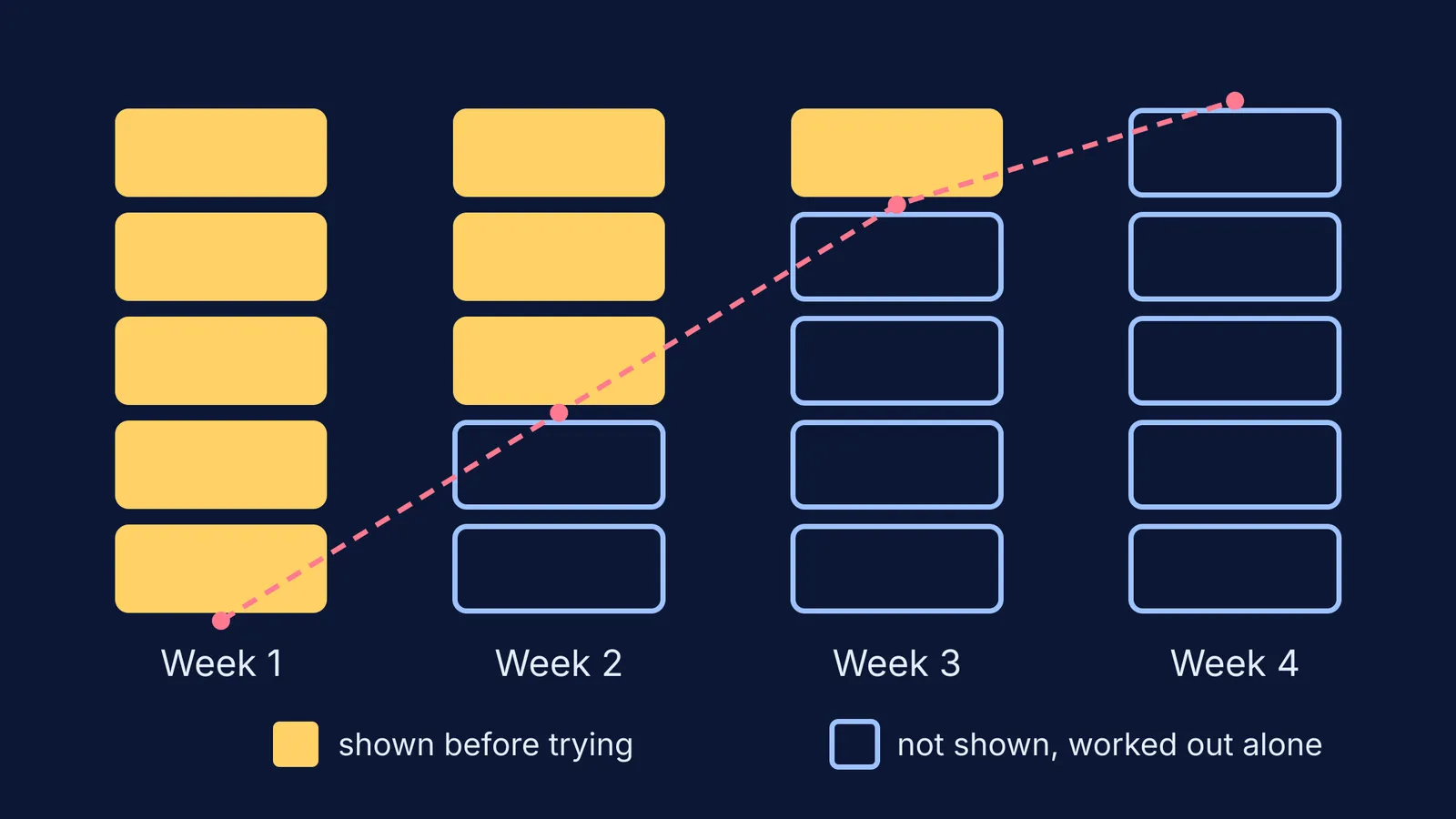
The routine stays the same; only the amount of example shown before trying changes.
Week 1: read the whole example, cover it, and rewrite the same problem from a blank page.
Week 2: cover the last two lines of the example and finish it alone, then compare.
Week 3: show only the first line (the knowns), then solve a new problem with different numbers.
Week 4: no example first. Try the problem cold and open the example only to compare.
If week 3 goes badly, repeat it. The aim is a child who can start a problem alone, not a ticked-off calendar. To add short weekly self-tests, see practice tests at home: how often and how to mark them.
What should I say when they get stuck?
You don't need to know the subject, just to hold back the answer.
"Don't look at the example yet. Show me the last line you are sure of."
"What does the question give you? Write those down first."
"Which line in the example would have told you this?"
"Good. Now cover it again and do just that step."
If your child can't recall what was taught that day, start with why children can't tell you what was taught in class. For middle-school maths, see helping with Class 8 maths without solving it for them.
Sometimes the compare step shows a gap your child can't explain even with the example open. The Fermi Problem Library has worked problems with a step-by-step solver that explains the reasoning rather than printing an answer, so they can see why that line comes next, then cover it and try again.


