

On this page
Many evenings look like this: 20 minutes of maths, then science, then a Hindi worksheet, then social science, then back to maths because a test is coming. By 9 pm your child has touched five subjects and finished none of them properly. If that sounds familiar, the fix is not more hours. It is fewer switches.
This post gives you a simple rule (two subjects per evening), how to run each session, and a weekly rotation that still covers everything.
Why does switching between subjects every evening feel so tiring?
Every switch has a cost. In four experiments, psychologists Joshua Rubinstein, David Meyer and Jeffrey Evans found that people lost time when they switched from one task to another, and that the cost grew when the tasks were more complex or less familiar (press release on the 2001 study; paper). Those were short lab tasks done by young adults, not homework, but a new physics chapter is both complex and unfamiliar.
There is a second cost. Sophie Leroy's 2009 experiments found that it is hard to move attention away from an unfinished task, and performance on the next task suffers (Leroy, 2009). Her paper calls this leftover thinking attention residue. Her studies were with adults, but a child who stops maths halfway through a problem and opens a history chapter may well still be partly doing maths.
So five 20-minute slots can mean five warm-ups and five half-finished jobs.
Is studying every subject every day better for memory?
Not necessarily. What helps memory is coming back to material after a gap. A review of 839 assessments in 317 experiments on verbal recall found benefits of spacing study sessions apart, and that the gap giving the best retention grew the longer the material had to be remembered (Cepeda and colleagues, 2006). A wider review of study techniques rated distributed practice and practice testing as high utility, and rereading and highlighting as low (Dunlosky and colleagues, 2013).
A subject studied on Monday, Wednesday and Friday is spaced. You do not need it every day. Our piece on what Harry Bahrick learned about spaced retention explains why the gaps matter.
One nuance: mixing different problem types *within* a subject, such as a maths set that mixes chapters, is a different thing from hopping between subjects. That is interleaving, which the same review rated as moderately useful, with the strongest evidence in maths. Here is how interleaved practice works, with a plan.
How do you set up a two-subject evening?
These timings are a starting point we suggest, not a research finding. The clean-stop step draws on Leroy's experiments. Adjust everything for your child's age and school load.
Do tomorrow's homework first. Anything due the next day comes before the rotation, kept short.
Block 1, about 45 minutes, one subject. Pick one chapter and one goal: "finish exercise 4.2" or "explain photosynthesis from memory".
Finish at a clean stopping point. Leroy found that finishing the first task under some time pressure helped people disengage from it and do better on the next one. Set a timer, end on a finished question, and write one line: "Next time: start at Q7."
Break, 10 to 15 minutes. Water, a walk, no phone feed.
Block 2, about 45 minutes, a different subject. Same rules.
Five-minute close. Without the book, your child writes three things they learnt today. That is a simple form of practice testing.
If homework alone is stretching past bedtime, start with a timer routine for shorter homework evenings before adding the rotation.
What does a weekly rotation look like?
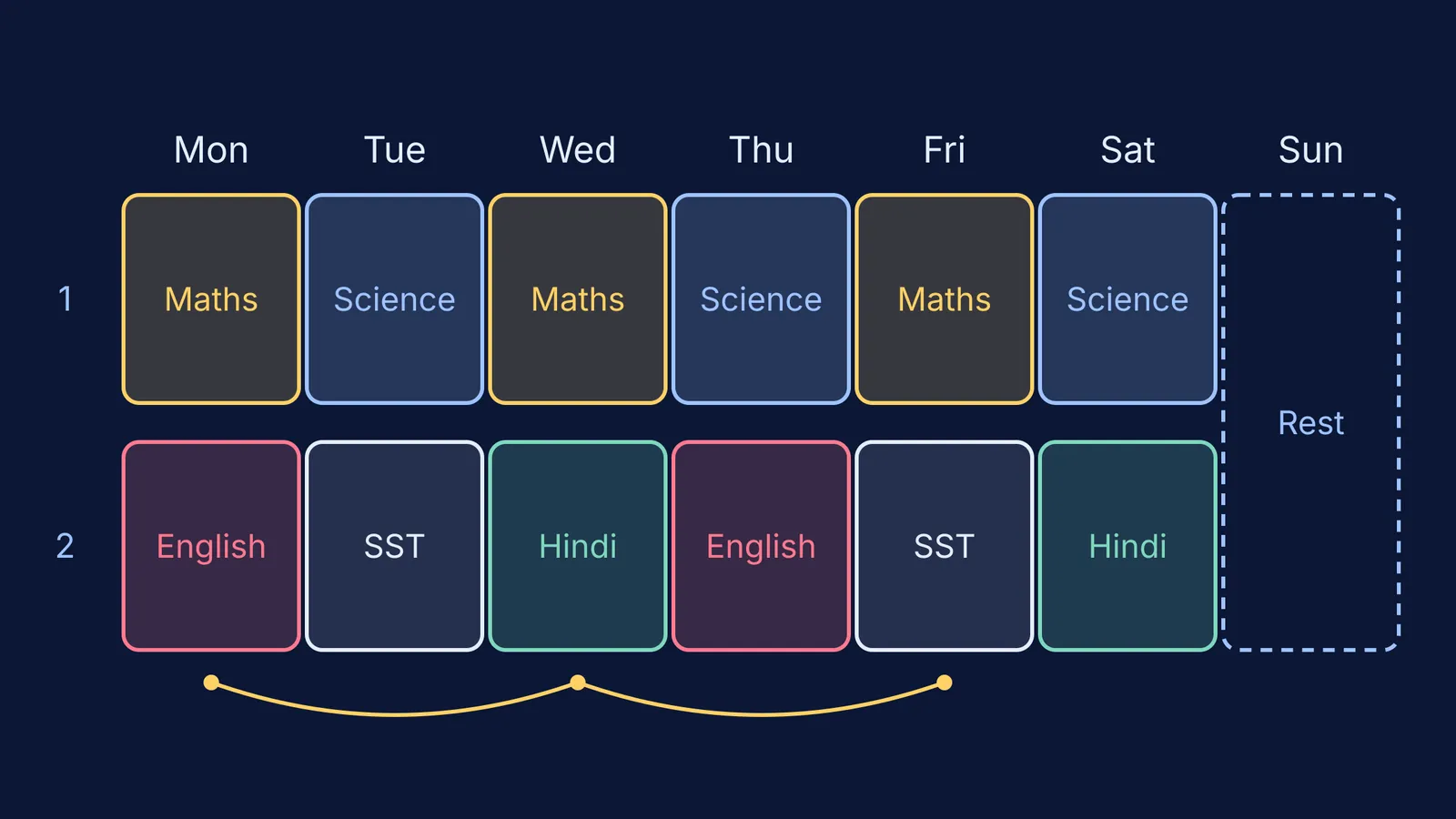
The aim is to build in the gaps that spacing research favours. Here is a worked example for a Class 9 student with five subjects: maths and science get three sessions each, the others two.
Monday: Maths, English
Tuesday: Science, Social Science
Wednesday: Maths, Hindi
Thursday: Science, English
Friday: Maths, Social Science
Saturday: Science, Hindi
Sunday: rest, plus 20 minutes looking back at the week's three-line notes
That is 12 sessions. No subject appears on two days in a row, so every subject gets a gap, and every subject is covered by Saturday. When a unit test is coming, swap that subject into an extra slot for the week, then go back to the pattern.
What can you say to your child?
Try: "You are working hard but jumping around a lot. Let's try two subjects a night for two weeks. You choose which two go on which day." Letting them build the rotation gives them ownership.
If they sit down to a block and do not know where to begin, Fermi's AI tutor works out what they already know and builds a plan for the session, so the 45 minutes start with a clear next step.
If study evenings keep ending in tears or constant worry, talk to the school counsellor or a doctor. Tele MANAS, the free national mental-health helpline, is on 14416 (details).
Pick two subjects for tomorrow evening, and write down where each one stops.


