On this page
Your child brings home 94%, and instead of relief you see a tight face, a closed door, or a flat 'it should have been 98'. Good marks and an unhappy child are not a contradiction, and the way through starts with how you ask.
Why would a child with good marks be unhappy?
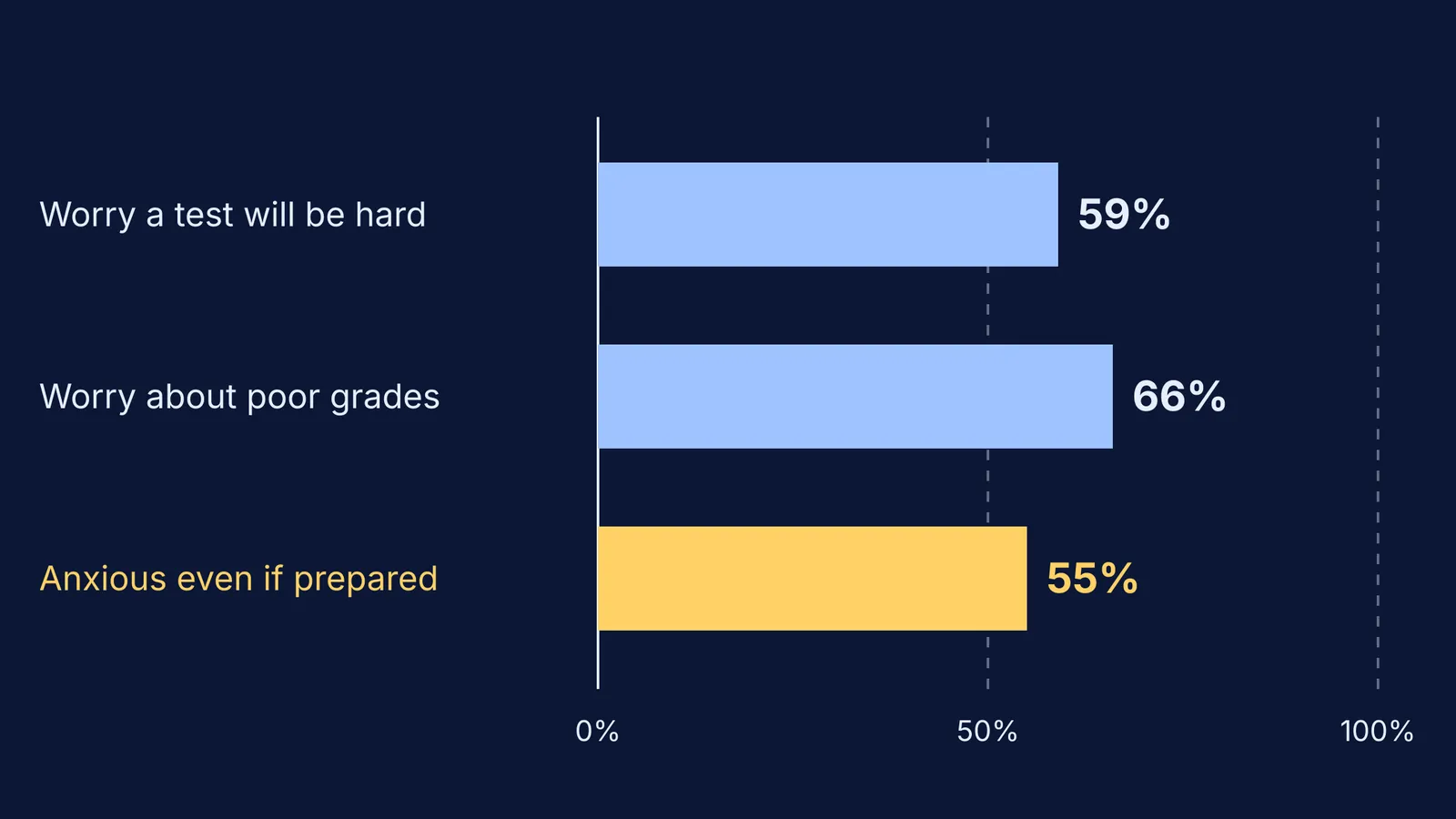
Marks measure how a paper went. They say very little about how the work felt. The OECD's PISA 2015 report on students' well-being found that, on average across OECD countries, 66% of students worry about poor grades. In the same survey, 55% of students said they feel very anxious for a test even if they are well prepared. The report also notes that students in some of the countries that top the PISA tables in science and mathematics reported comparatively low satisfaction with life, and that achievement motivation has downsides when it is a response to external pressure.
Pressure can come from inside too. A meta-analysis by Thomas Curran and Andrew Hill in Psychological Bulletin pooled 164 samples covering 41,641 college students in the US, Canada and the UK, and found that perfectionism rose steadily between 1989 and 2016, including the sense that other people demand perfection. Those were Western university students, not Indian teenagers, but the pattern may sound familiar.
Common reasons a high scorer feels low:
The bar keeps moving, so every good result becomes the new minimum.
Their sense of worth rides on the rank, so any slip feels like a verdict on them.
They score by memorising and privately feel they do not understand the subject.
Something outside study, such as friends, sleep or a teacher, is going wrong and the marks hide it.
How do you ask a child about stress without making it worse?
Pick a low-stakes moment, not the evening the result arrives. Car rides and walks work because you sit side by side. The PISA 2015 well-being report found that students whose parents regularly reported 'spending time just talking to my child', eating the main meal together or discussing how the child was doing at school were between 22% and 39% more likely to report high life satisfaction. That is a link, not proof, but it costs nothing to try.
A script you can adapt:
Notice without judging: 'You did well in maths, but you seemed quiet when you told me. What was that like?'
Ask about the experience, not the score: 'Which part of the paper felt hardest? Which part did you enjoy?'
Find the hidden rule: 'What mark would have felt okay to you? Where did that number come from?'
Separate the two things out loud: 'I'm glad about the marks. I care more about how you are.'
Stop and listen. If you get a shrug, leave it and try again in a few days.
Avoid 'But you got 94, why are you upset?' It tells your child the feeling is wrong. Watch what you praise, too. Across six studies, Claudia Mueller and Carol Dweck found that children praised for intelligence cared more about performance than learning and, after a failure, persisted less and enjoyed the task less than children praised for effort (Mueller and Dweck, 1998). 'You're so clever' sets a standard a child then has to keep proving.
How do you separate effort, outcome and wellbeing?
Treat them as three questions, each with its own answer:
Effort: What did you do? Hours, methods, what you tried.
Outcome: What happened? The mark, the mistakes, what the paper tested.
Wellbeing: How are you? Sleep, appetite, mood, friends, fun.
Here is an imagined example. Meera, in Class 10, scores 92% in science and is upset.
Effort: she revised by re-reading her notes for three weeks. Steady, but passive.
Outcome: she lost marks on two electricity numericals she never really understood.
Wellbeing: she has been sleeping late before tests and stopped going to badminton.
One vague worry has become three small, separate fixes: swap some re-reading for practice questions, close the electricity gap, and protect sleep and badminton.
If the outcome column keeps pointing to ideas your child memorised but never understood, the Fermi Concept Library covers every concept in physics, chemistry, biology, mathematics and computing, each with its own lesson, so they can go back to the idea itself instead of another round of rote revision.
For related situations, read how to support a child who always comes first in class, what to do when a perfectionist child takes forever on homework and why to stop discussing your child's marks with relatives.
When should you get outside help?
Everyday exam stress rises and falls. Talk to the school counsellor or your family doctor if your child's low mood or worry does not ease, or starts to affect sleep, eating, friendships or going to school. If your child talks about hurting themselves, seek help the same day.
Tele MANAS is a free, 24x7 national mental-health helpline launched by the Ministry of Health and Family Welfare, on 14416 or 1800-891-4416 (Tele MANAS details). You can call as a parent, too.