

On this page
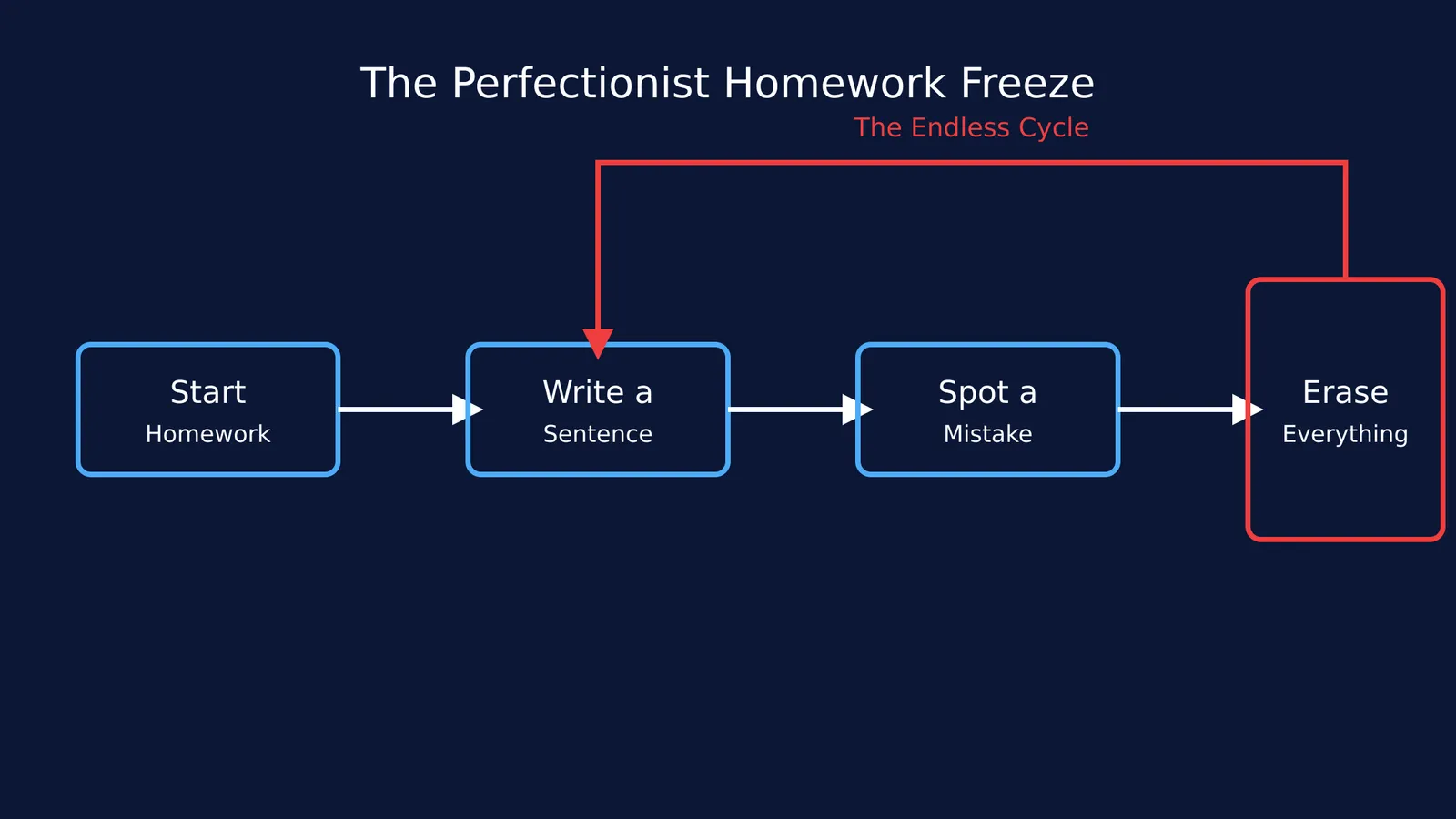
It starts as a regular evening. Your child sits down at the kitchen table to do a page of maths or write a short paragraph. But ten minutes later, they are still on the first question. They write a sentence, spot a slightly messy letter, and erase the whole thing until the paper tears. They are not confused by the material, and they are not being lazy. They are stuck in a perfectionist freeze.
For many students, procrastination and endless rewriting are driven by a fear of failure. It is an exhausting cycle for both the child and the parent, turning a twenty-minute worksheet into a two-hour ordeal.
Why is perfectionism rising among students?
If you feel like you are seeing more of this behaviour today than when you were in school, you are probably right. A landmark 2019 study published in *Psychological Bulletin* by Thomas Curran and Andrew P. Hill tracked 41,641 college students from 1989 to 2016 to measure generational changes in perfectionism.
The researchers found that socially prescribed perfectionism increased by 33% over those 27 years. This is the feeling that others have excessively high expectations and will judge you harshly for mistakes. Children today are growing up in an environment where every grade feels high-stakes, making the fear of getting something wrong overwhelming.
Why do perfectionist children erase and rewrite homework?
When a child fears their work will not be perfect, their brain treats the assignment as a threat. Erasing and rewriting is a coping mechanism. It provides a temporary sense of control, delaying the moment they have to hand the work over and risk criticism.
Perfectionist children struggle to distinguish between a major exam and a nightly spelling worksheet. To them, both require a flawless performance. You can help by setting a "good enough" target before they pick up their pencil.
Use a simple 1 to 5 scale. Explain that a final project might require a 5 (maximum effort and neatness), but tonight's rough draft only needs a 2 (legible and complete). Show them what a "B" or "C" level effort looks like, and reassure them that it is exactly what is required for the task. If you are adjusting their environment, creating a dedicated home study space can also help them mentally separate work time from rest time.
How do time limits help?
The most effective way to help a child stuck in this loop is to shift the focus away from the quality of the final product and onto the process.
Instead of telling them to finish the page, set a clear time box. You might say, "We are going to work on this worksheet for twenty minutes. Whatever is on the paper when the timer goes off is what we are putting away."
This teaches the child that "done" is better than "perfect". It gives them a safe space to practice tolerating the discomfort of leaving an untidy or incomplete page, knowing that the time limit is the only rule they have to follow.
What should you do when they freeze?
Sometimes, a child will refuse to write anything at all because they do not want to make a mistake on the first step. If they are completely stuck, moving to a different task can help reset their brain.
If the freeze happens frequently because they are unsure of the method, Fermi's AI tutor can help. The tutor teaches rather than answers: it holds a line of reasoning across a session, notices where a student is stuck, and decides whether to explain, ask, or show. It works out what the student knows and builds a plan for the session, so they sit down to a clear next step instead of a blank page.
Change how you praise their work. If you normally say, "Your handwriting looks beautiful," or "You got them all right," you are accidentally reinforcing the idea that only perfect results matter.
Instead, praise their efficiency and resilience. Try saying, "I am so proud of how you kept going even when you made a mistake on number three," or "You finished that whole page in fifteen minutes without erasing once!" Over time, and as part of a study routine that lasts, this shifts their goal from being flawless to being finished, helping them overcome perfectionism and studying with a healthier mindset.


