On this page
Your child goes to their desk at 7, comes out at 7:10 and says, 'Done.' Maybe they are. Maybe they read the page twice and it felt familiar. You can't tell from the clock, and often neither can they. The fix is not a longer timer. It is a five-minute check of what stuck, and a goal set by task, not minutes.
Is ten minutes of studying ever enough?
Sometimes, yes. Learning a list of Hindi spellings or revising one formula sheet can genuinely take ten minutes. The catch is that 'I studied' often means 'I looked at it', and looking feels a lot like knowing. The useful question is not 'How long did you study?' but 'What can you do now that you couldn't do before?'
Why does my child feel finished when they haven't learned it?
Rereading makes a page feel familiar, and familiarity is easy to mistake for memory. In a 2009 study of student habits in the journal Memory, Jeffrey Karpicke, Andrew Butler and Henry Roediger proposed that many students experience 'illusions of competence' while studying.
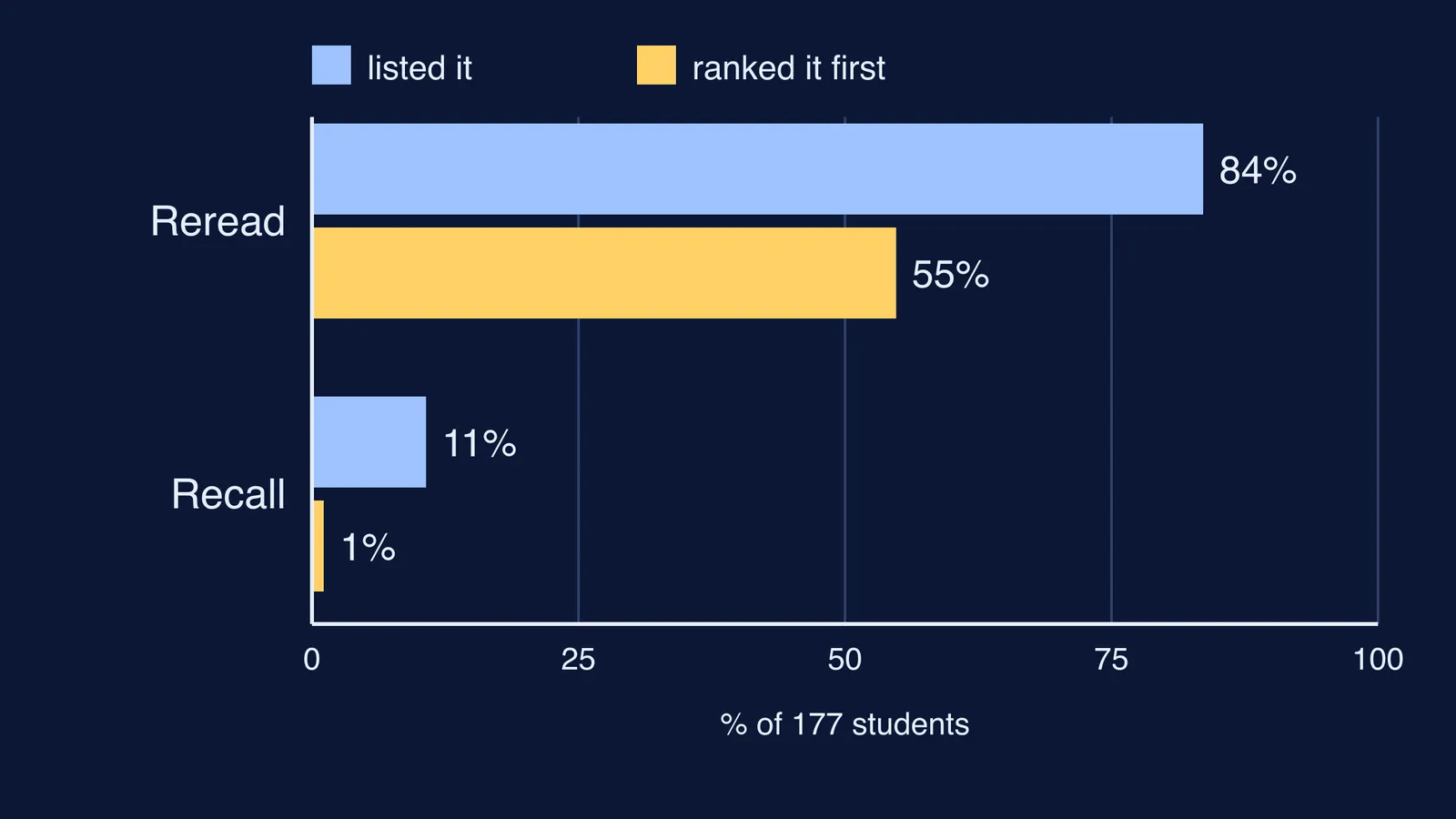
In that survey of 177 undergraduates at Washington University in St. Louis, 84% listed rereading their notes or textbook as a study strategy and 55% ranked it as their main one (Karpicke, Butler and Roediger, 2009). Only 11% said they practised recalling information while studying, and just 1% ranked recall first.
A review of 10 study techniques by John Dunlosky and colleagues in Psychological Science in the Public Interest rated practice testing and distributed practice (spreading study out over time) as high utility. Rereading and highlighting were rated low utility.
So a child who says 'done' is probably not lying; they are reporting how familiar the page felt.
How do I ask my child to teach back what they studied?
A teach-back is simple: your child closes the book and explains the topic to you in their own words, as if you were the student. It helps because it makes them pull the ideas out of memory.
In a 2018 study in Applied Cognitive Psychology, Aloysius Koh, Sze Chi Lee and Stephen Lim found that students who taught a lesson without notes scored higher on a comprehension test a week later than students who taught from their notes. A group that only practised recall also beat the teach-with-notes group, and the authors suggested that retrieval practice is possibly what makes teaching help the teacher. So the book has to be closed.
Here is a script that takes about five minutes. You don't need to know the subject.
'Nice. Close the book and teach me the main idea, like I'm in Class 5.'
'Give me one example.'
'What's the part people usually get wrong?'
'Do one question from the end of the chapter without looking.'
'Which bit was shaky? Go back for just that bit, then tell me again.'
Listen for gaps: long pauses, 'it's something like...', or a hand reaching for the book. Those gaps are the real homework.
What is a task-based study goal?
A time goal says 'Study science for an hour.' A task-based goal names what will be true at the end: 'I can explain the topic without the book and answer the NCERT exercise questions.' Time goals reward sitting; task goals reward finishing something you can check.
A worked example for a Class 8 child with a science chapter on force and pressure:
Time goal: 'Study the chapter for 45 minutes.'
Task goal: 'Explain the difference between force and pressure with one everyday example, answer the first five exercise questions with the book closed, then mark them against the book.'
A good task goal passes four checks:
It starts with a verb you can see: explain, solve, draw, derive, list.
It names the material: which chapter, which questions.
It ends with a check: a teach-back, closed-book questions, or marking against the answer key.
It fits in one sitting.
Agree the goal before your child sits down. If the task is done in ten minutes and the teach-back is solid, ten minutes was enough. Marking their own work is a skill too; here is how to teach your child to check their own answers.
What if the teach-back goes badly?
Expect it to, at first. A shaky explanation is useful information, not a failure: it shows exactly which part to go back to. Thank your child, agree on one small fix, and stop there.
If the gap is a concept neither of you can explain, Fermi's AI tutor works out what a student already knows and checks understanding as it goes, so the weak spot your child found has a next step.
If daily checks start turning into fights, step back to a weekly plan that replaces nagging your teenager to study. If the short sessions are part of a wider loss of interest, read why a Class 9 child may not take studies seriously. And if low mood, worry or poor sleep seem to sit underneath the reluctance, talk to a school counsellor or doctor, or call the government's Tele MANAS helpline on 14416 or 1-800-891-4416.
Tonight, try one line at the door: 'Nice. Close the book and teach me.'