

On this page
By Class 9 or 10, the reminder that worked at age ten ("Go and do your homework") often gets a sigh, a "five minutes" or a closed door. That is not only stubbornness. How a message sounds, and who made the plan, change how a teenager hears it.
Why do reminders stop working with teenagers?
Tone matters as much as words. In a 2019 study in Developmental Psychology, Netta Weinstein, Maarten Vansteenkiste and Silke Paulmann played 1,000 adolescents aged 14 to 15 the same sentences spoken by mothers in a controlling, a supportive or a neutral tone. The University of Essex summary lists lines such as "you will read this book tonight". When the tone was controlling, teens reported more negative feelings, felt less close to their mother and were less willing to cooperate; a supportive tone drew more positive reactions than a neutral one.
The tenth reminder of an evening is hard to say supportively. It also tells your teen that the plan lives in your head, not theirs, so they wait for your voice instead of the clock.
What works better than nagging?
Research on parents and schoolwork points away from standing over homework and towards structure and conversation.
Hill and Tyson's 2009 meta-analysis of 50 studies of middle-school students found parental involvement was linked to higher achievement, except help with homework. The strongest link was academic socialisation: talking about the value of education, learning strategies and plans for the future.
A 2008 research synthesis by Patall, Cooper and Robinson found that parents setting rules for homework had a stronger link with achievement than other kinds of homework involvement.
Specific plans help teenagers follow through. In a 2011 experiment led by Angela Duckworth with 66 high-school students preparing for a high-stakes exam, those randomly assigned to think through obstacles and write "if-then" plans completed more than 60% more practice questions than a control group.
Put together: agree the rules once, make the plan visible, and save your words for one conversation a week.
How do you set up an agreed study plan?
Sit down together on a Sunday with the school timetable, coaching hours and upcoming test dates. Your teen writes; you ask questions.
List the fixed things first: school, coaching, travel, meals, sleep and one activity they enjoy.
Choose study blocks with a start time, a place and a first task, such as "8:00, desk, chemistry worksheet".
Write one if-then plan for the most likely obstacle: "If a friend messages during a block, I reply after it ends."
Agree your part. Usually: no reminders during the week unless a block is missed twice.
Put the week on the wall or in a shared calendar you can both see.
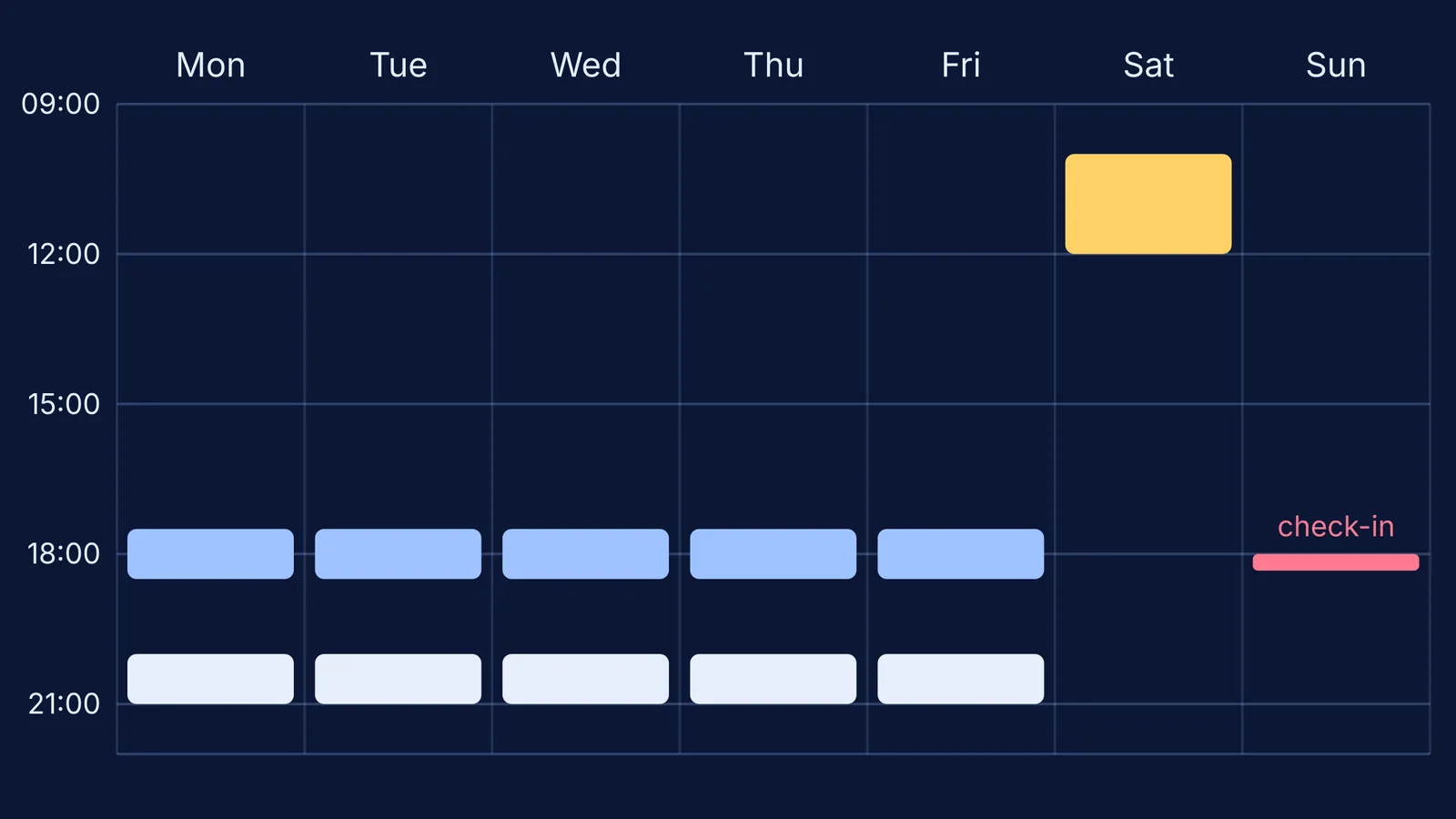
Worked example. A Class 11 student has school and coaching until 5:00 on weekdays. Their plan: Monday to Friday, 5:30 to 6:30 for school homework and 8:00 to 9:00 for physics or maths practice; Saturday 10:00 to 12:00 for a chapter test and corrections; Sunday free except a 20-minute check-in at 6:00. The chart on the fridge does the reminding. If Wednesday's 8:00 block is missed, nobody says anything that night; it goes on the list for Sunday.
If your teen pushes back on fixed hours, our guide to fixed hours versus task lists can help them choose. If the phone is the main obstacle, setting up Focus mode on a teen's phone is something you can do together.
What should you say in the weekly conversation?
Keep it short, at the same time each week, and not on results day. A script:
"What went well this week?" Let them answer first.
"Which blocks didn't happen, and what got in the way?"
"What would you change for next week?" Accept a reasonable change, even if you would have chosen differently.
"Is there anything you're stuck on?"
Agree next week's plan and put it back on the wall.
Keep marks for another day, and skip comparisons with cousins and "you always". Describe what you saw ("three of the five evening blocks happened") rather than what you fear.
If the answer to question 4 is "I don't know where to start with this chapter", Fermi's AI tutor can work out what your teen already knows and build a plan for the session, so the next block starts with a clear first step.
When is it more than a study problem?
Sometimes not studying is a sign of something else: low mood, poor sleep, bullying or exam worry. If your teen seems withdrawn for weeks or stops enjoying things they used to, talk to the school counsellor or a doctor. In India, the Tele MANAS mental-health helpline, listed by UNICEF India, is on 14416.
For a teen who seems uninterested rather than unwell, our piece on why a Class 9 child may not take studies seriously looks at other causes.
This Sunday, skip the lecture. Bring a blank week, a pen and the five questions.


