

On this page
You find the glow under the blanket at 11:40 pm. It is a novel, not Instagram, so being strict feels unfair. Both instincts are right: an e-ink reader is gentler than a phone, and your child still needs a fixed lights-out time.
Is reading on a Kindle at night bad for sleep?
It depends on which Kindle. A basic Kindle or Paperwhite has an E-ink screen made to look like ink on paper. A Kindle Fire, or the Kindle app on a phone, is an ordinary backlit screen.
In a 2013 PLOS ONE study, 12 adults read for about 73 minutes on a Kindle Paperwhite, a Kindle Fire HD and a paper book. The backlit Fire HD caused more visual fatigue; the E-ink Paperwhite showed no difference from paper. That study measured eye strain, not sleep.
Light-emitting screens are a different story. In a sleep-lab study published in PNAS, 12 young adults read for about four hours before bed on five evenings, either on an iPad or in a printed book. After iPad reading they took nearly 10 minutes longer to fall asleep, their evening melatonin was suppressed by about 55%, and their melatonin rise came more than 1.5 hours later.
Two cautions. That study tested adults on a tablet, and we found no study of front-lit e-ink readers at bedtime in children. And light is not the only problem. A review of 67 studies by Lauren Hale and Stanford Guan found screen time in school-aged children and teenagers linked to shorter or later sleep in 90% of them. One likely reason is that time on a device pushes out time asleep, and a gripping novel can do that as well as a game.
How much sleep does my child need?
The American Academy of Sleep Medicine recommends 9 to 12 hours of sleep a day for children aged 6 to 12, and 8 to 10 hours for teenagers aged 13 to 18 (AASM consensus statement). Count back from wake-up time to get lights-out, which sets the reading cut-off.
Two worked examples:
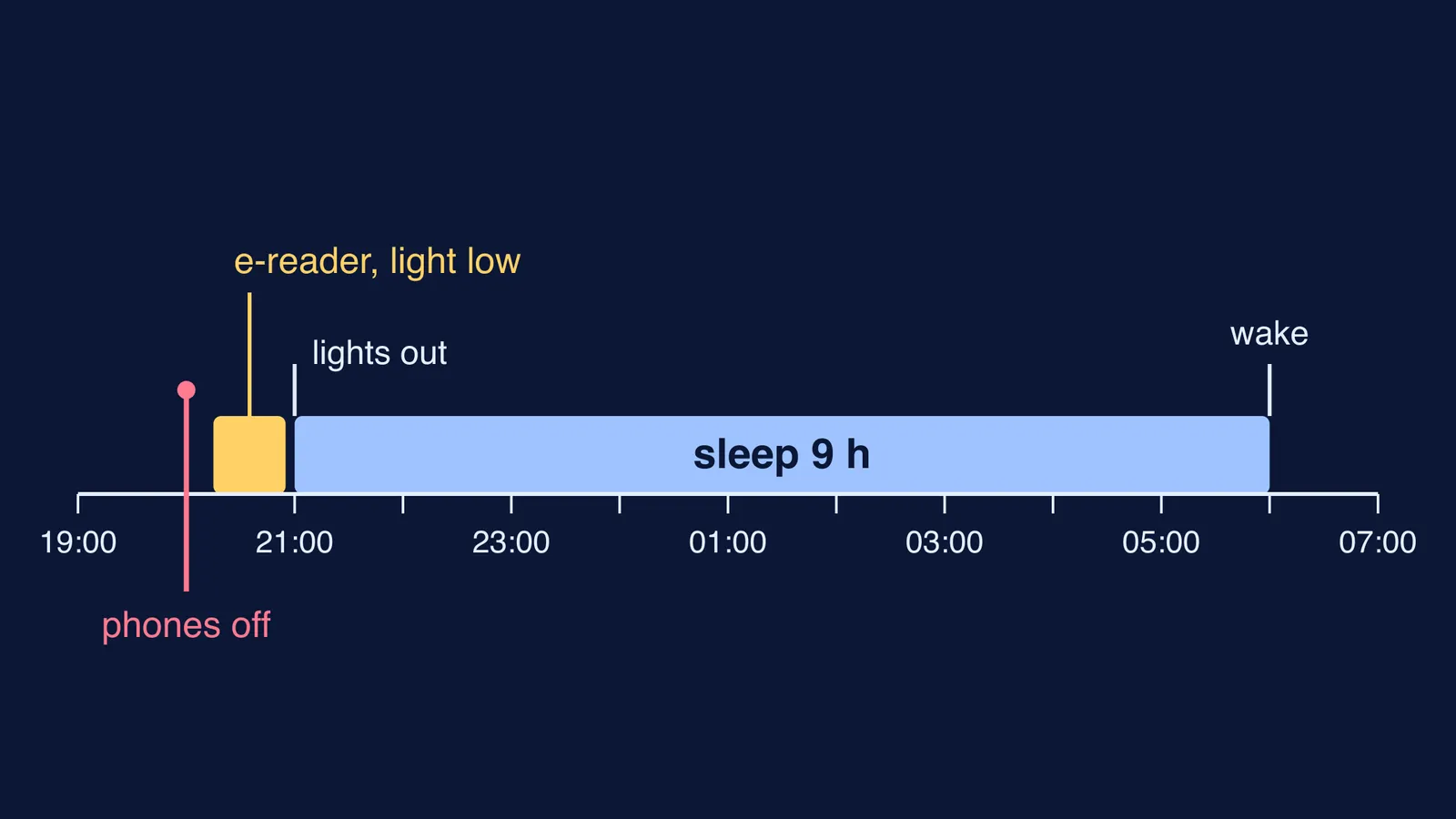
Riya, 12, Class 7. Wakes at 6:00 for a 7:00 school bus. At least 9 hours of sleep means lights-out by 9:00 pm. Reading window: 8:15 to 8:55 pm.
Arjun, 16, Class 11. Also wakes at 6:00. At least 8 hours means lights-out by 10:00 pm. Reading window: 9:15 to 9:55 pm.
Teenagers' body clocks run later; our guide to a night-owl teen with an early school start covers that.
What makes reading different from other screen use?
The American Academy of Pediatrics advises avoiding screens for 1 hour before bed and keeping phones out of the bedroom at night (AAP guidance on screens and sleep). Its reasons are alertness, a raised heart rate and light that can disrupt melatonin. The page does not mention e-readers, so here is our own three-question test:
Does it glow at you? E-ink reflects light like paper, and a Paperwhite's built-in front light shines onto the page; a phone or tablet is backlit and shines out towards your eyes.
Does it ping? A dedicated reader with Wi-Fi off has no notifications, feeds or chats.
Does it end? A chapter ends. A feed, a webnovel app or the next episode does not.
A dedicated e-ink reader with the light turned down passes all three, so we think it can stay in the reading window. The Kindle app on a phone fails the first two, so it goes off with the other screens. Our comparison of ebooks and printed books for children helps with choosing a format; for phone reading, see what to do when a child reads webnovels on their phone.
How do I set a reading cut-off without a fight?
Agree on the plan in daylight, not at bedtime. Then:
Fix lights-out together from the wake-up time, as in the examples above.
Set phones and other screens off one hour before lights-out, in line with the AAP's one-hour advice, with phones charging outside the bedroom.
End the reading window five minutes before lights-out. The reader then goes on the desk, not under the pillow.
Set the reader up: brightness low, warm light on if the model has it, airplane mode on.
Use a chapter rule: finish the chapter running at the cut-off, or bookmark it if it is long.
Let weekends run a little later, but keep wake-up close to school days so Monday is not a shock.
What to say: "I'm not taking the book away. You need nine hours before the bus, so read from 8:15 to 8:55, and the next chapter waits for tomorrow."
If the late nights are really homework spilling over, move study earlier. Fermi's AI tutor can work out what your child already knows and build a plan for the session, so evening study starts with a clear next step.
If your child lies awake for long even with a steady routine, or is very sleepy by day, talk to your paediatrician. If worry keeps them up, Tele MANAS, the free 24x7 government mental-health helpline, is on 14416.
Start tonight with one number: the time your child needs to wake up.


