

On this page
For many families, screens are a convenient way to bring hundreds of books on a holiday or keep a child occupied on a long drive. But as schools increasingly adopt digital textbooks and e-readers become common, parents often wonder whether reading on a screen is as good as reading on paper.
The research suggests that the medium does matter. From toddlers sitting on a parent's lap to high school students preparing for exams, studies consistently show a "print advantage" for focus, comprehension, and connection.
Are ebooks or paper books better for toddlers?
For the youngest readers, the value of a book lies not just in the story, but in the conversation it sparks. In a 2019 study published in *Pediatrics*, researchers observed 37 parent-toddler pairs reading print books, basic ebooks, and "enhanced" ebooks with sounds and animations. They found that parents and toddlers verbalized significantly less when using electronic formats (https://doi.org/10.1542/peds.2018-2012).
With print books, parents naturally engaged in "dialogic reading"—asking questions like "What do you think happens next?" or pointing out details in the pictures. With ebooks, the conversation shifted to the technology. Parents spent more time telling their child not to touch the screen or how to swipe, which interrupted the bonding and the story.
The format also affects how well young children understand what they read. A 2021 meta-analysis in the *Review of Educational Research* examined 39 experimental studies involving 1,812 children between the ages of one and eight (https://doi.org/10.3102/0034654321998074). It found that children had lower comprehension scores when reading plain digital books compared to paper books. Digital books only outperformed print when they included "story-congruent" enhancements—features that directly supported the narrative rather than acting as a distraction.
Does reading on a screen affect student comprehension?
As children grow and begin reading to learn, the type of text changes from narrative stories to complex, informational writing. This is where the gap between screens and paper becomes even clearer.
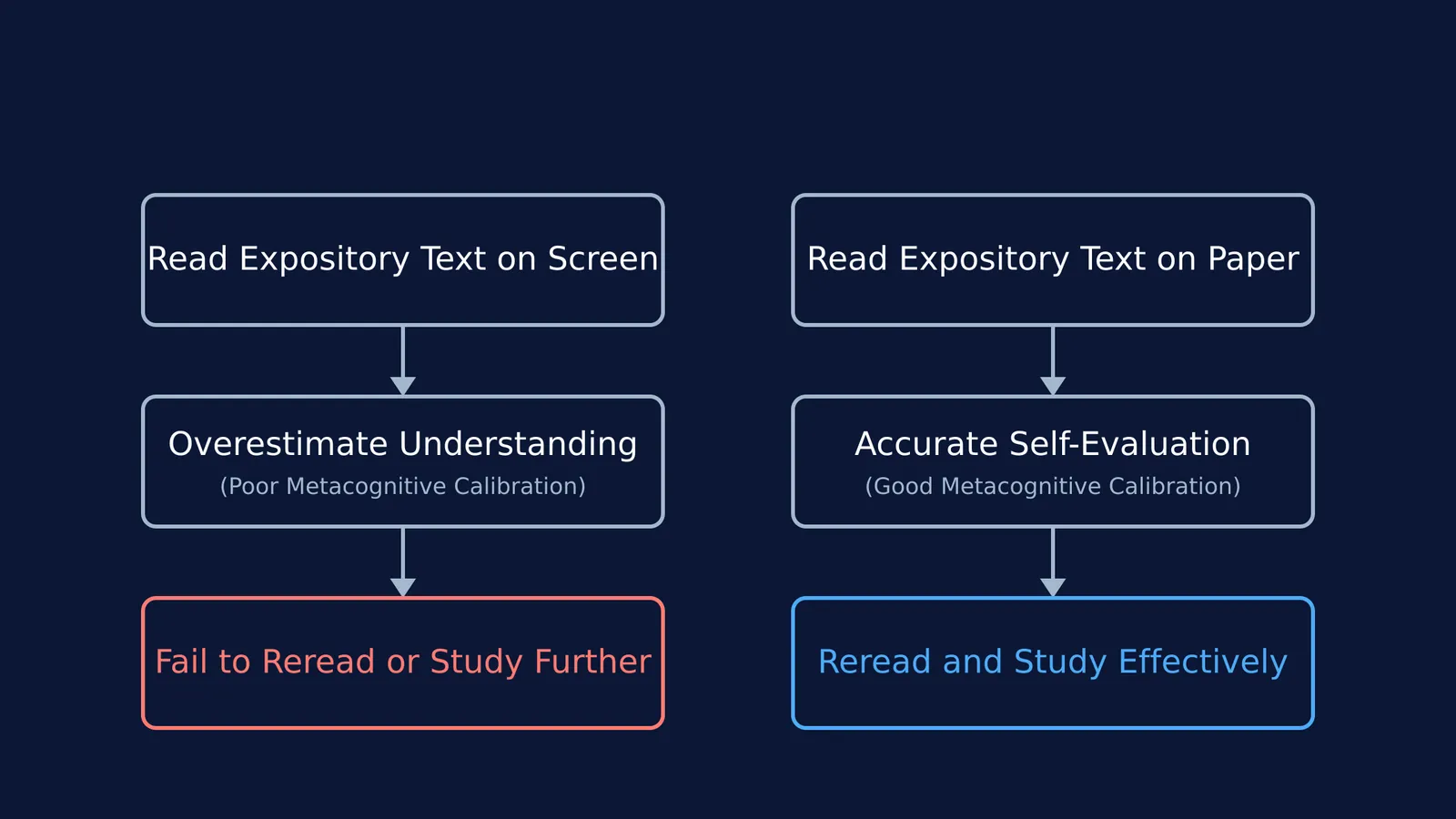
A 2019 meta-analysis published in the *Journal of Research in Reading* consolidated findings from 33 studies involving 2,799 participants. It found that reading from screens had a negative effect on reading performance for expository or informational texts, though there was no significant difference for narrative fiction (https://doi.org/10.1111/1467-9817.12269).
Crucially, the study revealed that readers on screens suffered from poor "metacognitive calibration"—meaning they consistently overestimated how well they understood the material. Paper readers, by contrast, were much more accurate in judging their own comprehension. When a student thinks they have grasped a concept on a screen but actually haven't, they are less likely to reread or study it further.
If your older child is studying complex topics and overestimates their understanding on a screen, they might need active testing to reveal gaps. The Fermi Problem Library has worked problems with a step-by-step solver that explains the reasoning rather than printing an answer. If they struggle with a specific idea, Fermi's AI tutor can work out what they already know and build a plan for the session, so they sit down to a clear next step.
A practical checklist for digital reading
While print has clear advantages, digital reading is sometimes unavoidable. If your child is reading on a screen, you can manage the downsides with a few deliberate habits.
Turn off the bells and whistles: For younger children, choose basic ebooks over interactive ones. The less a book acts like a game, the more a child will focus on the story.
Co-view and converse: If you are reading an ebook with a toddler, consciously treat it like a print book. Ask open-ended questions about the story and ignore the interactive distractions.
Print the heavy stuff: Encourage older students to use paper for complex subjects, long-form reading, or exam preparation. Save screens for light fiction or quick reference. For a similar debate, see Laptop or notebook for notes? What the research really shows.
Test for understanding: Because screens can create a false sense of fluency, have your child actively summarise what they just read or explain it back to you. If they use digital tools, check out Should children use ChatGPT for homework? A parent's guide for more advice on navigating screen-based study.
Protect sleep: The blue light from screens interferes with rest. Keep e-readers and tablets out of the bedroom for at least an hour before sleep.


