On this page
It usually happens on a Sunday. A test went badly, and by evening your child has a fresh notebook, a new timetable and a plan to "do it properly this time", starting from chapter one. Three weeks later another test goes wrong, and the cycle begins again. The early chapters get revised four times; the later ones never get opened. The pattern is fixable, and it is not necessarily laziness.
Why does my child keep starting the syllabus again from chapter one?
Part of it is a normal human pull towards clean slates. In the study The Fresh Start Effect, Hengchen Dai, Katherine Milkman and Jason Riis found that people are more likely to pursue goals right after "temporal landmarks" such as the start of a new week, month or semester. They propose that these landmarks relegate past imperfections to a previous period. That energy is useful; the problem is spending it on chapters your child already knows.
The other part can be perfectionism. Restarting promises a syllabus with no gaps and no messy notes. Carrying on means studying with a known weakness behind you, and some students find that unbearable.
Perfectionism among young people appears to be rising. A meta-analysis by Thomas Curran and Andrew Hill of 164 samples and more than 41,000 college students in the US, Canada and the UK found that all three forms of perfectionism they measured increased between 1989 and 2016 (Psychological Bulletin).
Is restarting a sign of perfectionism?
It can be. Psychologists separate two sides of perfectionism. Perfectionistic strivings means setting high standards. Perfectionistic concerns means fearing mistakes and harsh self-judgement.
A meta-analysis by Fuschia Sirois, Danielle Molnar and Jameson Hirsch, covering about 10,000 people, found that perfectionistic concerns went with more procrastination (r = .23), while perfectionistic strivings went with less (r = −.22) (European Journal of Personality). High standards are not the problem; fear of falling short is. Restarting can be a respectable-looking way to put off the harder, newer chapters.
Signs the restart habit is fear rather than strategy:
The trigger is a single bad test or a messy notebook, not a real gap in understanding.
Time goes into rewriting neat notes for chapters that were already fine.
The new plan is stricter than the last one, with no room for a bad day.
What does a 'continue from where you are' plan look like?
Once the first upset has passed, sit down together and set it up in five steps.
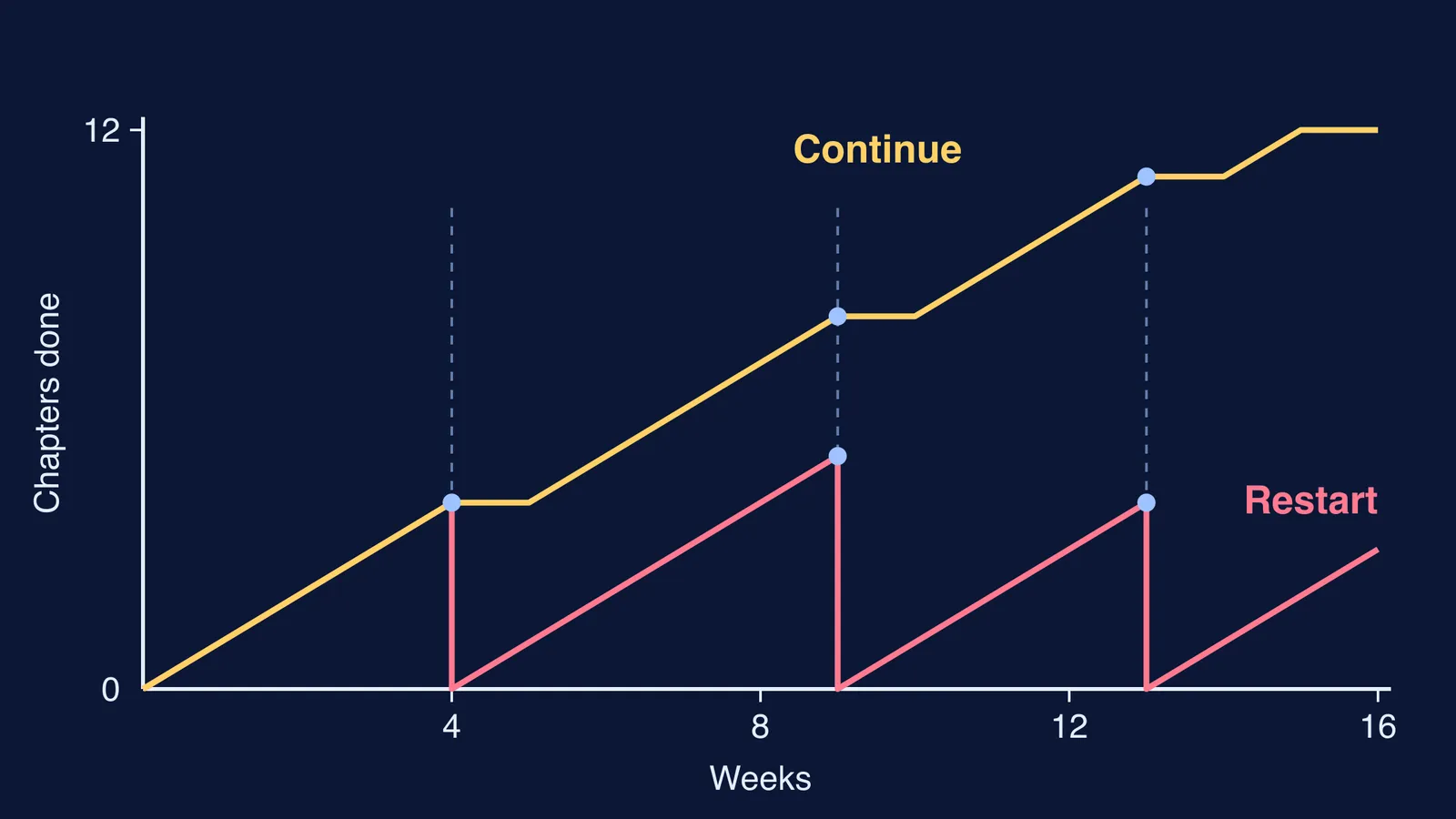
Mark the line. On the syllabus list, draw a line under the last chapter studied. Everything above it stays done, even if imperfect.
Name the gap, not the chapter. Look at the bad test and write down the two or three specific ideas that went wrong, for example "sign of acceleration on the way up" or "balancing redox in basic medium".
Repair on the side. Give each gap a short, fixed slot alongside new work, never instead of it.
Keep a forward rule. Most of each week's study time goes to chapters below the line.
Plan for the next setback now. Agree in advance: "If a test goes badly, we add its gaps to the repair list. We do not move the line back."
A worked example. Riya, a hypothetical Class 11 student, has finished six physics chapters and does badly on a test. Instead of restarting, she lists three gaps from the paper: free-body diagrams on inclines, friction direction and work done by a variable force. Chapter 7 stays on her plan; the gaps get repair slots. The Fermi Concept Library has every concept in physics, chemistry, biology, mathematics and computing, so your child can revisit one idea without reopening a whole chapter. If the gap is in method rather than theory, the Fermi Problem Library has worked problems with a step-by-step solver that explains the reasoning.
What should parents say after a bad test?
In experiments by Juliana Breines and Serena Chen, people encouraged to be self-compassionate about an initial failure spent more time studying for a difficult follow-up test than those in comparison groups (Personality and Social Psychology Bulletin). Self-kindness went with more effort, not less.
Try lines like these:
"That test showed us two or three things to fix. It didn't erase what you've done."
"Where's your line? Let's keep going from there."
Avoid "You need to start again properly" and praise for redoing old chapters. Both teach your child that a clean slate is the goal.
When is it more than a study habit?
If the restarting comes with ongoing distress, poor sleep, panic before tests or talk of being worthless, treat it as more than a planning problem. Talk to a school counsellor or a doctor. In India, the government's Tele MANAS helpline is toll-free and works around the clock: dial 14416 or 1800-89-14416 (Ministry of Health and Family Welfare).
Related reads: the perfectionist child who takes forever over every task, the child who makes study plans and then abandons them and the child who is afraid of making mistakes.