On this page
It is December, pre-boards are close, and your child has not really started. Ten weeks is enough to change a lot, as long as the time goes to the chapters that carry the most marks and to practice that sticks. This plan is written for a CBSE Class 10 or 12 student and the parent across the dinner table; for ICSE or a state board, use the same steps with your board's own syllabus and papers.
Is it too late to start board exam preparation in December?
No, but there is no room for a slow warm-up. For the 2026 exams, CBSE's tentative date sheet put the start on 17 February (All India Radio News). The 2027 date sheet was not out when we wrote this, so check cbse.gov.in for your dates. Counting back from a mid-February first paper, a December start leaves about ten weeks.
The method matters more than the start date. A 2013 review of ten study techniques by John Dunlosky and colleagues rated practice testing and distributed practice as high utility, and rereading and highlighting as low utility (Psychological Science in the Public Interest). In two 2006 experiments by Henry Roediger and Jeffrey Karpicke, students who took recall tests remembered more two days and a week later than students who restudied, even though restudying made them more confident (Psychological Science). So a late starter should not spend December rereading the textbook from page one.
How do you sort chapters by marks?
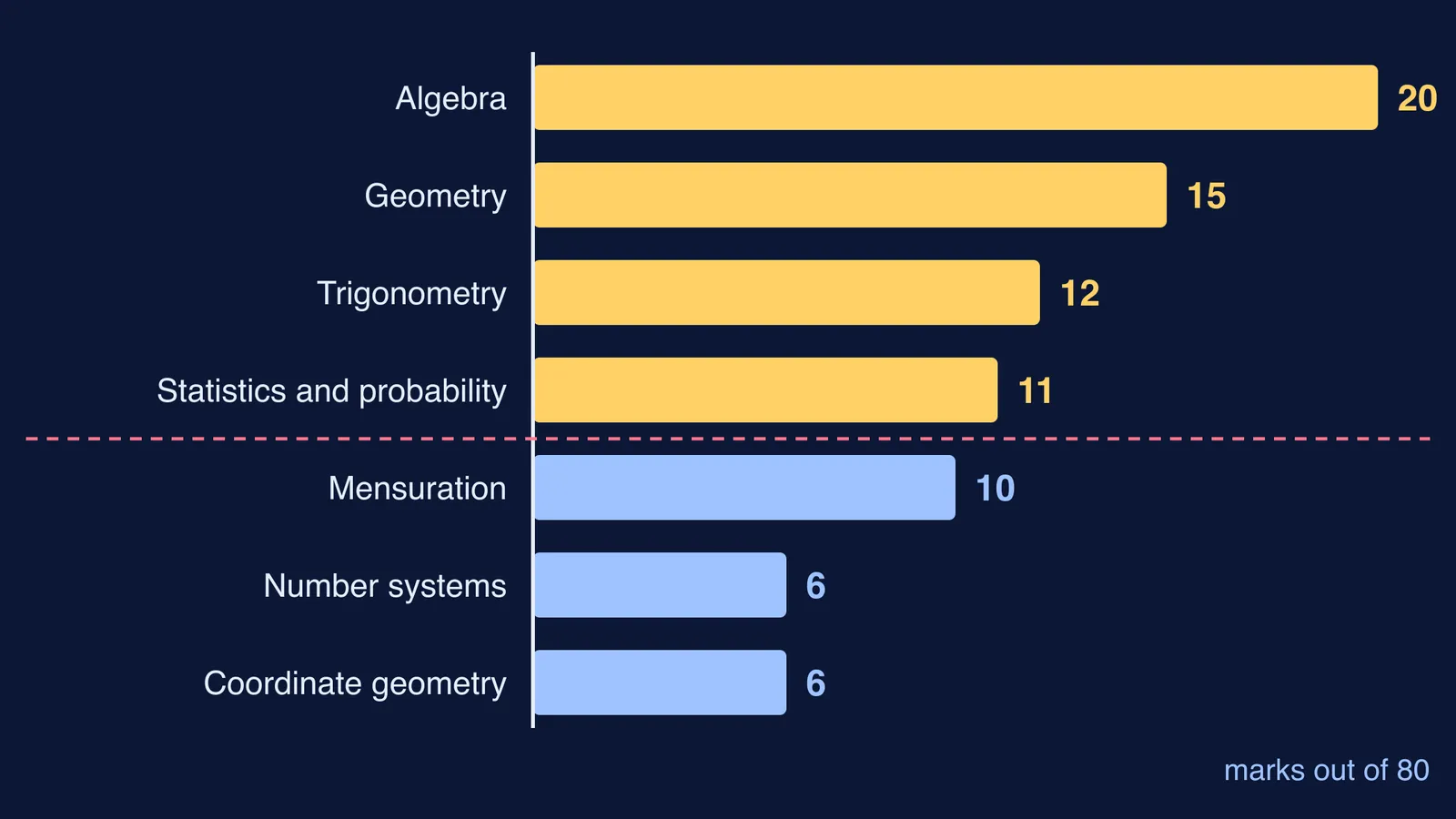
Open the official syllabus for each subject. CBSE's curriculum documents list the marks for every unit; the Class 10 Mathematics curriculum for 2026-27 is a good worked example. Its 80 theory marks split like this:
Algebra: 20 marks
Geometry: 15 marks
Trigonometry: 12 marks
Statistics and probability: 11 marks
Mensuration: 10 marks
Number systems: 6 marks
Coordinate geometry: 6 marks
The top four units carry 58 of the 80 marks, nearly three-quarters of the paper. Now give each unit a colour: green (can solve questions without notes), amber (shaky) or red (not started). Study in this order: high-mark reds, then high-mark ambers, then low-mark reds. Greens get practice questions only.
What does a 10-week board exam plan look like?
Start past papers in week one, not week nine; their first job is to show what you do not know. CBSE publishes sample question papers and marking schemes, and the marking scheme shows where each step earns marks. Our guide to using previous year papers well goes into detail.
Weeks 1-2, sort and test: make the marks sheet, attempt one past paper per main subject, mark it with the scheme, and begin the biggest red unit.
Weeks 3-6, build: each day, learn one red or amber unit, then close the book and answer questions on it from memory. Every Sunday, do a mixed set from all units covered so far.
Weeks 7-8, full papers: timed papers in each main subject, each followed by time spent fixing every mistake. Many schools hold pre-boards around now; treat the marks as information.
Weeks 9-10, sharpen: formula sheets, diagrams, derivations and a notebook of past mistakes. Regular sleep. No new big chapters in the last week.
When a red unit feels like a wall, the Fermi Concept Library gives each concept in physics, chemistry, biology and mathematics its own lesson. When a practice answer goes wrong and the marking scheme does not show why, the Fermi Problem Library has a step-by-step solver that explains the reasoning rather than printing an answer.
How should parents check in without causing panic?
Once a week, same time, about fifteen minutes, with your child holding the sheet. Daily questions feel like surveillance; one fixed conversation feels like support. A script:
"Show me the sheet. What turned green this week?"
"Which red unit is next, and which day will you do it?"
"What got in the way?" Then listen without fixing it straight away.
"What do you need from me?" A quiet room, skipping a family function, nothing at all.
"Good. Same time next Sunday."
Leave out comparisons with cousins, predictions about marks, and "you should have started in July". If family events are crowding the exam months, our board exam year calendar for parents helps you plan around them.
When is it more than exam nerves?
Some worry before boards is normal. If your child stops sleeping or eating normally, pulls away from everyone, or talks about feeling hopeless, that is beyond a study plan. Talk to the school counsellor or a doctor, or call Tele MANAS on 14416, the government's mental health helpline (Department of Empowerment of Persons with Disabilities helpline list). Our piece on when exam stress needs outside help lists the signs to watch for.
Tonight, make the marks sheet together. Week one starts tomorrow.