

On this page
If your child is in Class 10 this year, the board exam is not one event in February. It is a chain of deadlines, most set by the school or by CBSE, not by your child. Knowing the order helps you step in at the right moments and stay out of the way the rest of the time.
What happens in each month of the Class 10 board year?
The dates below come from CBSE circulars. Where a 2027 date is not announced, we give the 2026 pattern. When we checked CBSE's website on 26 October 2026, the 2027 Class 10 date sheet had not been released.
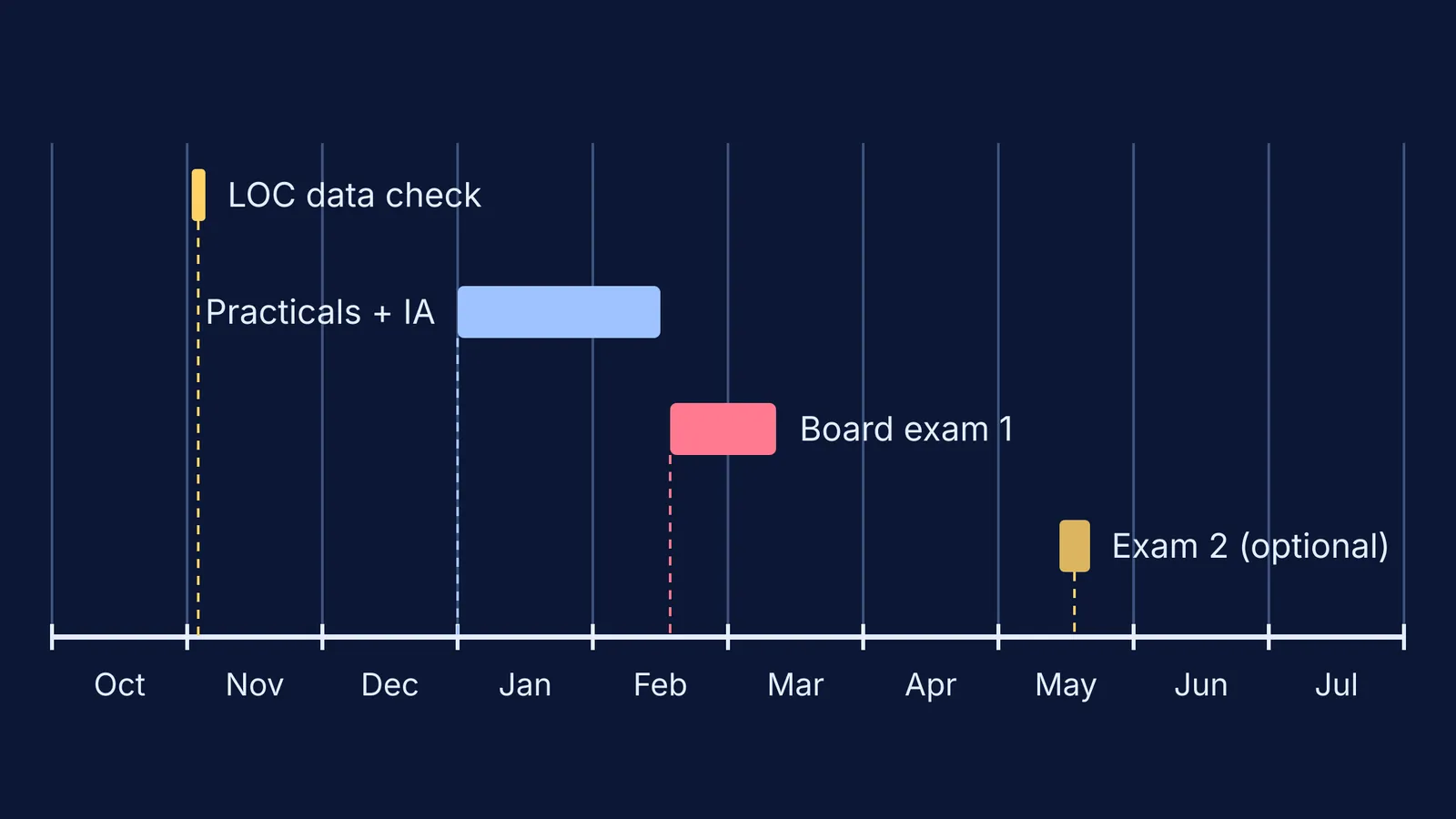
Late September to early November: registration. Schools submit the List of Candidates (LOC) for the 2027 exams. CBSE's LOC circular of 17 September 2026 set the submission window from 24 September to 21 October 2026, or to 30 October with a late fee. It says a wrong name, parent's name, date of birth or subject on a student's data verification slip can be corrected only from 2 to 4 November 2026. Your job: ask the school for the slip and check every letter, including Mathematics Standard (041) or Basic (241).
November and December: syllabus completion and revision. Your job: protect a regular bedtime and a fixed daily study slot rather than adding hours.
December and January: pre-boards. Pre-boards are school exams, not CBSE exams, so the dates come from your school's calendar. Treat them as a rehearsal: the marks matter less than the list of mistakes they produce.
January to mid-February: practicals and internal assessment. For 2026, CBSE's practical examination circular set a window from 1 January to 14 February for practicals, projects and internal assessment, with Class 10 internal assessment marks due by 14 February. Your job: make sure the practical file, project and lab record are complete before January starts.
Mid-February to mid-March: the main board exam. The 2026 Class 10 date sheet ran from 17 February (Mathematics) to 11 March, with Science on 25 February and Social Science on 7 March. Your job: logistics. Admit card, the route to the centre, a calm morning.
May: the optional second exam. In 2026 the second board exam date sheet ran from 15 to 21 May, starting with Mathematics.
How does the second board exam in May change the plan?
From 2026, Class 10 has two board exams a year. CBSE's clarification of 14 February 2026 sets out the rules that matter for planning:
The first exam is compulsory for every student.
Students who pass can try to improve their performance in up to three subjects out of Science, Mathematics, Social Science and languages.
A student who misses three or more subjects in the first exam cannot sit the second one and is placed in the "Essential Repeat" category, taking the main exam the following February.
The practical point: the May exam is a safety net, not a second plan. Prepare for February as if it were the only exam. We explain the scheme in more detail in how CBSE's two Class 10 board exams work.
Where can parents actually help?
Most of the board year runs on the school's clock, so a parent's part is small and specific. CBSE launched a Parenting Calendar for 2026–27 on 29 April 2026 to structure school–parent engagement; ask your school how it uses it. Then keep this checklist on the fridge:
Early November: check the data verification slip with your child (name, parents' names, date of birth, subject codes).
December: ask the school for the pre-board timetable and the practical schedule in writing.
After each pre-board: sit with the answer sheet once and sort the lost marks into three piles: did not know it, knew it but used the wrong method, careless slip.
Before January: practical file, project and lab record finished and signed.
February: admit card photocopied, the exam centre visited once in advance, no new topics the night before a paper.
The middle pile, "knew it but used the wrong method", is where patient practice pays off most. The Fermi Problem Library has worked problems with a step-by-step solver that explains the reasoning rather than printing an answer, so your child can see where a method went wrong.
What should parents avoid in the board year?
Comparisons with cousins, running commentary on the percentage and new classes squeezed into January add pressure when a teenager has the least room for it. We cover the day-to-day side in how to run a calm home in exam season.
If worry starts to affect your child's sleep, eating or daily life, talk to the school counsellor or a doctor; our guide to exam stress in teenagers and when to get help goes further. Tele MANAS, the government's free, round-the-clock mental health helpline, is on 14416 or 1800-891-4416.
Put these dates on the family calendar this week; the first one, the 2 to 4 November correction window, is only days away.


