
On this page
Around Class 10, many students take a career aptitude or interest test and get back a report ending in a list of careers. Here is what that report can honestly tell a 15-year-old, where it is weak, and how to use it at home.
What does a career aptitude test actually measure?
Most reports mix two things. An aptitude test measures how well you do on timed reasoning tasks today: numbers, words, shapes, patterns. An interest inventory asks what you enjoy and sorts your answers into types such as investigative, artistic or social.
In India, CBSE and NCERT developed Tamanna (Try And Measure Aptitude And Natural Abilities) for students of Classes IX and X, according to NCERT's Tamanna page. The same page is clear about its limits: the test shows students' strengths, there is no pass or fail, it should be taken voluntarily, and it "must not be used to impose any subject" on students. That is a good rule for any test, free or paid.
Are career aptitude tests reliable for Class 10 students?
Reliable means a test gives similar results when repeated. Useful means those results predict something that matters to you. A test can be the first without the second.
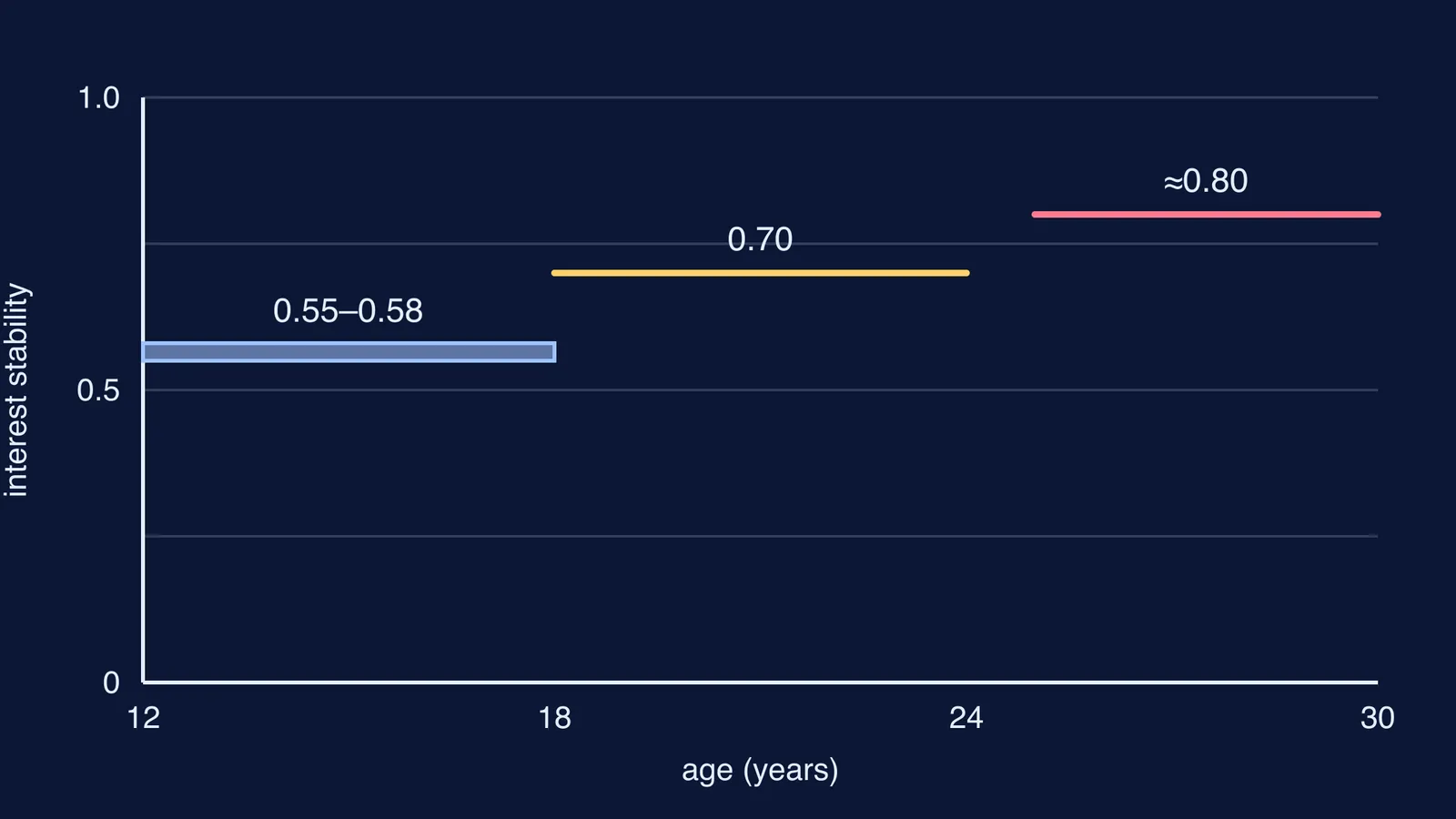
On reliability, the best evidence is about interests. A 2005 review of 66 longitudinal studies by Low, Yoon, Roberts and Rounds tracked how stable people's interests stay over time. As summarised in a 2025 Frontiers in Psychology paper, stability was 0.55 to 0.58 between ages 12 and 18, rose to about 0.70 in the college years and reached about 0.80 by ages 25 to 30. A coefficient of 0.55 means the broad pattern holds for many teenagers, but plenty of individual rankings shift over the next few years.
On usefulness, interests do matter. A meta-analysis of 60 studies by Nye, Su, Rounds and Drasgow found interests are related to performance and persistence at work and in study, and that the fit between a person's interests and their environment predicted more than interest scores alone.
Why does the report feel so accurate?
In a classroom demonstration published in 1949, psychologist Bertram Forer gave every student the same vague personality sketch, and they rated it as a highly accurate description of themselves. This is now called the Forer or Barnum effect. Before you trust a sentence in a report, ask whether it would fit your cousin too.
How do you read a career test report?
NCERT publishes a guide for teachers and parents on how to interpret Tamanna results; any report you get should explain its scores as clearly. Read it in this order:
Find what was measured: aptitude, interests or personality. They answer different questions.
Check who you were compared with. A percentile only means something if you know the group.
Treat close scores as a tie. A few points apart is not a real difference.
Separate the scores from the career list. The list is the company's suggestion layered on top.
Check each strength against real life: marks over two years, what you do when nobody is asking.
Note the date. A test taken during board-exam stress is a snapshot of a stressful week.
A worked example (an invented report): Riya scores in the 78th percentile for numerical reasoning, the 74th for verbal and the 40th for mechanical. Her top interests are investigative and artistic, and the report suggests architecture and data science. Read well, this says her number and word skills are both strengths and about level, and she likes figuring things out and making things. It does not say she should do architecture; it gives her two hunches to test.
How do you turn the report into a conversation?
Start with questions, not conclusions. A parent might say:
"Which part of this felt true, and which part felt wrong?"
"Is there anything here you'd like to try for a few weeks?"
"What would you want to know about this career before deciding?"
Then test one hunch for two weeks: talk to someone who does the job, look at what the Class 11 subjects involve, and spend a few evenings on the material. If the report points to science or maths, the Fermi Concept Library has a lesson for every concept in physics, chemistry, biology, mathematics and computing, so you can see whether the subject itself holds your interest.
Weigh the report alongside marks and enjoyment, as in our guide to choosing a stream by aptitude or Class 10 marks. Take it to school with our list of questions for the school career counsellor. And if the report clashes with what everyone expected, read what to do when a high scorer wants humanities.
If the decision is affecting sleep or mood, talk to a school counsellor or call Tele MANAS, the free 24x7 national mental-health helpline, on 14416.