

On this page
Every year, millions of Indian students choose their Class 11 stream based on a single number: their Class 10 board percentage. If a student scores 95% in Mathematics and Science, they are ushered into the science stream (PCM or PCB) by default.
But a high board score measures what a student *did*, not necessarily how they *think*. A 2023 Ministry of Education study on board exam trends found that nationally, 18.3% of students opt for the science stream. However, this masks massive regional pressure: in states like Andhra Pradesh, a staggering 75.6% of students choose science. When science is the default for anyone with good grades, the "marks trap" catches students who have the discipline for Class 10, but not the abstract aptitude for Class 11.
Why do Class 10 marks mislead?
Class 10 board exams reward discipline, steady effort, and a good memory. A student who meticulously solves every past paper and follows a timetable can score above 90% without deeply understanding the abstract principles behind the formulas.
Class 11 science is a different landscape. It demands cognitive aptitude: spatial reasoning (essential for organic chemistry and mechanics), logical deduction, and the ability to link unrelated concepts. Educational research such as Schibeci (1984) highlights that a student's aptitude and attitude (interest and motivation) are key drivers of their science achievement.
If a student's high Class 10 marks were built purely on rote learning and long hours, that scaffolding collapses under the weight of the Class 11 curriculum. This is the root cause of the infamous "Class 11 crash," where straight-A students suddenly find themselves failing physics mid-terms. Students navigating Class 10 boards with foundation coaching: when to slow down often encounter this wall early.
How do you choose a stream by aptitude?
You cannot measure aptitude by looking at a report card. You have to watch the student think when they encounter a problem they have never seen before.
Watch the struggle, not the success: When your child is stuck on a hard maths problem, do they try different approaches, or do they immediately look for the "formula" to plug numbers into? Abstract reasoning involves playing with the problem.
Observe their natural curiosity: Do they ask "why" things happen, or are they satisfied knowing "what" will be on the test? Science requires the former to sustain motivation over two grueling years.
Use psychometric testing: A standardized Differential Aptitude Test (DAT) measures numerical, mechanical, and spatial reasoning independently of a school syllabus. It reveals natural strengths that board exams ignore.
How does the Trial Summer experiment work?
The most effective way to test whether your child has the aptitude and the attitude for the science stream is a "trial summer". Over a three-week period after the board exams, have them study a notoriously difficult Class 11 topic—like Rotational Motion in Physics or Stoichiometry in Chemistry.
The goal is not to master the topic, but to observe *how* they handle the complexity leap. If you are looking for structured environments for this, you might ask, Is a science summer camp worth it? Questions to ask first.
Do they have the conceptual patience? If they hit a roadblock and get frustrated because their old memorisation tricks no longer work, their aptitude might be misaligned with the stream's demands.
Can they hold a line of reasoning? When they encounter a complex idea, the Fermi Concept Library can help them explore the concept deeply and see where it fits in the broader map of physics or chemistry.
How do they handle failure? When they try to solve an unfamiliar numerical problem, observe their process. Instead of checking the final answer, they can use the Fermi Problem Library to work through the solution step by step. Fermi's AI tutor explains the reasoning behind each step rather than just printing an answer, which helps reveal if the student grasps the underlying logic.
If the trial summer feels like a miserable chore, you have valuable data. It is far better to pivot to Commerce or Humanities in May than to face a crisis in November.
How do you balance marks, effort, and interest?
Marks are not useless; they prove a student can sit at a desk and work hard. That effort pattern is essential for any stream. But effort without interest leads to burnout, and effort without aptitude leads to a ceiling.
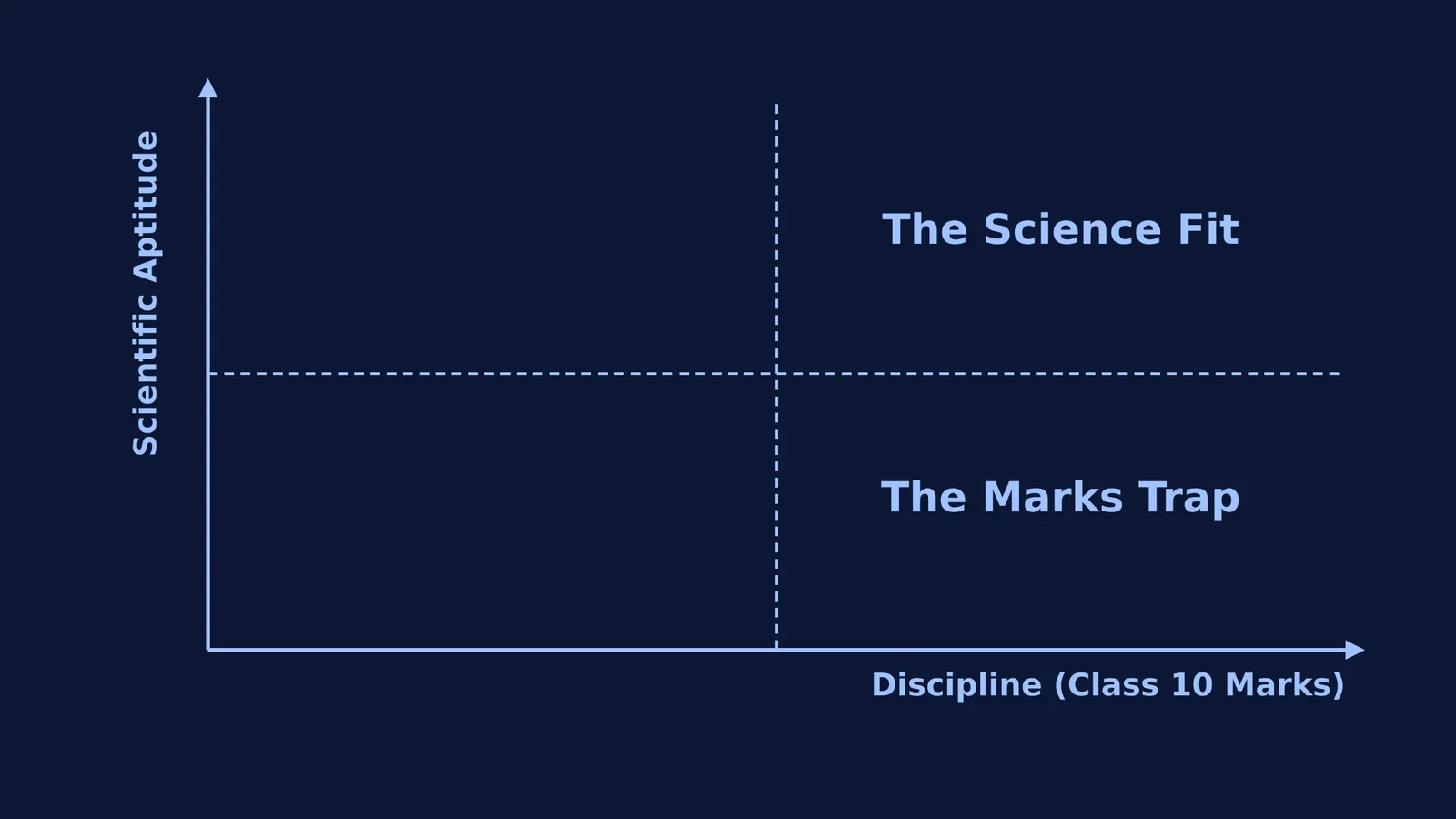
Before locking in a stream, map your child on two axes: their discipline (Class 10 marks) and their scientific aptitude (abstract problem-solving). The science stream requires both. If they only have the former, they might thrive much more—and be much happier—applying that incredible work ethic to economics, law, or design.


