

On this page
If you are in Class 10 and also attend a JEE or NEET foundation course, the two timetables collide hardest from November: coaching keeps moving ahead while the board exam pulls everything back to NCERT. Here is how to decide whether to keep, slow or pause coaching, and a three-month plan.
Why do foundation coaching and Class 10 boards clash?
Foundation courses often go beyond the Class 10 syllabus and train quick objective answers. Board papers give marks for written steps and labelled diagrams. You can do well in a coaching test and still lose board marks for skipped working.
Time is the other clash. The Ministry of Education's Guidelines for Regulation of Coaching Center (January 2024) say coaching should not be more than 5 hours a day, should not run during school hours, and should give students a weekly off. They also say centres should not enrol students below 16 years of age, or should enrol them only after the secondary school examination. The Ministry sent them to states to adopt through their own laws, so local rules may differ.
When should you pause or slow foundation coaching before boards?
CBSE's main Class 10 examination in 2026 ran from 17 February to 11 March, so three months out is roughly mid-November; check the official date sheet for your exam year. Our explainer on how CBSE's two Class 10 board exams work covers the second exam, but plan around the main one.
In early November, count these five signals:
Your last maths or science test is below your target mark.
An NCERT chapter hasn't had a full first pass, back exercises included.
Most of the next three months of coaching is outside the Class 10 syllabus.
You regularly sleep less than 8 hours; the American Academy of Sleep Medicine's consensus statement says teenagers aged 13 to 18 should sleep 8 to 10 hours per 24 hours.
Coaching homework is replacing school work.
Zero or one: keep coaching, but ask for Class 10 overlap topics first. Two or three: slow down, attending only classes on Class 10 chapters and skipping coaching tests. Four or five: pause until the main exam ends.
What does a three-month board plan look like?
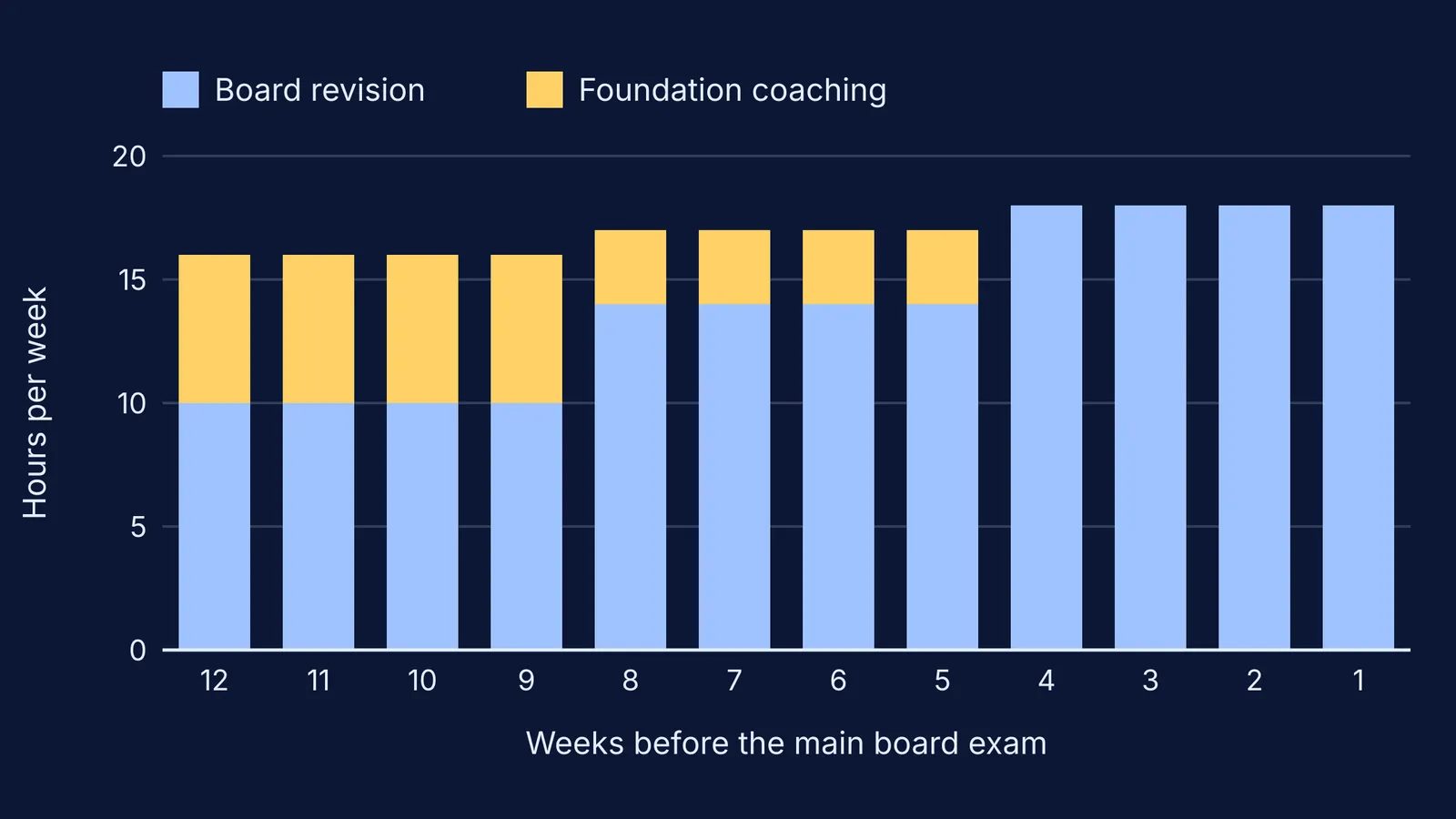
This worked example assumes coaching took about 9 hours a week, then cuts it to 6, 3 and 0 hours while board revision rises from 10 to 14 to 18, as the chart at the top shows.
Weeks 12 to 9 (mid-November to mid-December): 6 hours of coaching, 10 of board revision a week. Finish every NCERT chapter that hasn't had a first pass. Each evening, close the book and write one answer, derivation or diagram from memory, then check it. In a study by Roediger and Karpicke, students who took recall tests on a passage remembered more of it a week later than students who reread it, even though rereading made them feel more confident.
Weeks 8 to 5 (mid-December to mid-January): 3 hours of coaching, 14 of board revision. Do one timed paper a week from CBSE's Class 10 sample papers, mark it against the official marking scheme, and redo every question that lost marks. In a 2008 study of more than 1,350 people, Cepeda and colleagues found the best gap before a review shrank as a share of the time to the test, from about 20 to 40% for a test a week away to about 5 to 10% for one a year away. For a test two to three months away, our rough reading (not the study's finding) is to revisit each chapter every one to two weeks.
Weeks 4 to 1 (mid-January to the exam): coaching paused, 18 hours of board revision. Write two full papers a week in exam timing, reread your mistake list every few days, and keep bedtime fixed. Our six-week Class 10 science revision plan gives a chapter order for this block.
If a chapter still doesn't make sense, the Fermi Concept Library has a lesson for every concept in physics, chemistry, biology and mathematics. For numericals, the Fermi Problem Library has a step-by-step solver that explains the reasoning rather than printing an answer; compare its steps with your own working.
What should you say to the coaching centre?
A parent can send this: "Until the main board exam ends, our child will attend only Class 10 chapter classes and skip weekly tests. Please share notes for missed classes and your catch-up plan."
A student can tell their parents: "I'm not giving up on JEE. I want to finish the boards well and go back to coaching with nothing hanging over me."
When is it more than exam pressure?
Some nerves before boards are normal. If sleep or eating changes, your child pulls away from friends, or talks about feeling hopeless, speak to a doctor or school counsellor. Tele MANAS, the Health Ministry's 24x7 toll-free mental health helpline, is on 14416, and our guide to exam stress and when to get help covers everyday support at home.
This week, write the five signals on a sheet, count them as a family, and choose keep, slow or pause before mid-November.


