

On this page
Most families meet the school career counsellor once, in a rush, after Class 10 results. By then the biggest choice, the stream for Class 11, is nearly made. A better plan is three or four short meetings, starting in Class 9.
When should you first meet the school career counsellor?
Book the first meeting in Class 9, when there is time to explore without a deadline. CBSE's Circular 02/2026, dated 19 January 2026, requires every affiliated school to appoint one career counsellor for up to every 500 students in Classes IX to XII. In a CBSE school, that support is meant to start in Class 9.
The OECD's 2025 report The State of Global Teenage Career Preparation, built on PISA 2022 data, found that 39% of 15-year-olds across OECD countries were unsure of their career plans. It cites an OECD review in which 15 of 19 studies linked teenage career uncertainty with poorer employment outcomes later, and it argues that guidance should begin early in school life, not only at the end. India is not in this data, but the pattern is a useful warning.
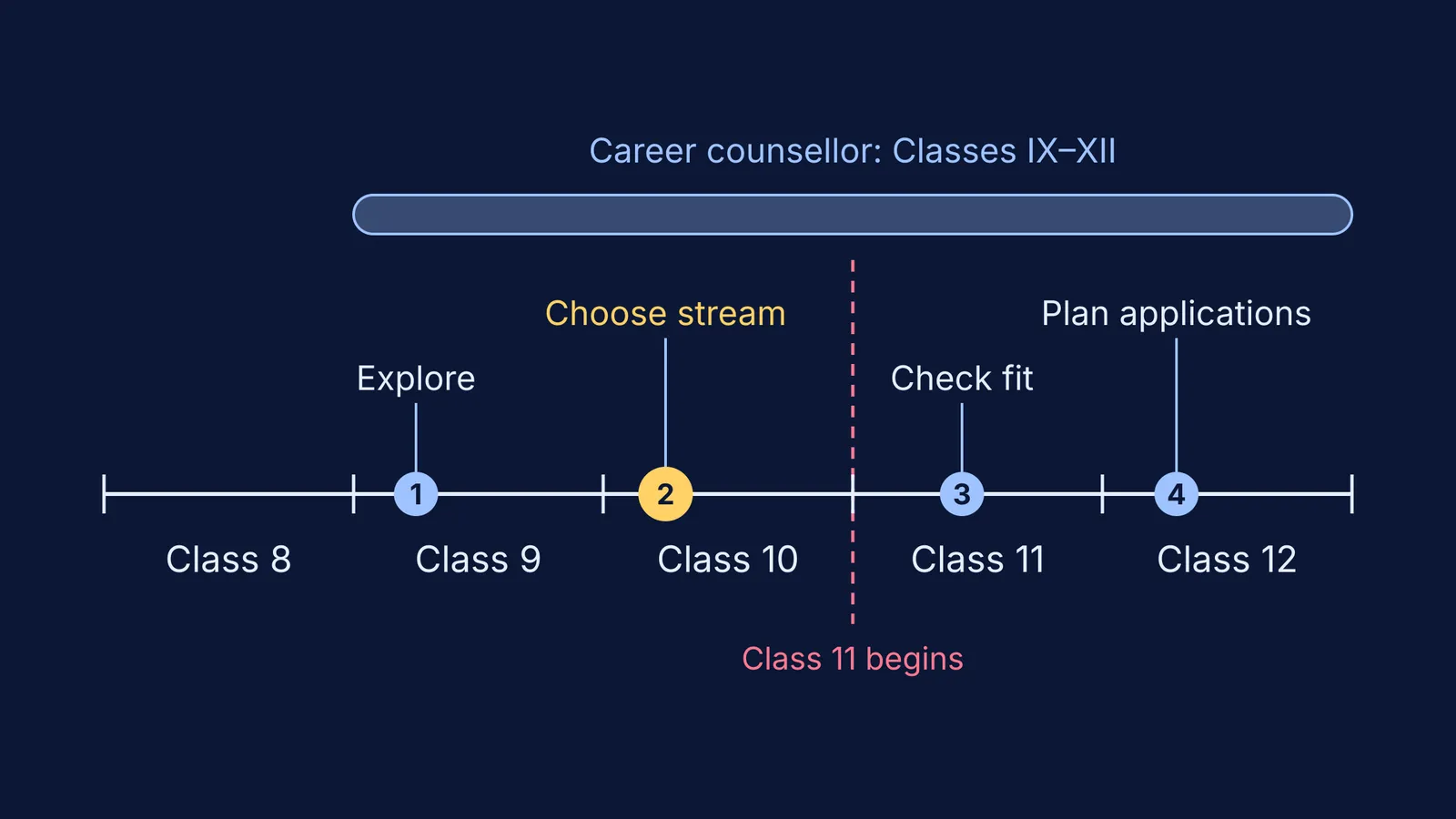
A simple four-meeting plan:
Class 9, any term: explore. Interests, strengths, the subjects your child enjoys, careers they have never heard of.
Class 10, first term: choose the stream. This is the meeting that matters most. Go before pre-boards, while there is still time to talk it over at home.
Class 11, first term: check the fit. Is the stream working? Is a change still possible at your school?
Class 12, start of the year: plan applications. Entrance exams, colleges, deadlines and a back-up route.
If your child is already in Class 11 or 12, start now. One late meeting is better than none.
What should you prepare before the meeting?
Counsellors see many students, so a prepared family gets far more from a short slot. Bring:
Marks for the last two years, subject by subject, and any recent test that went unusually well or badly.
A list your child writes alone: three subjects they enjoy, one they dislike, and why.
Two or three careers they are curious about, even vague ones ("something with animals").
What the family can manage: budget, whether moving to another city is possible, coaching or not.
Any aptitude or interest test results from school.
Let your child lead. The circular lists student and parent career counselling among the counsellor's skills, but the student is the one who has to live with the choice. If you and your child already disagree, read our piece on when a parent's dream career differs from the child's interest before you go in.
What questions should you ask the career counsellor?
The CBSE circular says a career counsellor should be able to interpret career assessments and know about higher education in India and abroad. Ask:
"From these marks and interests, which streams keep the most options open?"
"Which subject choices at this school would close off a course later?"
"What do students with a profile like this usually find hard in Class 11?"
"What does this aptitude test result tell us, and what does it not tell us?"
"Which entrance exams and courses should we read about, and where are their official pages?"
"If the stream does not suit, how, and until when, can it be changed here?"
A short opening line for the student: "I like maths and I'm curious about design, but I don't know which jobs mix the two. Can we look at what I'd need to study for each?"
How do you use the advice alongside your own research?
Treat the meeting as a starting list, not a verdict. In the week after it:
Check every exam or course name on its official website, since rules and dates change each year.
Talk to one or two people who do the job. Our guide to career exploration activities in Class 9 has ideas.
Try the subjects, not just the job titles. A student weighing physics against biology can spend a few evenings with Class 11 topics in each, for example in the Fermi Concept Library, which has its own lesson for every concept in physics, chemistry, biology and mathematics.
Sit down together and decide, using a method such as the one in how to choose between PCM and PCB together.
Many students already do part of this. The OECD report found that by age 15, 76% of students had used the internet to explore careers, while 55% had spoken with a career adviser. The internet gives breadth; the counsellor knows your school and your child. Use both.
If career worry turns into constant stress, poor sleep or panic, talk to the school's counselling and wellness teacher, or call Tele MANAS on 14416, the government's free mental health helpline, open 24 hours a day.
Book the Class 9 meeting this term, and put the Class 10 one on the calendar now.


