

On this page
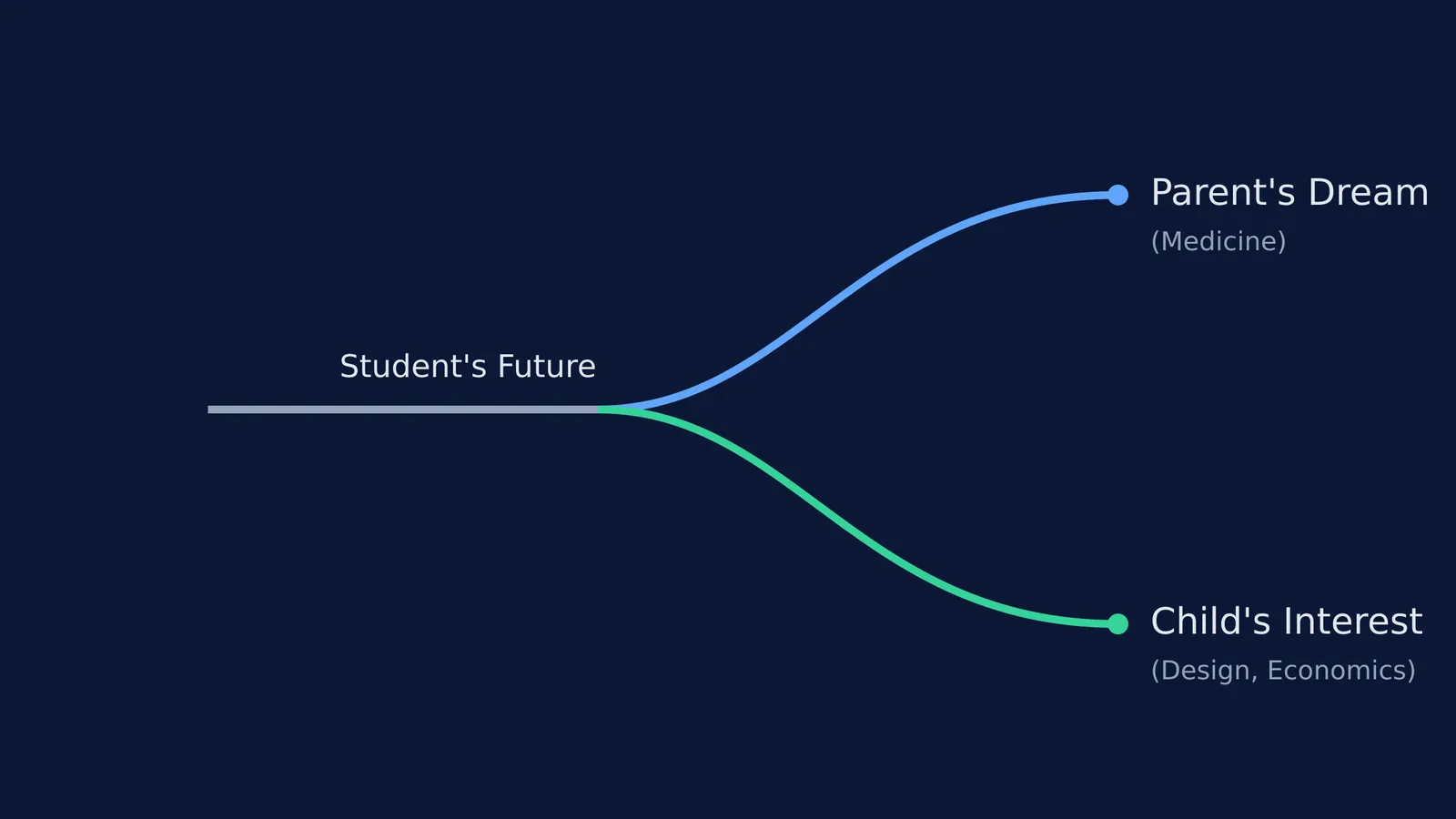
For many parents, seeing their child in a white coat is the ultimate dream. It represents financial stability, societal respect, and a lifetime of meaningful work that helps others. Many families view becoming a doctor as a guaranteed path to a secure future, especially in a highly competitive job market. But what happens when your child clearly states they want to pursue design, economics, or pure mathematics instead?
When a parent's dream career clashes with a child's actual interests, the resulting pressure can cause deep friction within the household. The teenager may feel unheard or undervalued, while the parents may feel their life experience and well-intentioned guidance are being dismissed. Rather than forcing a predetermined path, having an honest, open conversation about their future is the safest way to ensure they thrive emotionally and academically.
Why do parents push for medicine?
The competition for medical seats in India highlights how strongly families value the profession. In 2024, the National Testing Agency (NTA) reported that over 2.4 million candidates registered for the NEET-UG exam, vying for approximately 1.37 lakh MBBS seats. The 5.7% selection rate is not just a measure of student ambition; it reflects intense parental aspiration and societal conditioning.
Families often view medicine as a foolproof safety net. It is a known quantity in a rapidly changing world. However, pushing a teenager into a demanding career purely for security ignores their inherent strengths and the reality of the profession. The psychological toll of this mismatch is severe. The National Crime Records Bureau (NCRB) recorded 13,044 student suicides in its 2022 report, with "family problems" and "failure in examination" cited among the leading causes. High expectations frequently transform into unbearable academic pressure, leaving children feeling trapped between their own identity and their parents' approval.
What happens when a child studies for their parents?
When students enter a rigorous curriculum to fulfill someone else's dream, their motivation rarely lasts. Medicine is an inherently demanding path that requires immense intrinsic drive. Without a genuine passion for patient care or human biology, the exhaustion of continuous reading, lack of sleep, and the harsh reality of the clinical journey quickly outweigh the initial desire for social respect or financial stability.
Many students find themselves overwhelmed by the sheer volume of the syllabus, leading to academic stagnation. Over time, this emotional friction manifests as severe burnout and career regret, often leaving them feeling stuck in a profession they never truly wanted. This shows why understanding high expectations vs pressure is an important distinction for families. Expectations become pressure when they ignore the child's reality and personal aptitude.
How to have an honest conversation about careers?
If your child is resisting the medical path, avoid treating it as a passing phase, youthful rebellion, or a lack of ambition. A teenager who does not want to be a doctor is not necessarily rejecting hard work; they are simply trying to find work that fits their unique cognitive style and passions. Try these active steps to genuinely understand their perspective:
Separate your fears from their aptitude. Ask yourself if your push for medicine is rooted in your own anxiety about their financial future. Recognizing your own worries can help you approach the conversation with empathy rather than authority.
Explore the alternatives together. If they are interested in technology, data science, or allied health fields, spend time researching those sectors. There are countless paths to success, so try talking about STEM careers beyond engineering and medicine.
Ask the right questions. Instead of asking "What job do you want?", which can be overwhelming for a sixteen-year-old, ask "What problems do you enjoy solving?" and "Which subjects make you lose track of time?"
Listen without interrupting. When they explain their interests, resist the urge to immediately point out the flaws or lack of job security in their chosen field. Validate their curiosity first.
Can an AI tutor help explore interests?
Sometimes, a child pushes back against a subject simply because of how it is taught. Rote learning and constant testing can kill a natural curiosity for biology or chemistry, making them reject the entire field of science.
If your child is struggling to find their academic footing, letting them explore without the pressure of an entrance exam can be transformative. The Fermi Problem Library provides worked problems with a step-by-step solver that explains the reasoning, allowing students to build confidence. Rather than memorising formulas, they might discover a hidden talent for problem-solving while interacting with the Fermi Simulation Lab for ideas that are easier to see than to read. Giving them the space to learn actively is the best way to uncover what they truly want to do, and perhaps, what career they are meant to pursue.


