

On this page
If your child has a part in the annual day dance, play or choir, rehearsals can take over whole periods for weeks, often just as half-yearlies or pre-boards come close. Missed lessons turn into a backlog that shows up in the exam hall. The answer is usually not to pull out. It is to know exactly what was missed, make it up in small tested pieces, and keep sleep protected.
Is annual day practice worth missing classes before exams?
Often, yes, as long as the backlog stays visible. In a study in Developmental Psychology, Jennifer Fredricks and Jacquelynne Eccles found that 11th graders who took part in school clubs and organised sports showed better academic and psychological adjustment, even after accounting for which students choose to join (Fredricks and Eccles, 2006). The study followed American teenagers and shows a link, not proof that activities raise marks.
So the useful question is not practice or studies. It is how much is being missed, and how close the exam is:
A few periods missed and the exam still some weeks away: keep going and follow the catch-up plan below.
The same core subject missed again and again, or pre-boards close in a board class: ask whether rehearsals can move away from that subject's periods.
Behind in several subjects and sleeping less: talk to the class teacher about fewer rehearsals or a smaller role.
How do you make up lessons missed for annual day practice?
Use three steps, every rehearsal day:
Keep a missed-lesson log. One line per missed period: date, subject, topic, homework set.
Fill each line the same day. Borrow a classmate's notes or photos of the board, and ask the subject teacher which pages were covered.
End every catch-up block with recall. Read the topic, shut the book, then write down what you remember or solve two questions without looking.
That last step matters most. In a study in Psychological Science, students who took recall tests on a passage remembered substantially more a week later than students who restudied it the same number of times (Roediger and Karpicke, 2006). Restudying also made students more confident, even though they remembered less.
If the notes are hard to follow, our guide to using AI to explain a friend's missed class notes shows how to turn them into questions. And if a topic still makes no sense, the Fermi Concept Library has a lesson for every concept in physics, chemistry, biology and mathematics, so one gap does not block the rest of the chapter.
What does a rehearsal-week study plan look like?
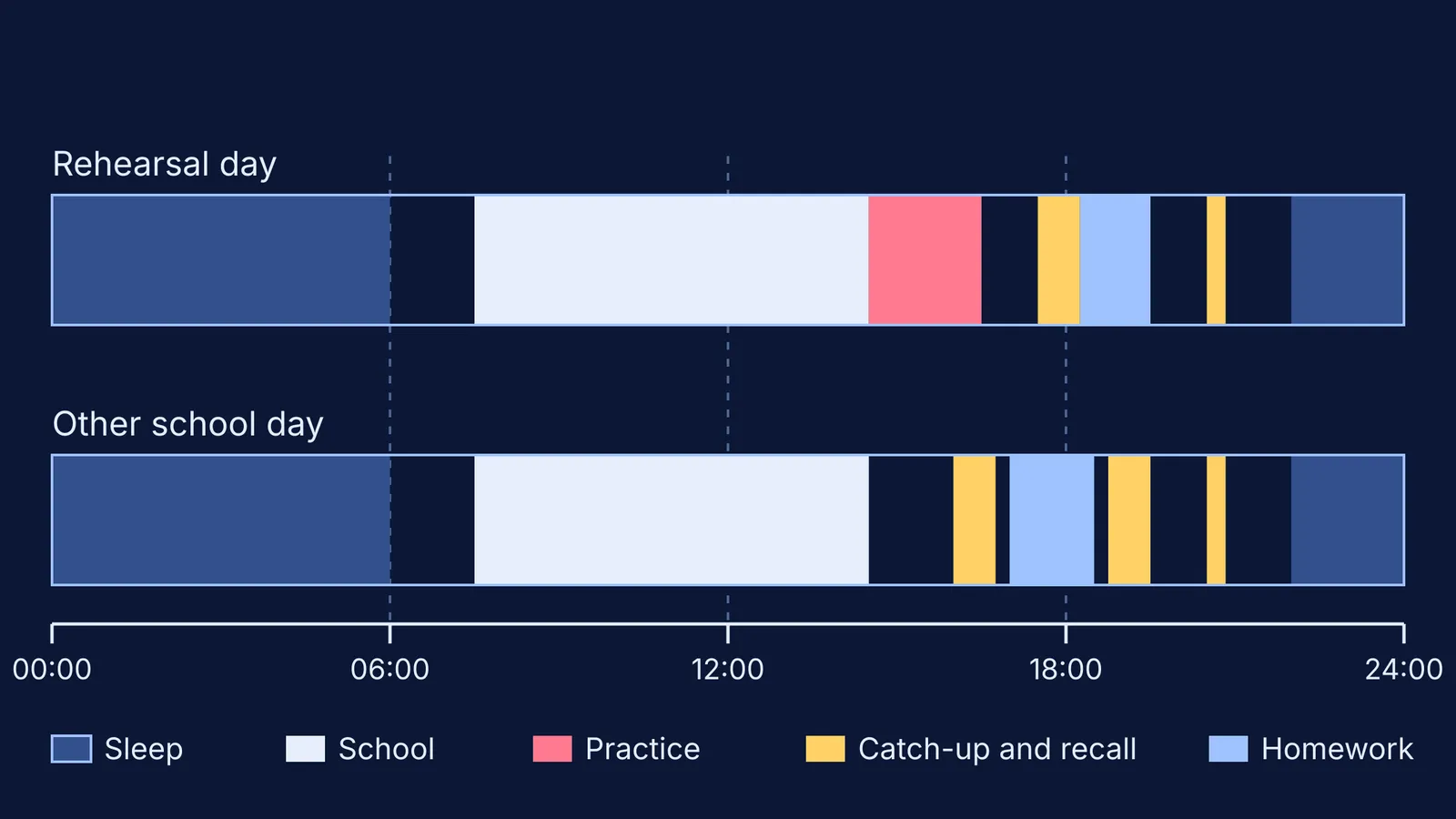
Take a Class 10 student with rehearsals after school on three weekdays and half-yearly exams about three weeks away. A rehearsal day could run like this:
2:30 to 4:30 pm: rehearsal.
4:30 to 5:30 pm: home, snack, rest. No books.
5:30 to 6:15 pm: one catch-up block from the log, ending with recall.
6:15 to 7:30 pm: the day's homework.
8:30 to 8:50 pm: a short self-quiz on yesterday's catch-up topic.
10 pm: lights out, for eight hours before a 6 am alarm.
On days without rehearsal, add a second catch-up block. On Sunday, clear what is left in the log and plan the week. Teenagers aged 13 to 18 should sleep 8 to 10 hours a day, according to a consensus statement from the American Academy of Sleep Medicine (Paruthi et al., 2016). The same statement links enough sleep with better attention, learning and memory, which is why the late-night cram is the first thing to cut.
If your child stares at a long log and doesn't know where to begin, Fermi's AI tutor can work out what they already know and build a plan for the session. For a student-facing version of this routine, see how to keep studying through annual day and sports week.
What can parents say to the teacher?
A short, specific message works better than a complaint. You could send:
"Hello Ma'am, [Name] has missed several maths and science periods for annual day rehearsals. Could you share which topics were covered and any classwork to complete? If a test falls during rehearsal weeks, could we know the date early so we can plan around it?"
It also helps to ask for the full rehearsal schedule up front, so you can see which subjects will be hit hardest.
When should your child step back?
Watch for three signs: sleep regularly cut short, a log that grows every week however hard they work, or a child who is tearful or dreads school. Start with a calm conversation, then the class teacher; a smaller role is a fair outcome, not a failure. The same log works if coaching classes are also being missed, as in our guide to helping your child catch up after missing a week of coaching.
If worry or low mood keeps going, speak to the school counsellor or a doctor. The government's Tele MANAS helpline, 14416, offers toll-free mental health support 24/7 (Press Information Bureau).
Start tonight: one notebook page titled "Missed lessons", one line per period, and one catch-up block tomorrow.


