

On this page
When illness forces you to miss class, the standard fix is simple: ask a classmate for photos of their notes. But sitting with someone else's handwritten pages is rarely reassuring. Formulas appear without context, arrows point to undefined abbreviations, and essential steps seem to vanish between lines.
Pasting those photos or scribbles into an AI chatbot with a generic prompt like "explain these notes" usually backfires. While the chatbot generates a fluent essay, passive reading creates an illusion of competence that breaks down under exam pressure. Learning missed material requires reconstructing the teacher's unspoken reasoning. AI can help you do that—if you treat it as a targeted bridge between lines rather than a summariser, and anchor every step in your textbook.
Why are a friend's class notes so hard to understand?
A student's notebook is an external memory aid tailored to the writer, not a textbook. During class, students record conclusions while skipping explanations they find intuitive.
In a review on the cognitive psychology of note-taking, researcher Kenneth A. Kiewra found that students typically record only about one-third of critical lecture ideas in their notes [[1]](https://doi.org/10.1007/bf01326640). Roughly two-thirds of the teacher's spoken explanations, conditions, and intermediate calculations never reach the paper.
When you borrow those notes, you are reading an incomplete outline. Copying those lines into your own notebook without the missing arguments only preserves the writer's gaps and misunderstandings.
Why does asking AI for a summary backfire?
Feeding a full page of raw notes into an AI produces two significant learning problems.
First, language models generate fluent prose by predicting likely text. When presented with gaps in reasoning, an AI fills them by guessing. In STEM subjects, it often invents a plausible-sounding derivation that is valid in general but inconsistent with your syllabus or the assumptions made in class. Our guide on why AI makes maths mistakes examines how chatbots stumble when boundary conditions are omitted.
Second, passive reading prevents genuine comprehension. A 2025 field experiment in the *Proceedings of the National Academy of Sciences* (PNAS) examined high school students using AI tools [[2]](https://doi.org/10.1073/pnas.2422633122). Students with unrestricted access to standard chatbots that provided full solutions scored 17% lower on subsequent unassisted exams than peers who studied without AI. The researchers found students used direct answers as a cognitive crutch. By contrast, students whose AI tutor provided guided hints largely preserved their learning gains. You can explore this distinction in our review of tutoring research on hints versus direct answers.
How do you prompt AI to bridge missing reasoning?
Instead of asking AI to explain an entire page, use it surgically to bridge specific gaps between two consecutive steps.
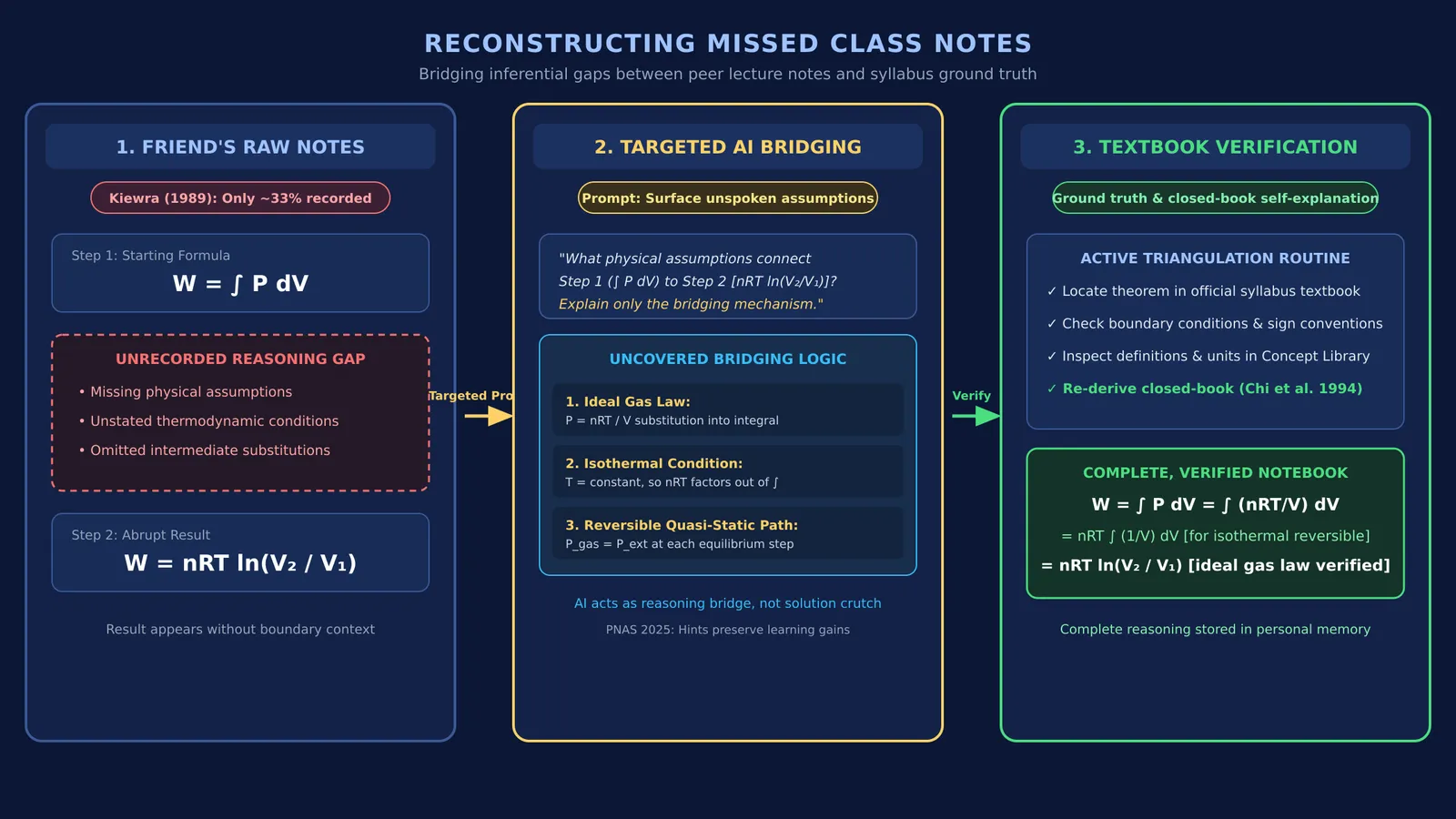
Consider an example from thermodynamics notes: Line A: W = ∫ P dV Line B: W = nRT ln(V₂/V₁)
Between Line A and Line B, three crucial ideas were spoken by the teacher but omitted from the page:
The gas is ideal, allowing the substitution P = nRT/V.
The expansion is isothermal, meaning temperature T is constant and factors out of the integral.
The process is reversible, keeping internal and external pressure equal throughout.
To uncover those hidden steps, paste the specific lines into the AI with a focused prompt:
"Here are two consecutive steps from my class notes on gas expansion: Step 1: W = ∫ P dV Step 2: W = nRT ln(V₂/V₁) What physical assumptions, definitions, or substitutions connect Step 1 to Step 2? Explain only the bridging mechanism."
This prompts the AI to surface the unstated premises. When you encounter conceptual leaps you cannot resolve alone, Fermi's AI tutor teaches rather than answers: it holds a line of reasoning across a session, notices where you are stuck, and decides whether to explain, ask, or show.
How do you verify the AI's explanation against your textbook?
An AI explanation is a hypothesis, not verified truth. Before accepting the connection, cross-check it against your official textbook, such as NCERT.
Follow this four-step active triangulation routine:
Locate the theorem. Find the section in your textbook corresponding to the AI's explanation (such as isothermal work). Confirm that your syllabus covers this formulation and uses the same sign conventions.
Check boundary conditions. Did the AI assume ideal gas behavior or constant temperature? Check whether your textbook specifies conditions where the formula fails.
Inspect the definitions. If the derivation introduces unfamiliar symbols, look them up in the Fermi Concept Library, which covers every concept in physics, chemistry, biology, mathematics and computing, each with its own lesson and its place in the map.
Re-derive with the book closed. Research by cognitive scientist Michelene T. H. Chi and colleagues demonstrated that students prompted to self-explain text line-by-line build significantly deeper conceptual understanding than those who simply reread material [[3]](https://doi.org/10.1207/s15516709cog1803_3). Close both the AI tool and your textbook, and write the derivation from scratch in your own words.
Taking time to check your understanding after an AI explanation turns borrowed notes into an active learning session rather than a passive copying chore.


