

On this page
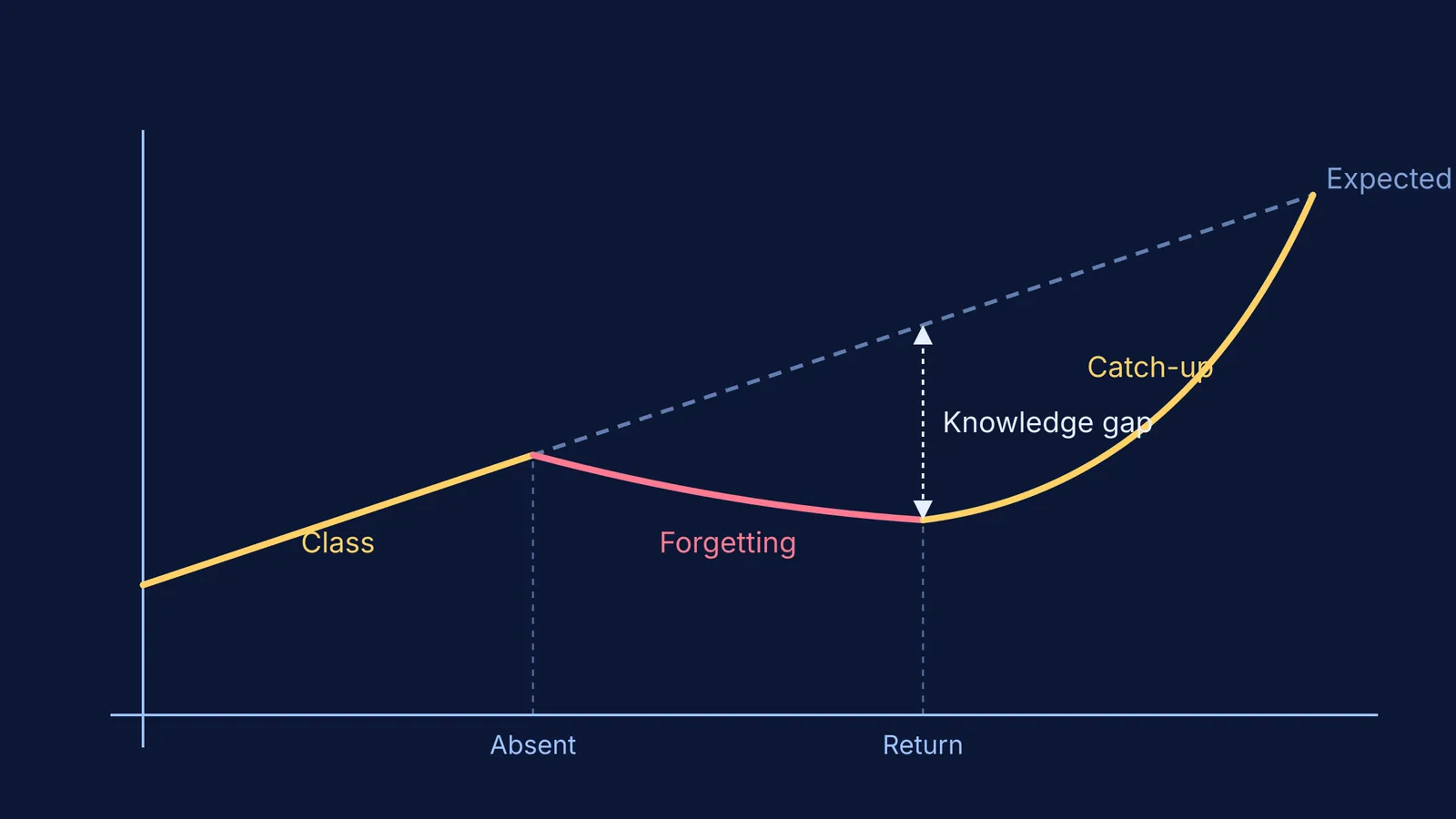
When a student misses a week of coaching due to illness or a family emergency, the hardest part is not the five days of lost time. It is the knowledge gap that makes the *following* week incomprehensible.
In subjects like physics and mathematics, concepts build sequentially. If your child misses the introduction to rotational mechanics on Tuesday, they will not understand torque on Friday. Without a clear plan, students often panic, try to do two weeks of work in three days, and end up exhausted and further behind.
Here is a practical, step-by-step recovery plan to help your child get back on track.
What is the real cost of a missed week?
The impact of absenteeism is measurable and disproportionately affects sequential subjects. Eighth-graders who miss three or more days of school in a month score between 0.3 and 0.6 standard deviations lower on standardised mathematics tests than those with perfect attendance.
This drop happens because missing the foundational steps of a new chapter prevents a student from understanding subsequent lessons. The goal of the first few days back is not to finish every missed worksheet, but to rebuild that foundation so current classes make sense again.
Day 1: How should we prioritise the missed work?
Before opening a textbook, triage the backlog. Help your child apply the 80/20 rule: identify the 20% of the missed material that is absolutely required to understand this week's classes.
Get the syllabus and notes: Ask a reliable peer for a list of topics covered and borrow their notes.
Identify the blockers: Which missed concepts are prerequisites for today's lecture?
Bridge the immediate gap: Focus solely on those blocker concepts first.
If they need to quickly grasp a missed idea before class, the Fermi Concept Library contains focused lessons on every topic in physics, chemistry, biology and mathematics to help them catch up.
Days 2 to 4: How can they learn the missed material efficiently?
Once they can follow current lectures again, they can start clearing the backlog. The most common mistake here is passively rewatching hours of recorded lectures. To close the gap, they need active recall.
Use recorded lectures actively: Watch missed recordings at 1.25x or 1.5x speed. Pause every 15 minutes and have them write down what they just learned without looking at the screen. This forces the brain to retrieve information, which builds stronger neural pathways than simply listening to a teacher speak.
Do a representative sample of problems: Instead of solving all 50 missed physics problems, have them do every third problem. This covers the breadth of the topic without taking three times as long. If they miss a concept while jumping between problems, they can review their peer's notes to see if a specific formula was applied differently in class.
When working through these selected problems at home without a teacher, they can use the Fermi Problem Library; it provides a step-by-step solver that explains the reasoning rather than printing an answer. If you are exploring digital help, reading a 20-minute parent's guide to trying an AI tutor can show you how to set up an effective session that prioritises learning over shortcut answers.
Why should we avoid the weekend all-nighter?
When facing a mountain of catch-up work, teenagers often sacrifice sleep to squeeze in an extra chapter. This actively damages their ability to learn.
Sleep is when the brain consolidates short-term learning into long-term memory. A study by Walker and Stickgold found that a night of sleep improved performance on a newly learned task by 20% the next day, while equal time spent awake provided no significant benefit.
Instead of an all-nighter, help your child time-block an extra 45 to 60 minutes each evening dedicated exclusively to catch-up work. Keep their bedtime strictly protected. This is particularly important for managing exam stress in teenagers, as exhaustion only amplifies anxiety and makes the remaining catch-up work take twice as long.
A script for parents: What should you say?
Anxiety is the biggest barrier to catching up. If your child feels overwhelmed, their instinct may be to avoid the work entirely. You can help by changing the narrative, especially if they are already studying away from home where you cannot monitor their daily routine as closely.
Instead of: *"You have so much to do, you need to study all evening to clear this backlog."*
Say: *"It makes sense that you feel behind; anyone would after missing a week. Let's just pick the two most important things to do today. The rest can wait until tomorrow."*
Focusing on small, daily progress removes the pressure of the entire backlog. It shifts their perspective from a seemingly impossible mountain of missed assignments to a very achievable next step, allowing them to catch up smoothly and sustainably.


