
On this page
If a chatbot has ever shown you "Thinking..." for a few seconds before it replied, you have probably used a reasoning model. These models write out a working before they answer, much like you show steps in a board exam. That makes them stronger at maths and physics, but not always right.
What is a reasoning model in AI?
A reasoning model is a large language model trained to produce a chain of intermediate steps before it commits to a final answer. For the basics of how language models predict text, see our explainer on how large language models work.
The idea has a name: chain of thought, which researchers defined in 2022 as "a series of intermediate reasoning steps" (Wei et al., arXiv). In that paper, people prompted the model with worked examples to get the steps. A reasoning model is trained to write them on its own.
How does a reasoning model work through steps?
A detailed public description comes from DeepSeek, whose R1 model was published in Nature in September 2025 (Guo et al., Nature). The full paper (arXiv) explains three things:
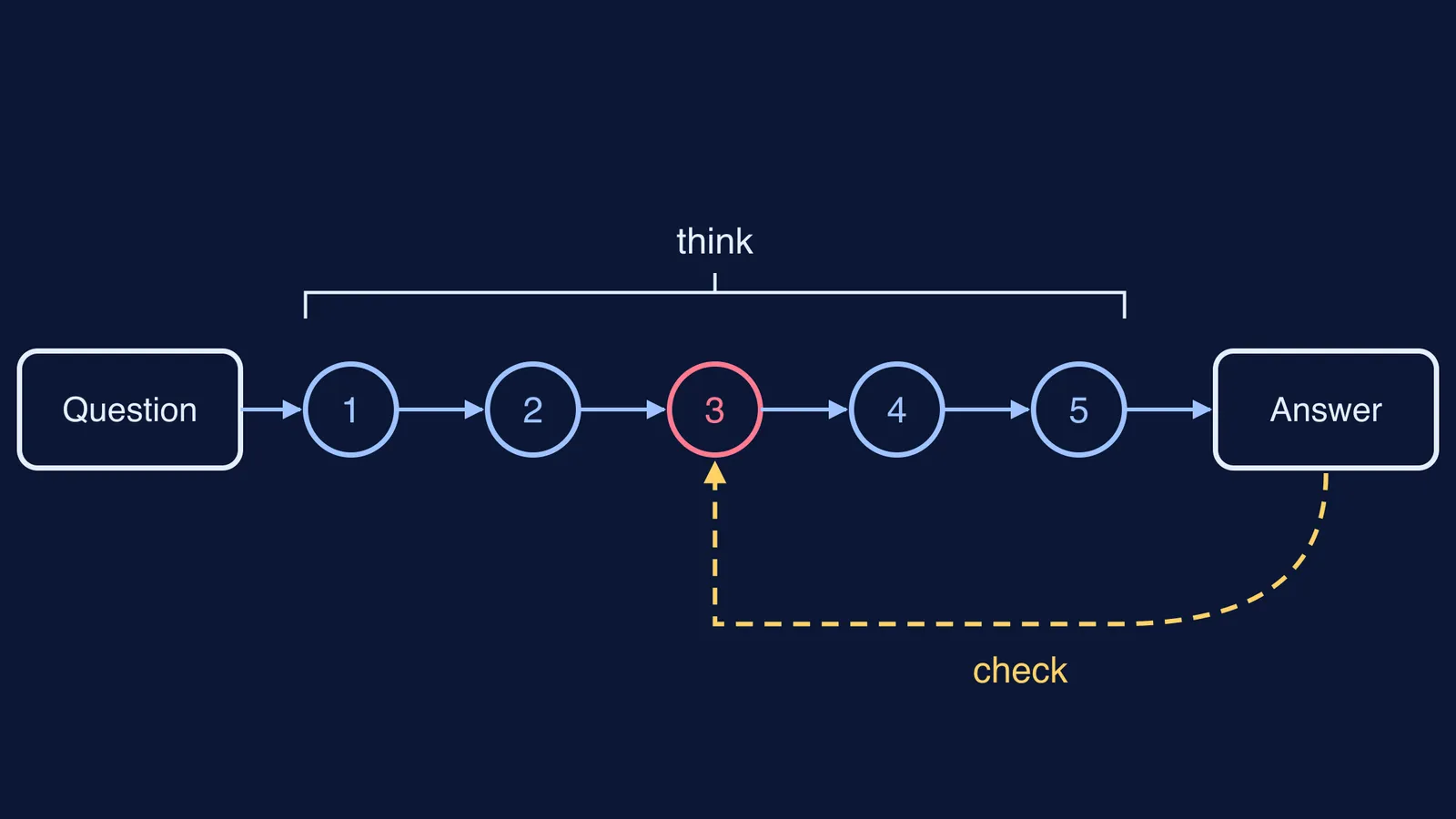
The model writes its reasoning inside a "think" section, then its final answer inside a separate "answer" section.
For maths, it gets a reward of 1 if the final boxed answer matches the reference answer and 0 if it does not.
Over training, it spent longer thinking, producing hundreds to thousands of tokens, and began writing "wait" and re-checking its own work.
Notice what is marked: only the final answer. The model learns to write steps because they help it reach answers that score, not because anyone confirmed each step is correct.
What do benchmarks show on maths and physics?
The maths results are strong. In the DeepSeek paper, training lifted the AIME 2024 average of an early version, DeepSeek-R1-Zero, from 15.6% to 77.9%, and the finished DeepSeek-R1 scored 79.8% on AIME 2024 and 97.3% on the MATH-500 test (arXiv).
Physics and science are harder. GPQA is a set of 448 graduate-level biology, physics and chemistry questions on which experts with or working towards PhDs scored 65% and the best GPT-4 setup scored 39% (Rein et al., arXiv). DeepSeek-R1 scored 71.5% on GPQA Diamond, a stricter subset of those questions (arXiv), so the numbers are not strictly comparable.
On PHYBench, 500 original physics problems from high school up to olympiad level, the best model tested, Gemini 2.5 Pro, scored 36.9% against 61.9% for human experts (Qiu et al., arXiv).
For Indian students, JEEBench is worth knowing. Built from 515 JEE Advanced problems in maths, physics and chemistry, it found the best model, GPT-4, scored under 40% in 2023, with errors in algebra, in turning concepts into equations, and in recalling the right concept (Arora et al., arXiv). Watch for those three errors in any AI working. Our guide to what AI benchmark scores mean for students explains how to read numbers like these.
Why do reasoning model answers still need checking?
The visible steps may not be the real reason. When researchers slipped hints into questions, the rate at which models' chains of thought admitted using the hint was often below 20% (Chen et al., arXiv).
Harder problems can break them. A 2025 study found reasoning models' accuracy collapses completely on puzzles beyond a certain complexity, and their thinking effort drops past that point even with budget left (Shojaee et al., arXiv).
Even the builders list limits. The DeepSeek authors report overthinking on simple questions and mixed-up languages in the reasoning (arXiv).
A long, tidy working feels convincing; see why AI sounds confident when it is wrong.
How do you check a reasoning model's answer?
Here is a five-step check, with a worked example. Say you ask: a ball is thrown straight up at 20 m/s; how high does it go (take g = 10 m/s²)? The AI replies 40 m.
Estimate first. At 20 m/s the ball takes 2 s to stop, averaging 10 m/s, so about 20 m. 40 m already looks too big.
Find the key equation. Correct is v² = u² − 2gh with v = 0 at the top, so h = u²/2g = 400/20 = 20 m. The AI's 40 m comes from u²/g: the 2 went missing.
Check units. (m/s)² divided by m/s² gives metres, so both formulas pass. Units alone will not catch a missing 2.
Try an extreme case. If u = 0, h should be 0. Again both pass, which is why you need several checks.
Ask for a second method. Energy gives mgh = ½mu², so h = 20 m again. When two methods disagree, trust neither until you find the slip.
If you want a solver that explains each step instead of printing an answer, the Fermi Problem Library has worked problems built that way. And Fermi's AI tutor holds a line of reasoning across a session, notices where you are stuck and checks your understanding as it goes.
Next time an AI shows its working, read it like an examiner: find the first wrong line, not just the final number.