

On this page
When a headline says an AI "scored 300 in JEE" or "beat the topper", it is reporting something real: a model answered most questions on one paper correctly, under one set of test conditions. It is not telling you that tonight's answer to your homework question is right.
What does "AI scored 300 in JEE" actually mean?
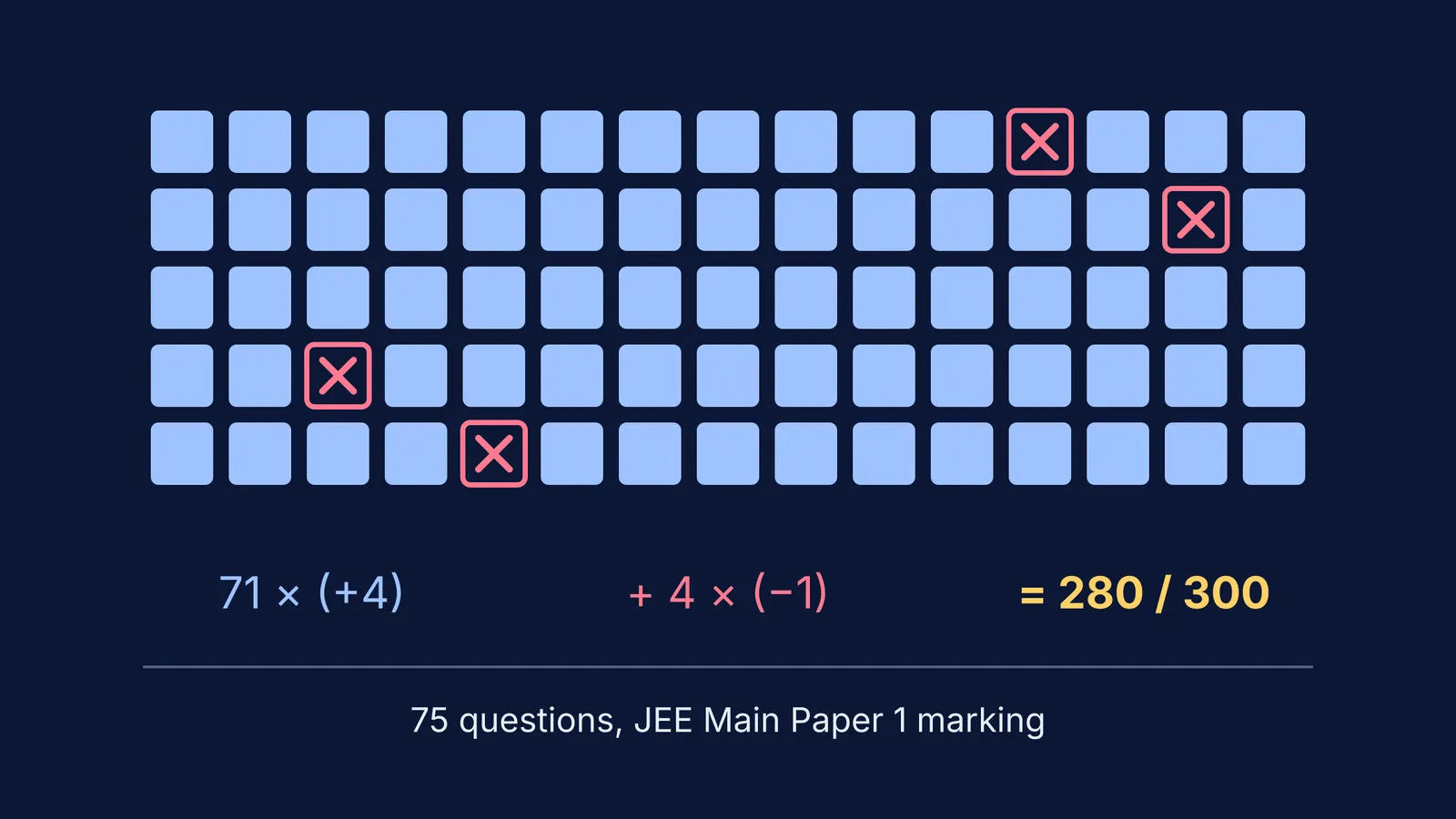
JEE Main Paper 1 has 75 questions worth 300 marks, with +4 for a correct answer and −1 for a wrong one, according to NTA's JEE (Main) 2027 information bulletin. So 300 out of 300 means all 75 answers were right. Anything less means some questions were answered wrongly or skipped.
Suppose a model scores 280. One way to get there is 71 correct and 4 wrong: 71 × 4 = 284, minus 4 for the wrong answers, gives 280. That is an excellent score, yet about one answer in 19 was wrong, written in the same confident tone as the rest. The total does not tell you which four.
How are AI benchmarks run?
A benchmark is a fixed set of questions with known answers, used to compare models on the same task. JEEBench collected 515 JEE Advanced problems in physics, chemistry and maths; in that 2023 study, the best model, GPT-4, scored below 40% even with its best prompting, and by prompting alone could not judge when a guess was worth the risk of negative marking (Arora, Singh and Mausam, EMNLP 2023).
Two years later the numbers looked very different. Outlook Business reported a ByteDance technical report in which Google's Gemini 2.5 Pro scored 336.2 out of 360 on JEE Advanced 2025, above the top human score of 332, and OpenAI's o4-mini-high scored 308.4 (Outlook Business). Separately, LearnOpenCV gave o4-mini-high a screenshot of every JEE Advanced 2025 question with the prompt "Solve and explain", compared its answers with the correct ones and reported 313 out of 360 (LearnOpenCV).
Same model name, same paper, two scores. The result depends on the testers' choices:
Was each question given as an image, as typed text, or with the figure described in words?
Was it one attempt, or an average of several? JEE Advanced awards whole marks, so a score like 336.2 suggests an average of several runs.
Could the model search the web? LearnOpenCV says it avoided a mode that could look solutions up online.
Who marked the answers, and against which key?
Why does data contamination matter?
Data contamination means the test questions, or their solutions, were already in the text a model learned from, so a high score may partly measure memory rather than problem-solving. JEE solutions are posted widely online, so papers released before a model was trained carry the most risk.
A 2024 study tested this by writing GSM1k, 1,205 new school-level maths word problems in the style of a popular benchmark called GSM8k. Some models scored up to 8% lower on the new problems, and models more likely to reproduce GSM8k questions tended to show bigger gaps (Zhang et al., 2024). Many models, especially the strongest, showed little sign of this, so contamination does not make every score fake; it means a score on fresh questions is worth more.
Does a high AI score mean every answer is right?
No. A score summarises a whole paper; your question is just one problem. A model that does well overall can still misread a figure, drop a sign or pick the wrong formula on your problem, and sound just as sure. Your blurry photo or reworded worksheet question is also not the clean test paper. Our guides on why AI chatbots get maths wrong and how to check an AI's physics solution show the common failure patterns.
A checklist for the next AI exam headline
Ask five questions:
Which paper and year? Was it released after the model was trained?
Were questions given as images or text, with figures?
One attempt, or an average of several?
Who ran and marked it, and is the method published?
How many answers were wrong?
When an AI solves a problem for you, check it like an examiner:
Estimate the sign, rough size and units first.
Read every step, not only the last line.
Put the answer back into the question, or test a simple case such as an angle of zero.
If you cannot explain a step to a friend, treat the answer as unchecked.
Parents can ask: "That's impressive. Which answers did it get wrong, and how would you know if it got yours wrong?"
Checking is easier when the reasoning is on the page. The Fermi Problem Library has worked problems with a step-by-step solver that explains the reasoning rather than printing an answer, so you can test each line yourself. Fermi's AI tutor decides whether to explain, ask or show, and checks your understanding as it goes.
Choosing an AI study tool? Our guide on how to evaluate an AI tutor turns these questions into tests you can run.


