On this page
The vector equation of a line looks abstract until you treat t as a slider. Push t forward and a point walks along the line; pull it back and it walks the other way. Once you have seen that, the Cartesian form becomes one line of algebra, not a formula to memorise.
What does each part of r = a + tb mean?
OpenStax Calculus Volume 3 writes the vector equation of a line as r = r₀ + tv, where v is "a parallel vector, which we call the direction vector" (OpenStax, section 2.5). Your school book may call the same pieces a, b and λ. The letters change; the idea does not.
a is the position vector of one fixed point on the line, measured from the origin O.
b is the direction vector: it says which way the line points, not where it is.
t is the parameter, a plain real number you are free to choose.
r is the position vector of the point you land on for that choice of t.
So r = a + tb reads as: start at a, then take t steps of b.
What happens when you move t along the line?
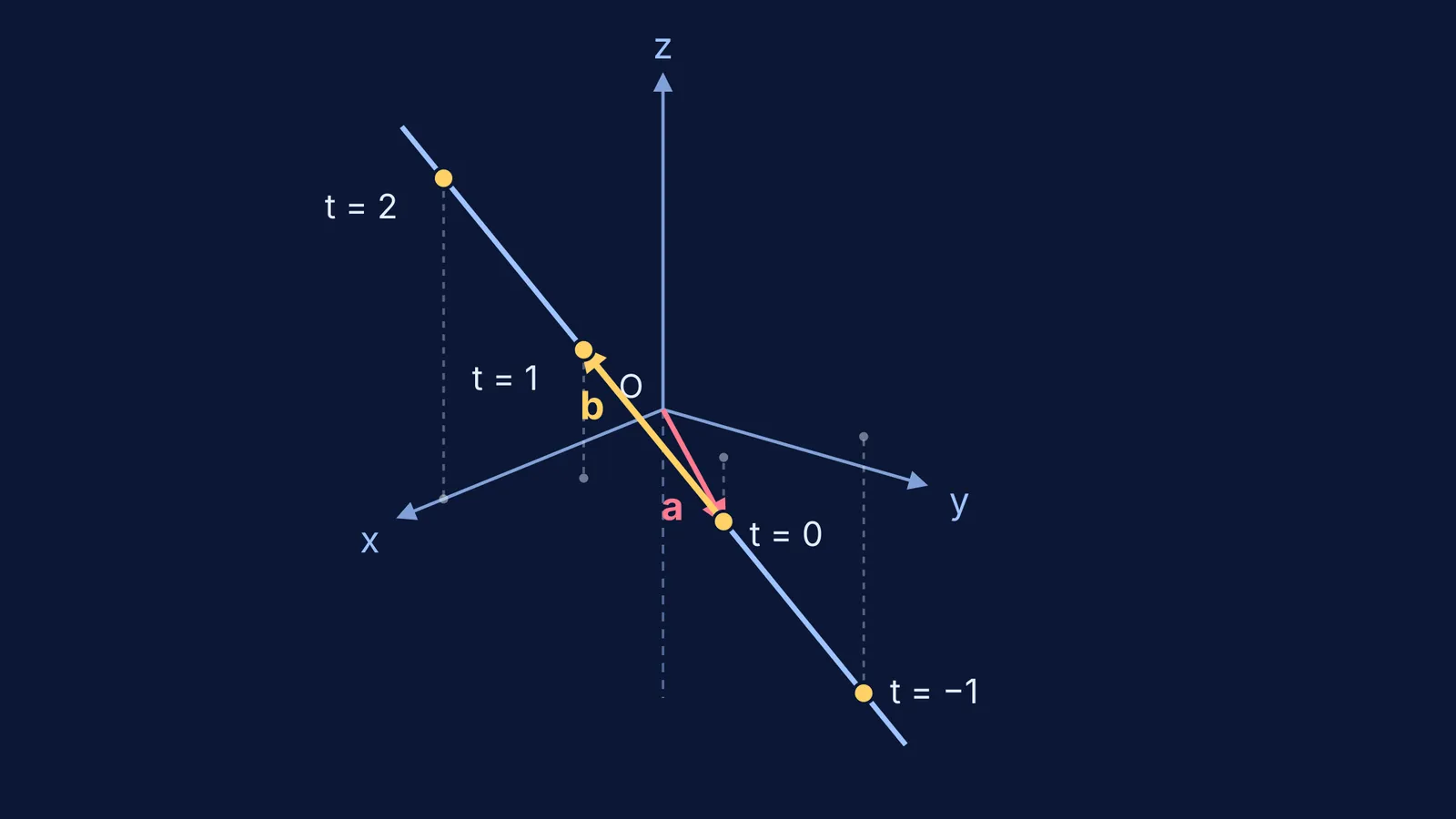
Take a = (1, 2, −1) and b = (2, −1, 3). Feed in a few values of t and work out each point:
t = −1 gives (1 − 2, 2 + 1, −1 − 3) = (−1, 3, −4)
t = 0 gives (1, 2, −1), the point a itself
t = 1 gives (3, 1, 2)
t = 2 gives (5, 0, 5)
Three things show up as you slide t. Equal steps in t give equal steps along the line, each the length of b, which here is √(4 + 1 + 9) = √14. Negative t walks backwards from a, so the line runs in both directions without end. And t = 2 lands on (5, 0, 5), where y is zero, so at that moment the point sits directly above the x-axis.
Ideas like this are easier to see than read, which is what the interactive simulations in the Fermi Simulation Lab are for. On paper, sketch three axes, mark the points for t = −1, 0, 1 and 2, and drop a dashed line from each to the xy-plane, as in the diagram above.
How do you convert the vector equation to Cartesian form?
The trick is to write r = a + tb one coordinate at a time, then remove t. OpenStax calls the three coordinate equations the parametric equations of the line and the result its symmetric equations (OpenStax, section 2.5).
Write r = (x, y, z) and split it: x = 1 + 2t, y = 2 − t, z = −1 + 3t.
Solve each for t: t = (x − 1)/2, t = (y − 2)/(−1), t = (z + 1)/3.
All three equal the same t, so set them equal: (x − 1)/2 = (y − 2)/(−1) = (z + 1)/3.
Check with a point you already know. For (5, 0, 5): 4/2 = 2, (−2)/(−1) = 2, 6/3 = 2. All equal 2, the t that produced the point.
In general, a line through (x₁, y₁, z₁) with direction (b₁, b₂, b₃) becomes (x − x₁)/b₁ = (y − y₁)/b₂ = (z − z₁)/b₃. The denominators are the direction ratios and the numbers subtracted are the point. To go the other way, our guide on converting a line from Cartesian to vector form in 3D runs the same steps in reverse.
What if one direction number is zero?
OpenStax gives the symmetric form for the case where the three direction numbers are all non-zero (OpenStax, section 2.5). Suppose b = (2, 0, 3) instead. Then y = 2 + 0t = 2 for every t, so y never changes. Write the line as (x − 1)/2 = (z + 1)/3 with y = 2 alongside. If a book prints (y − 2)/0, read it as shorthand for y − 2 = 0, never as division by zero.
Signs cause the other slip: (1 − x)/3 hides a direction ratio of −3, a trap covered in direction ratios from a reversed symmetric form.
A two-minute check before you move on
Put t = 0. Do you get the point you started from?
Read the denominators. Do they match b, or a multiple of it?
Read the numerators. Is z + 1 written for a point with z = −1?
Plug in one more point from the vector form, such as t = 1. Do all three fractions give the same number?
If the same sign error keeps coming back, the Fermi Problem Library has a step-by-step solver that explains the reasoning rather than printing an answer. When you are comfortable sliding t, try it on two lines at once: seeing the shortest distance between skew lines uses the same picture.