On this page
You throw three ordinary dice and add the faces. Which total turns up more often: 9 or 10?
Before you read on, write down your answer and one sentence of reasoning. A prediction you commit to shows you exactly which step in your thinking needs fixing.
Why does 9 look just as likely as 10?
The tempting argument goes like this. Count the ways to split each total into three numbers from 1 to 6, ignoring order.
9: 1+2+6, 1+3+5, 1+4+4, 2+2+5, 2+3+4, 3+3+3 (six ways)
10: 1+3+6, 1+4+5, 2+2+6, 2+3+5, 2+4+4, 3+3+4 (six ways)
Six each, so they should tie. Galileo described this puzzle in his note on dice, writing that 9 and 12 "can be made up in as many ways as 10 and 11", yet "long observation has made dice-players consider 10 and 11 to be more advantageous than 9 and 12" (Galileo, Concerning an Investigation on Dice, translated by E. H. Thorne, via the University of York). The players had noticed something the simple count misses.
Why is a sum of 10 more likely than 9 with three dice?
The dice are different objects, even if they look alike. Paint them red, blue and green, and a roll of (1, 2, 6) is not the same outcome as (6, 2, 1). Each of the 6 × 6 × 6 = 216 ordered outcomes is equally likely, and Galileo's note gives that same total of 216 (University of York translation).
So each unordered split must be weighted by how many orders it has:
three different numbers (like 1, 2, 6) can be arranged in 6 orders
two equal and one different (like 1, 4, 4) can be arranged in 3 orders
three equal (3, 3, 3) has only 1 order
That is where 9 loses. It owns the only triple, 3+3+3, which counts once. Ten has no triple at all.
How do you count the ordered outcomes for 9 and 10?
Take each split and write its number of orders beside it.
For a total of 9:
1+2+6: 6 orders
1+3+5: 6 orders
2+3+4: 6 orders
1+4+4: 3 orders
2+2+5: 3 orders
3+3+3: 1 order
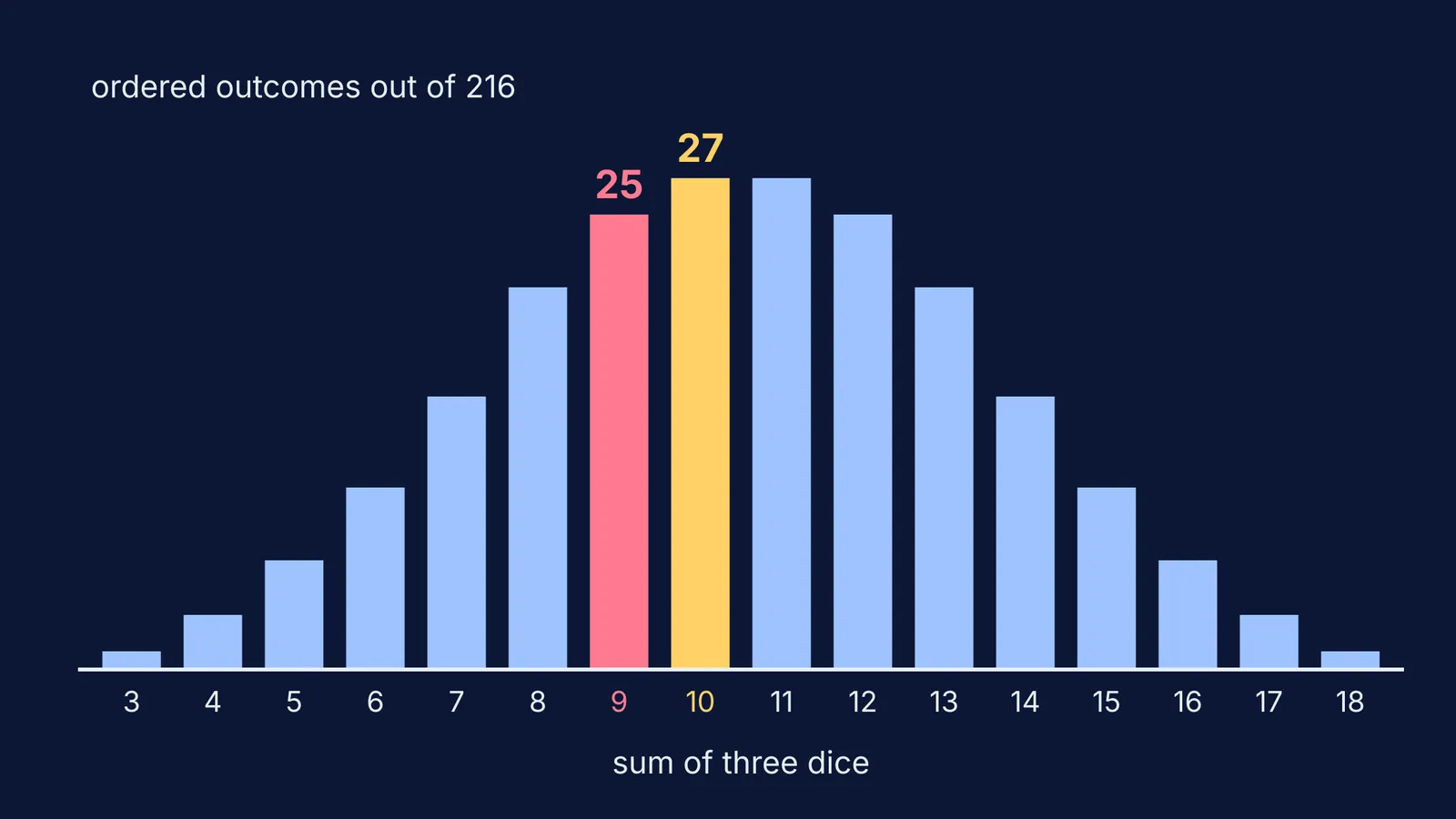
Total: 6 + 6 + 6 + 3 + 3 + 1 = 25.
For a total of 10:
1+3+6: 6 orders
1+4+5: 6 orders
2+3+5: 6 orders
2+2+6: 3 orders
2+4+4: 3 orders
3+3+4: 3 orders
Total: 6 + 6 + 6 + 3 + 3 + 3 = 27.
These match Galileo's figures of "27 different dice-throws" for 10 and "25 only" for 9 (University of York translation). So P(9) = 25/216, about 11.6%, and P(10) = 27/216, exactly 12.5%.
How many rolls do you need to see 10 beat 9?
Far more than most people guess. The gap is 2 outcomes in 216, under one percentage point. Mathematician Michael Lugo estimated that you need about 7,600 rolls to have a 95% chance that 10 has come up more often than 9 (Lugo, God Plays Dice, 2012).
That changes how you should run the experiment. A plan for a class or a family evening:
Everyone writes a prediction: 9, 10 or a tie.
Roll three dice 108 times and tally only the 9s and 10s.
Compare with the expected counts: 108 × 25/216 = 12.5 nines and 108 × 27/216 = 13.5 tens.
Expect your tallies may come out the other way: a gap of one expected roll is smaller than ordinary chance swings.
Pool every group's tallies, or use a simulation that rolls thousands of times, and watch the proportions settle towards 11.6% and 12.5%.
Step 4 is the real lesson. A short run can contradict a true probability, which is the same idea behind why probability only shows up over many trials, as in 10,000 coin tosses. If you want to see thousands of rolls without rolling them by hand, the Fermi Simulation Lab has interactive simulations for the ideas that are easier to see than to read.
Where do students slip on dice questions?
Watch for two errors: treating (1, 2, 6) and (6, 2, 1) as one outcome, and giving a split with a repeat, like 2+2+5, six orders instead of three. As a self-check, the counts for totals 3 to 18 must add up to 216.
The same counting habit decides a famous older puzzle, de Méré's problem of one six in four throws, and it is behind several of the common probability reasoning mistakes in JEE maths. If you get stuck partway through a counting problem, the Fermi Problem Library has worked problems with a step-by-step solver that explains the reasoning rather than printing an answer.
Next time you see two totals that look equally likely, ask one question first: can the dice be told apart?