On this page
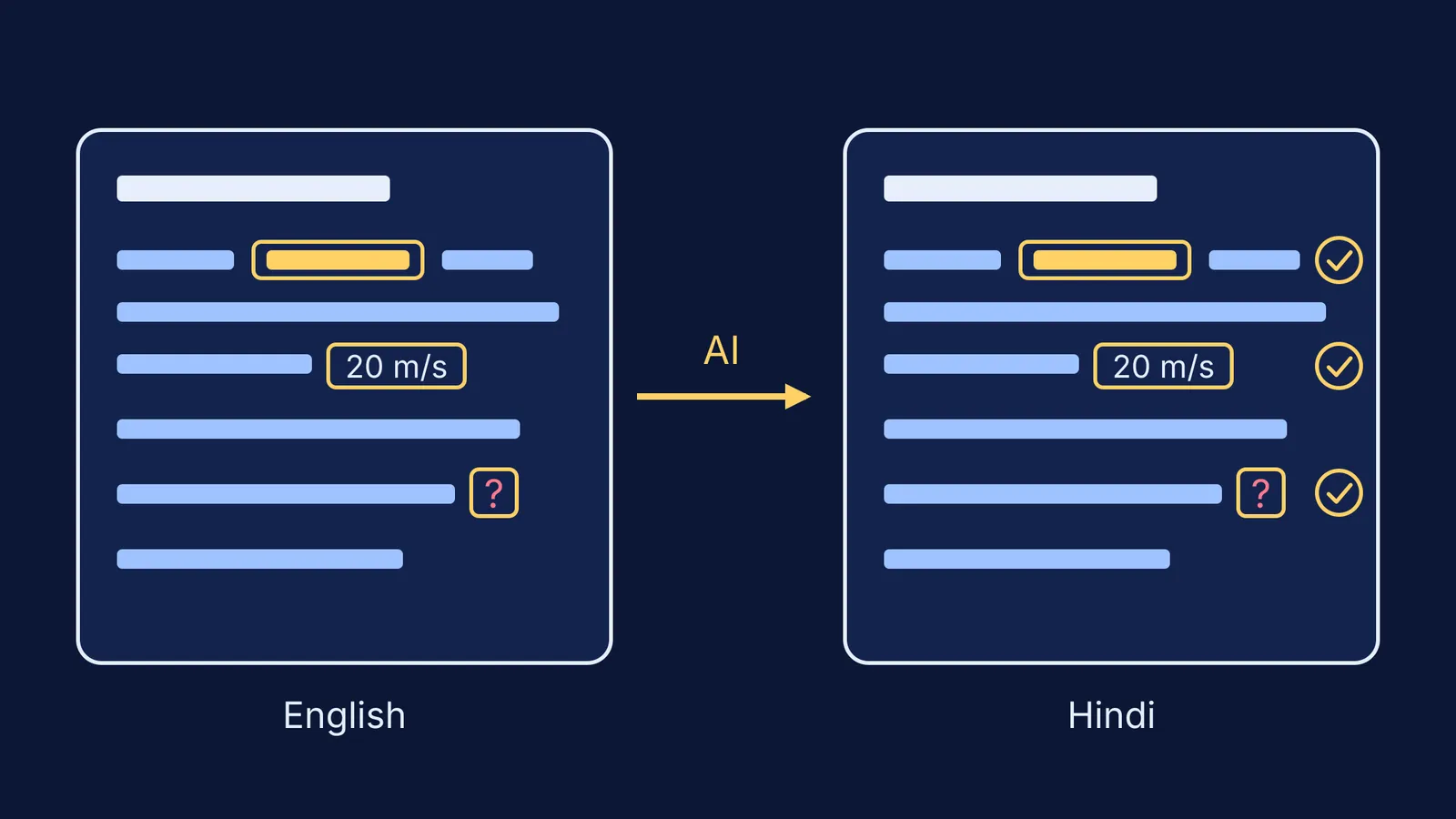
If half your class thinks in Hindi, Marathi or Bengali but your worksheets are in English, AI can give you a translated draft in minutes. The draft is not the finished worksheet. A science worksheet only works if each term, unit and question means exactly what it meant in English, and that is the part a fluent colleague has to check.
Why translate science worksheets at all?
India's National Education Policy 2020 says, in paragraph 4.11, that young children grasp nontrivial concepts more quickly in their home language. The same paragraph says teachers "will be encouraged to use a bilingual approach, including bilingual teaching-learning materials" with students whose home language differs from the medium of instruction.
So a Hindi version beside the English one is not a shortcut; it is the kind of material the policy encourages.
How accurate is AI translation for science?
It is good at meaning and weaker on terminology. In a study by Hannah Calzi Kleidermacher and James Zou at Stanford, AI translated scientific papers into 28 languages. In a user study, 15 researchers read translations of their own papers into their native languages, and 93.3% said the translation conveyed the original information with few or no issues. Yet 86.7% described an unnatural quality to the translation or dissatisfaction with how technical and domain-specific vocabulary was handled. The term errors went both ways: some terms were translated awkwardly when a standard native word existed, and some were translated when researchers would rather have kept the English. The study used research papers, not worksheets.
Indian languages have their own gaps. The team behind IndicTrans2, a translation model for all 22 scheduled Indian languages, noted that before their work there were no robust benchmarks covering all of these languages. Term errors are a known problem too: when Haque, Hasanuzzaman and Way studied terminology translation between English and Hindi in legal texts, they proposed an error typology for term translation errors.
India has an official body for this. The Commission for Scientific and Technical Terminology under the Ministry of Education works to evolve technical terminology in all Indian languages. In practice, your students' Hindi-medium textbook is the version to match, because those are the words they study from.
What should you ask the AI?
Paste the worksheet and use a prompt like this:
"Translate this Class 9 physics worksheet into Hindi for Hindi-medium students."
"Use the terms from the NCERT Hindi-medium textbook where they exist. If you are unsure of a term, keep the English in brackets after it."
"Do not change any number, unit symbol, formula or diagram label."
"Keep every question's command word exact: state, explain, calculate, compare."
"After the translation, list every technical term you translated, in two columns: English and Hindi."
That last list makes your colleague's check fast.
How should a colleague check the translation?
Give them the English, the draft and the term list, and ask them to check four things:
Terms: does each one match the Hindi-medium textbook? Are two English terms (speed and velocity, mass and weight) still two different words?
Units and symbols: are m/s, kg, mol and °C written exactly as the textbook writes them? Did any number, decimal point or sign change?
Question meaning: does "which of these is NOT" still carry the NOT? Does "explain" still ask for a reason, not just a fact?
Reading level: would a 14-year-old in your class read it without help, or did the AI choose formal words nobody uses?
A worked example
Take the English question: "A car's velocity changes from 10 m/s to 20 m/s in 5 s. Calculate its acceleration."
A draft that swaps velocity for the everyday Hindi word for speed reads smoothly, so a quick reader would pass it. But Class 9 students learn that speed and velocity are different. Your colleague marks the term and asks for the textbook word for velocity. They check that "10 m/s" was not turned into words or another unit, and that "calculate" was not softened into "find out roughly". That minute is what makes the worksheet correct.
What if students still get stuck on the idea?
A translated sentence fixes the language; it does not fix a concept gap. If a student reads the Hindi perfectly and still cannot say why velocity has a direction, they need the idea taught. The Fermi Concept Library has a lesson for every concept in physics, chemistry, biology, mathematics and computing, and Fermi's AI tutor notices where a student is stuck and decides whether to explain, ask or show.
Related reading: how students can build a Hindi and English maths glossary with AI, whether an AI tutor can explain science in Tamil, Telugu or Bengali, and how teachers can use AI to build a question paper from a blueprint.
Start with one worksheet this week: translate it, check the term list with a colleague, and save the list.