On this page
If you study maths in Hindi but practise or ask AI in English, you meet every idea twice: the derivative is also अवकलज, the matrix also आव्यूह. A glossary you build yourself, chapter by chapter, stops that switch slowing you down. Here is how to make one with an AI tutor without learning a wrong word.
Why do Hindi-medium students need a maths glossary?
Your Hindi-medium textbook, NCERT's गणित (Ganit) for Classes 11 and 12, is the reference your teacher and board papers follow. Much entrance-exam practice material is in English. If you plan to write JEE Main in Hindi, check the current information bulletin on NTA's website for the language options rather than relying on an old forum post.
The hard part is that Hindi sometimes has more than one good word for an idea, and sources choose differently. For example:
SATHEE's Hindi study notes on differentiation and determinants, hosted on IIT Kanpur's website, state the rule det(A⁻¹) = 1/det(A) as "किसी आव्यूह के प्रतिलोम का सारणिक आव्यूह के सारणिक के व्युत्क्रम के बराबर होता है", using प्रतिलोम for the inverse of a matrix and व्युत्क्रम for the reciprocal.
Vedantu's Hindi NCERT solutions for Class 12 maths Chapter 4 ask you to find the व्युत्क्रम of each matrix, using व्युत्क्रम for the inverse of a matrix.
Both are understandable Hindi. But if you learn one and the question paper uses the other, you lose time working out what is being asked. An AI chatbot may give you either word, so you have to check.
How do I ask an AI tutor to build the glossary?
Work one chapter at a time and name the chapter in both languages. You can copy this prompt and change the class and chapter:
"I am a Class 12 Hindi-medium student. For the chapter Determinants (सारणिक), make a two-column list: English term on the left, Hindi term on the right. Add one short worked example for each term, using symbols and numbers. Where Hindi has more than one common word for a term, give all of them and say so. If you are unsure of a term, write unsure instead of guessing."
Then turn the AI's list into something you can trust:
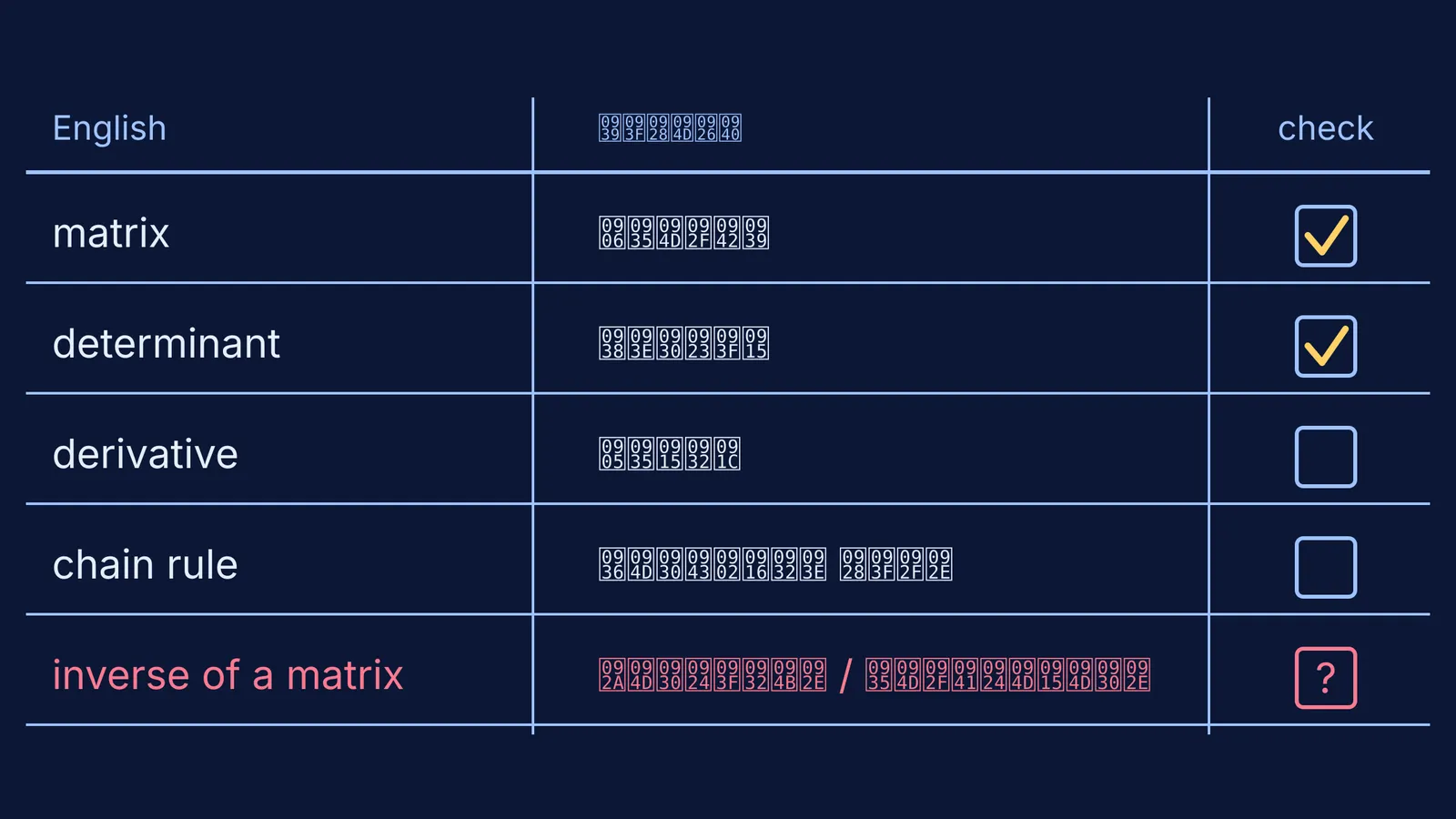
Copy it into your notebook in two columns, with a narrow third column for a tick.
Find each Hindi word in the same chapter of your Ganit book: headings, definitions, exercise questions.
Tick it if the book uses it. If not, cross it out and write the book's word.
Work every example yourself. If your answer differs, treat the AI's example as wrong until you find out why.
Mark anything unsettled with a question mark and ask your teacher.
Once a week, cover one column and test yourself both ways.
What does a finished glossary page look like?
Here is a determinants page that uses one matrix throughout. Take A as the 2 × 2 matrix with rows (2, 1) and (4, 3). The Hindi terms come from the SATHEE notes and the Vedantu solutions linked above.
matrix: आव्यूह. A has rows (2, 1) and (4, 3).
determinant: सारणिक. det A = 2 × 3 − 1 × 4 = 2.
minor: उपसारणिक. The minor of a₁₁ is 3.
cofactor: सहखंड. The cofactor of a₁₂ is (−1)¹⁺² × 4 = −4.
adjoint: सहखंडज. adj A has rows (3, −1) and (−4, 2).
inverse of a matrix: व्युत्क्रम (Vedantu solutions) or प्रतिलोम (SATHEE notes). A⁻¹ = ½ adj A, with rows (1.5, −0.5) and (−2, 1).
transpose: परिवर्त (SATHEE notes). det of the transpose of A is also 2. Still to tick against the book.
Check the last step yourself: A multiplied by A⁻¹ gives rows (1, 0) and (0, 1), the identity matrix. That check catches a wrong example, from an AI or from your own working.
Can I trust AI translations of maths terms?
Treat them as a first draft. Chatbots can be fluent and still wrong, in the Hindi word or in the arithmetic of an example, so use this five-step way to check AI maths answers on anything you are unsure of.
Thinking in one language and reading in another is normal. Read more about studying science in English when you think in another language and what NEP 2020 and research say about home language and learning.
If a term keeps tripping you because the idea is fuzzy, not the word, a glossary will not fix that concept gap. The Fermi Concept Library has a lesson for each concept in mathematics, and Fermi's AI tutor can work out what you already know and build a plan for the session, so you go back to the glossary with the idea clear.
Start tonight with the chapter you find hardest: one prompt, one book, one checked page.