

On this page
A smog tower is a giant outdoor air purifier: fans pull city air through filters and push it out cleaner. Delhi's tower at Connaught Place is 24 metres tall, uses 40 fans, moves about 960 cubic metres of air a second and cost Rs 20 crore to install, according to ThePrint. Whether that is enough is a question for Class 9 arithmetic.
Do smog towers work?
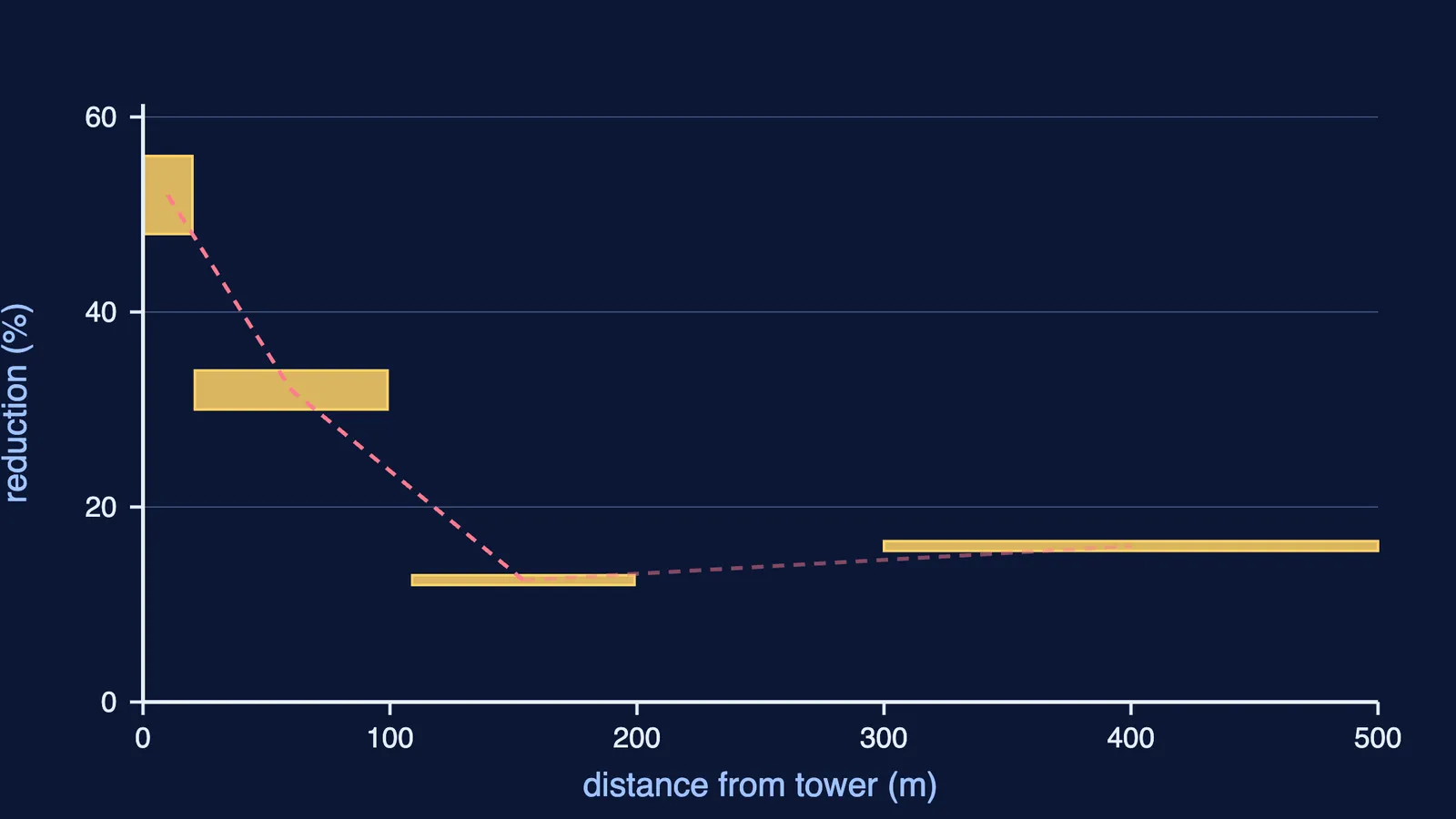
They work, but only very close to the tower. In an affidavit filed with the National Green Tribunal on 8 November 2023, the Delhi Pollution Control Committee (DPCC) cited an IIT Bombay study of the Connaught Place tower, as reported by Down To Earth. The study found a 48-56 per cent reduction within 20 metres of the tower. The reduction fell to about 30-34 per cent at 21-99 metres and 12-13 per cent at 109-199 metres. The affidavit concluded that continuing to use smog towers was not justified.
The DPCC report itself says the goal of clean air within a one-kilometre radius was not met. It calls the tower's performance "not satisfactory" and puts operation and maintenance at around Rs 20 lakh a month.
China tried the idea too. A 60-metre tower in Xi'an put out 5-8 million cubic metres of filtered air a day in winter. Early, unpublished results showed a 19 per cent drop in PM2.5 at monitors across about 10 square kilometres, compared with other parts of the city, reported by Nature News in 2018.
How much air does a smog tower clean in a day?
The Connaught Place tower moves 960 cubic metres a second (ThePrint). A day has 86,400 seconds, so the tower handles 960 × 86,400 ≈ 83 million cubic metres a day. To judge it, compare it with the air the tower must clean.
How much air sits over Delhi?
In the cold months, polluted air is trapped in a shallow layer near the ground, called the boundary layer or mixing layer. Ceilometer measurements over Delhi-NCR found an average boundary-layer height of 0.53 km in October-November 2022, though it varied widely, according to a 2023 conference abstract by Rathore and Ganguly. The DPCC affidavit puts Delhi's area at 1,483 square kilometres (Down To Earth).
Here is the worked example. Try each step on paper first.
Area in square metres: 1,483 km² × 10⁶ m² per km² = 1.48 × 10⁹ m².
Take the mixing layer as 500 m deep (a round number just below the measured average). Volume = 1.48 × 10⁹ × 500 ≈ 7.4 × 10¹¹ m³.
One tower cleans 8.3 × 10⁷ m³ a day.
Days for one tower to filter all of it once: 7.4 × 10¹¹ ÷ 8.3 × 10⁷ ≈ 8,900 days, or about 24 years.
To filter Delhi's air just once a day, you would need about 8,900 towers.
Step 5 is generous to the towers, because the air does not stay clean. Traffic, construction dust and smoke keep adding pollution every hour. The DPCC, working by a different route, told the tribunal that at least 40,000 towers would be needed to cut Delhi's pollution by 17 per cent (Down To Earth).
Why does the clean air vanish so close to the tower?
Shrink the problem to the tower's own neighbourhood. Picture a cylinder of air 200 m in radius and 500 m tall around it. Its volume is π × 200² × 500 ≈ 6.3 × 10⁷ m³. At 960 m³ a second, the tower needs about 65,000 seconds, roughly 18 hours, to pass that air through once.
Now add a light breeze of 1 metre a second, our assumption for a calm winter day. It carries air across that 400-metre-wide patch in under 7 minutes. Fresh, dirty air arrives long before the tower has cleaned what was there. The filtered air mixes into it and the effect fades with distance, which is consistent with the IIT Bombay pattern.
A home purifier is different. A closed room holds a fixed, small volume of air, so the same idea works. Our explainer on how HEPA air purifiers clean the air covers the filter physics. Our piece on photochemical versus classical smog explains what is actually in the haze.
How do you test any big claim like this?
The method works for any "giant machine fixes the city" headline:
Find the machine's rate (cubic metres a second, litres an hour).
Find the size of the problem (area times depth, or total volume).
Divide to get time per pass, then ask what refills the problem meanwhile.
This is estimation, the same skill as our crowd-size estimate using a grid. If unit conversions trip you up, the Fermi Problem Library has worked problems with a step-by-step solver that explains the reasoning. For the ideas underneath, such as volume, flow rate and diffusion, the Fermi Concept Library gives each concept its own lesson.
Next time someone says a tower will clean the city's air, ask for the flow rate and do the division.


