On this page
Blow up one balloon until it's big and another only part of the way. Fit them to the two ends of a clamped straw, then open the clamp. Most people expect the two to even out. Usually they don't: the small balloon shrinks and pushes its air into the big one. The Wikipedia article on the two-balloon experiment notes that this surprises people because most assume the balloons will end up the same size.
Why does the small balloon empty into the big balloon?
Air flows from higher pressure to lower pressure. So the real question is which balloon has more pressure inside. With rubber, that is often the smaller one.
In 1978, D. R. Merritt and F. Weinhaus of the University of Santa Clara derived an equation linking a rubber balloon's internal pressure to its radius. They showed that it matches experiment for low to moderate stretches, as long as hysteresis is ignored (American Journal of Physics, 1978).
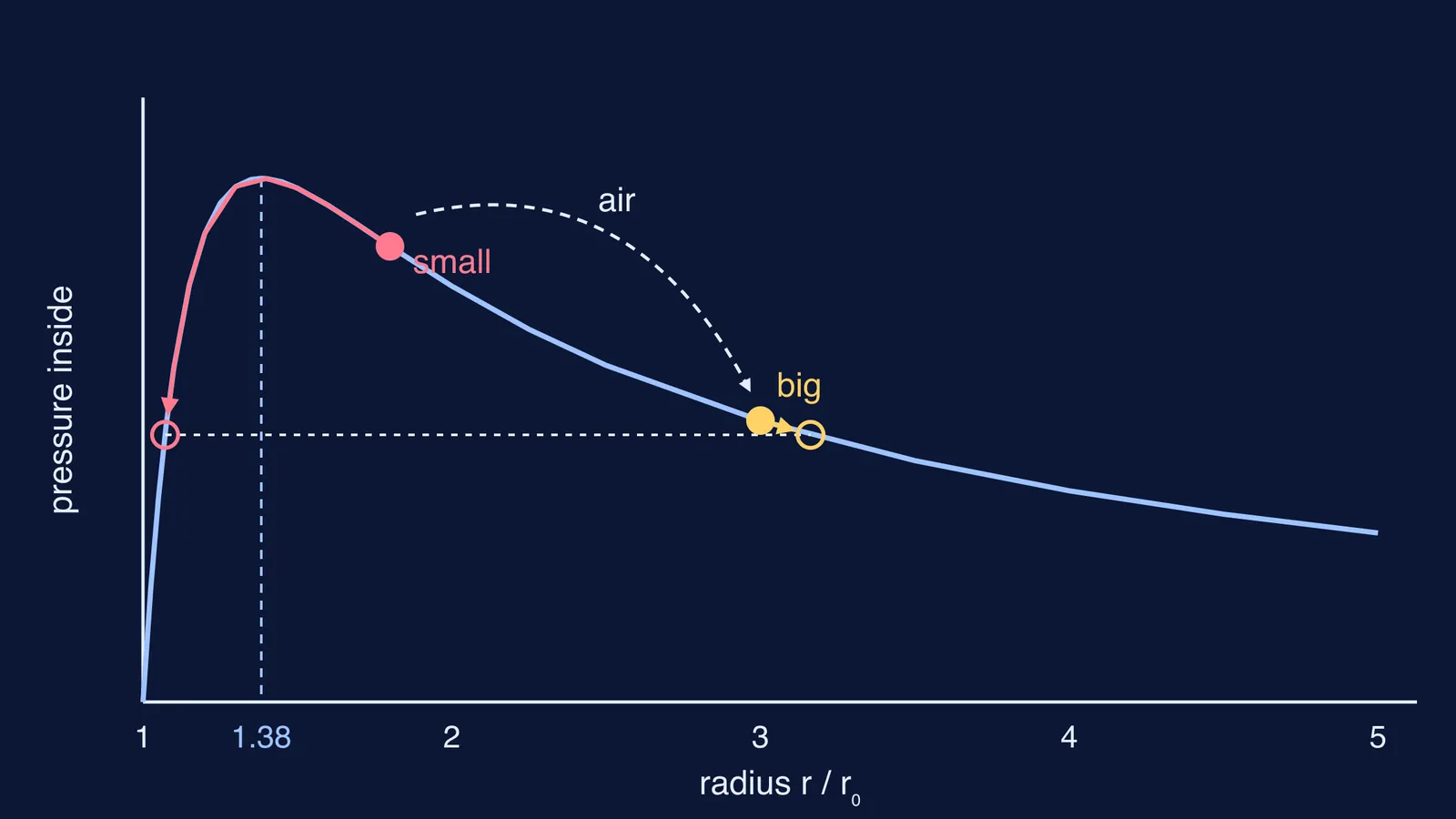
In terms of stretch, the excess pressure is P = C(r₀/r)[1 − (r₀/r)⁶], where r₀ is the uninflated radius, r is the current radius and C is a constant for a given balloon (two-balloon experiment).
The pressure inside a rubber balloon is highest when its radius is about 1.38 times its uninflated radius (the sixth root of 7), and it falls as the balloon grows beyond that (two-balloon experiment).
Why does the pressure drop as a balloon gets bigger?
Two effects pull against each other. Stretching the rubber raises its tension, which pushes the pressure up. But a wider sphere needs less pressure to balance the same wall tension. As the Laplace's law page on HyperPhysics puts it, the larger the radius, the larger the wall tension needed to hold a given pressure. Past the peak, the radius effect wins.
Soap bubbles are the extreme case. Their surface tension stays the same as they grow, and the pressure difference across the film depends on that surface tension and the radius, falling as the radius grows (HyperPhysics on bubbles). That's why a smaller bubble also feeds a larger one. For the shape side of the story, see why soap bubbles are always round.
Natural rubber adds one more twist. At very large stretches the pressure rises again, because effects that the simple theory ignores, such as crystallisation, take over (two-balloon experiment).
A worked example: predict, then check
Measure each radius in units of r₀ (call it x) and pressure in units of C. The pressure curve becomes P = (1/x)(1 − 1/x⁶). Our own calculations follow.
Small balloon at x = 1.8: P = 0.539.
Big balloon at x = 3: P = 0.333.
The small balloon has more pressure, so air flows from small to big.
As the small balloon shrinks towards the peak at x = 1.38, its pressure rises, so the flow keeps going. Only once it is past the peak, on the steep side, does its pressure fall.
Flow stops when the pressures match. We treat the total volume of air as fixed, which works because the pressure differences are tiny next to atmospheric pressure. The balloons stop at about x = 1.07 and x = 3.16, both at P ≈ 0.316.
The small balloon ends up barely inflated and the big one gets bigger. Two equal balloons (both at x ≈ 2.54) would also have equal pressures, but that balance is unstable. If one balloon gains a puff of air, its pressure drops, so it pulls in even more.
Now change one number. Make the small balloon x = 1.05, barely stretched and below the peak. Its pressure is 0.242, which is less than the big balloon's 0.333. This time air flows the "expected" way, from big to small, but only until the small one reaches about x = 1.08 and the pressures match.
How do you try the two-balloon experiment at home?
You need two identical balloons, a straw or short tube, tape and a clothes peg.
Stretch both balloons by hand a few times so they start out alike.
Blow one up fully and the other to about a third of that size. Pinch each neck while you fit it over an end of the straw, then tape it.
Clamp the middle of the straw with the peg.
Before you release the peg, everyone writes down a prediction and one sentence of reasoning.
Release the peg, watch, then use the curve to explain what happened.
Real balloons won't match the numbers exactly. The pressure at a given radius is always higher while the balloon is being inflated than while it is deflating (two-balloon experiment). Our post on elastic hysteresis in rubber explains where that energy goes.
If the hump is hard to picture, the Fermi Simulation Lab has interactive simulations for ideas that are easier to see than to read. For how rubber's response compares with steel's, try the stress-strain curve simulation. When you move on to excess-pressure numericals, the Fermi Problem Library has worked problems with a step-by-step solver that explains the reasoning rather than printing an answer.