On this page
Stir salt into water and an LED wired through the glass starts to glow, brightening with each spoonful until more salt barely matters. Here is why, with real numbers to check against.
Why does salt make water conduct electricity?
In a copper wire, electrons carry the current. In salt water, ions do: dissolved sodium chloride splits into positive sodium and negative chloride ions, which drift in opposite directions when you connect a battery. As the LibreTexts chemistry text on electrolytes/08%3A_Solutions/8.10%3A_Ions_and_Electrolytes/8.10.9C%3A_8.10.9C%3A__Weak_and_Strong_Electrolytes) puts it, "ions are the charge carriers" in these solutions.
High-quality deionised water has a conductivity of only about 0.055 µS/cm at 25 °C, drinking water is typically 200 to 800 µS/cm, and seawater is about 50 mS/cm (Conductivity (electrolytic), Wikipedia)).
How does salt concentration affect current through water?
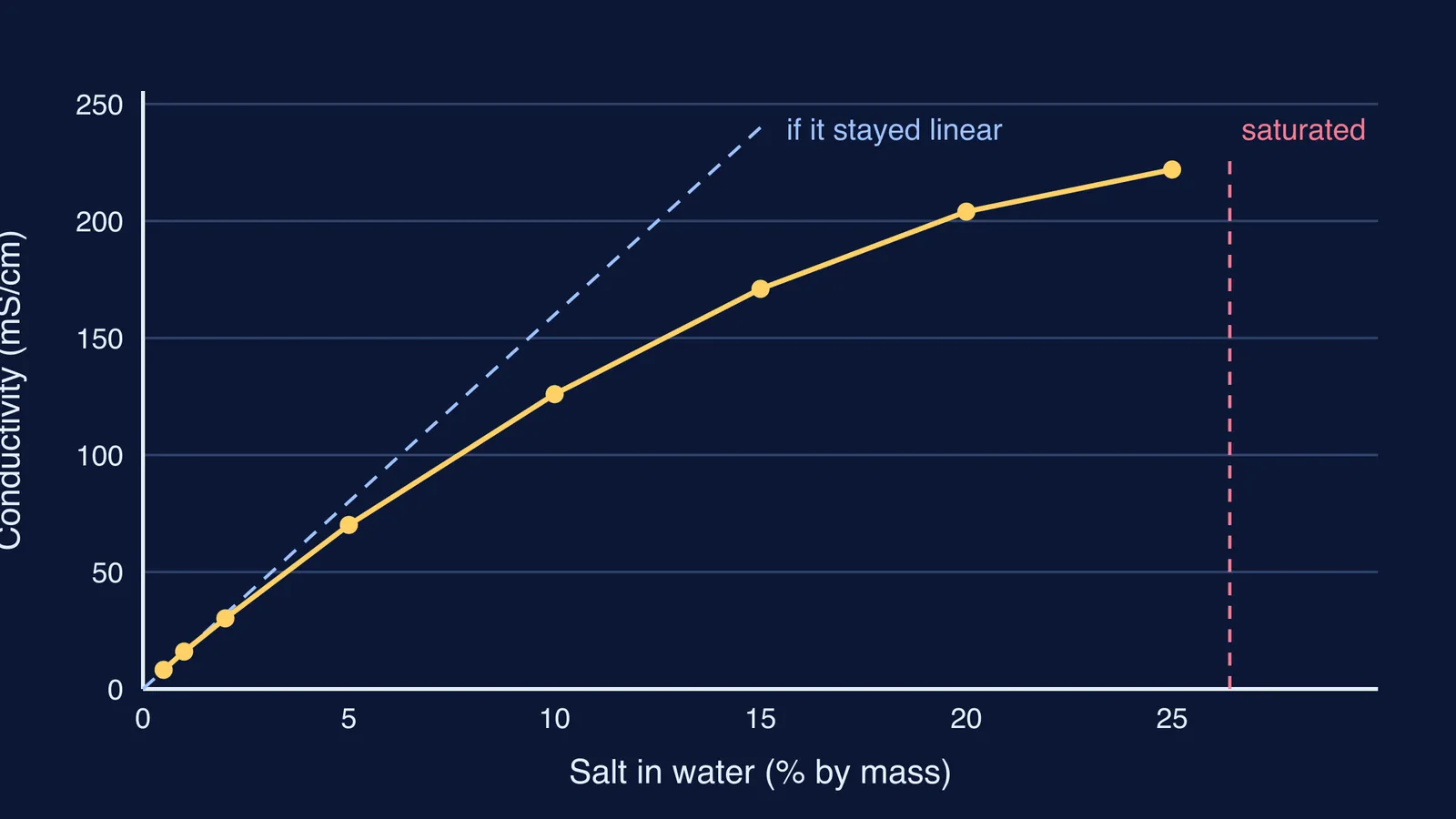
More salt means more ions, so the current rises, but not in a straight line. The CRC Handbook table for sodium chloride at 20 °C gives these conductivities (CRC Handbook, Electrical conductivity of aqueous solutions):
1% salt by mass: 16.0 mS/cm
2%: 30.2 mS/cm
5%: 70.1 mS/cm
10%: 126 mS/cm
20%: 204 mS/cm
25%: 222 mS/cm
From 1% to 2%, conductivity nearly doubles. From 10% to 20%, it rises only about 1.6 times, and 20% to 25% adds less than a tenth.
The reason is crowding. As concentration rises, oppositely charged ions sit closer together, their charges partly cancel, and each moving ion is held back by the cloud of counter-ions around it, LibreTexts explains/08%3A_Solutions/8.10%3A_Ions_and_Electrolytes/8.10.9C%3A_8.10.9C%3A__Weak_and_Strong_Electrolytes). Every extra ion still helps, but less. Then the water runs out of room: 100 g of water dissolves at most 35.89 g of salt at 20 °C (Ren et al., ACS Omega, 2024), which is about 26% salt by mass.
See how molar conductivity changes with dilution, in a simulation.
Why does the LED stop getting brighter?
The second reason is the circuit. A worked example for the kitchen table:
Pour 250 mL of water (about 250 g) into a glass. Each 2.5 g of salt adds roughly 1% by mass, so weigh one spoonful first.
Fix two foil or copper strips 3 cm apart, each with 2 cm² under the water.
Wire a 9 V battery, a 330 Ω resistor and a red LED in series with the strips. A typical red LED drops about 1.8 V and is rated for at most 25 mA (Futurlec red LED specification), which leaves about 7.2 V for the resistor and the water.
The water between the strips is a resistor: R = (gap ÷ area) ÷ conductivity. Gap ÷ area is 3 ÷ 2 = 1.5 per cm, the cell constant. This assumes flat, parallel strips, so treat the numbers as estimates. Taking 500 µS/cm for tap water (Wikipedia)) and the CRC values for salt water:
Tap water: R = 1.5 ÷ 0.0005 = 3,000 Ω, so current = 7.2 ÷ 3,330 ≈ 2.2 mA. A faint glow at best.
1% salt: R ≈ 94 Ω, current ≈ 17 mA.
5% salt: R ≈ 21 Ω, current ≈ 20.5 mA.
20% salt: R ≈ 7.4 Ω, current ≈ 21.3 mA.
Once the water's resistance is small next to the 330 Ω resistor, the resistor sets the current. Going from 5% to 20% quadruples the salt but adds less than 1 mA.
Real readings will be lower. With a battery, the strips also run electrolysis: bubbles form and some voltage goes into those reactions. Meters use alternating current partly to minimise electrolysis, as explained in why conductivity is measured with AC, not DC.
How does electrode spacing change the reading?
The water's resistance is proportional to the gap and inversely proportional to the wetted area. Double the gap to 6 cm in the example above and the cell constant becomes 3 per cm. Using the same CRC conductivities:
At 1% salt, R rises to about 188 Ω and the current falls from about 17 mA to about 13.9 mA.
At 20% salt, R rises to about 14.7 Ω and the current barely moves, from 21.3 to 20.9 mA.
So spacing matters most when the water is only slightly salty. For a fair test, fix the gap with a strip of card, keep the strips at the same depth, stir, and change only the salt.
Is the salt water experiment safe?
The Royal Society of Chemistry notes that electrolysing salt water gives chlorine at the positive electrode and hydrogen at the negative one; chlorine is toxic, hydrogen is extremely flammable, and the sodium hydroxide left behind is corrosive. Its guidance is to turn off the power as soon as you notice a bleachy, swimming-pool smell, which it says will probably take less than five minutes (RSC, Electrolysis of brine). Use batteries only, never mains, ventilate the room, wear eye protection and have an adult nearby.
The Fermi Simulation Lab has interactive simulations for ideas that are easier to see than to read, and the Fermi Concept Library gives each chemistry concept its own lesson if molar conductivity still feels slippery.
Weigh your spoon, fix the gap, and plot six readings against the CRC values above.