

On this page
Electrical conductivity has been measured in practice for more than 100 years, according to Mettler Toledo's Guide to Conductivity Measurement.pdf). The recurring problem: the current you send in to measure a solution can change it. Here is what "use AC and a conductivity cell" actually means, so you can explain it and use it in numericals.
Why can't you use DC to measure conductivity?
In a solution, ions carry the current, and Mettler Toledo's guide.pdf) points out that charge transfer in electrolytes is always linked to the transport of matter.
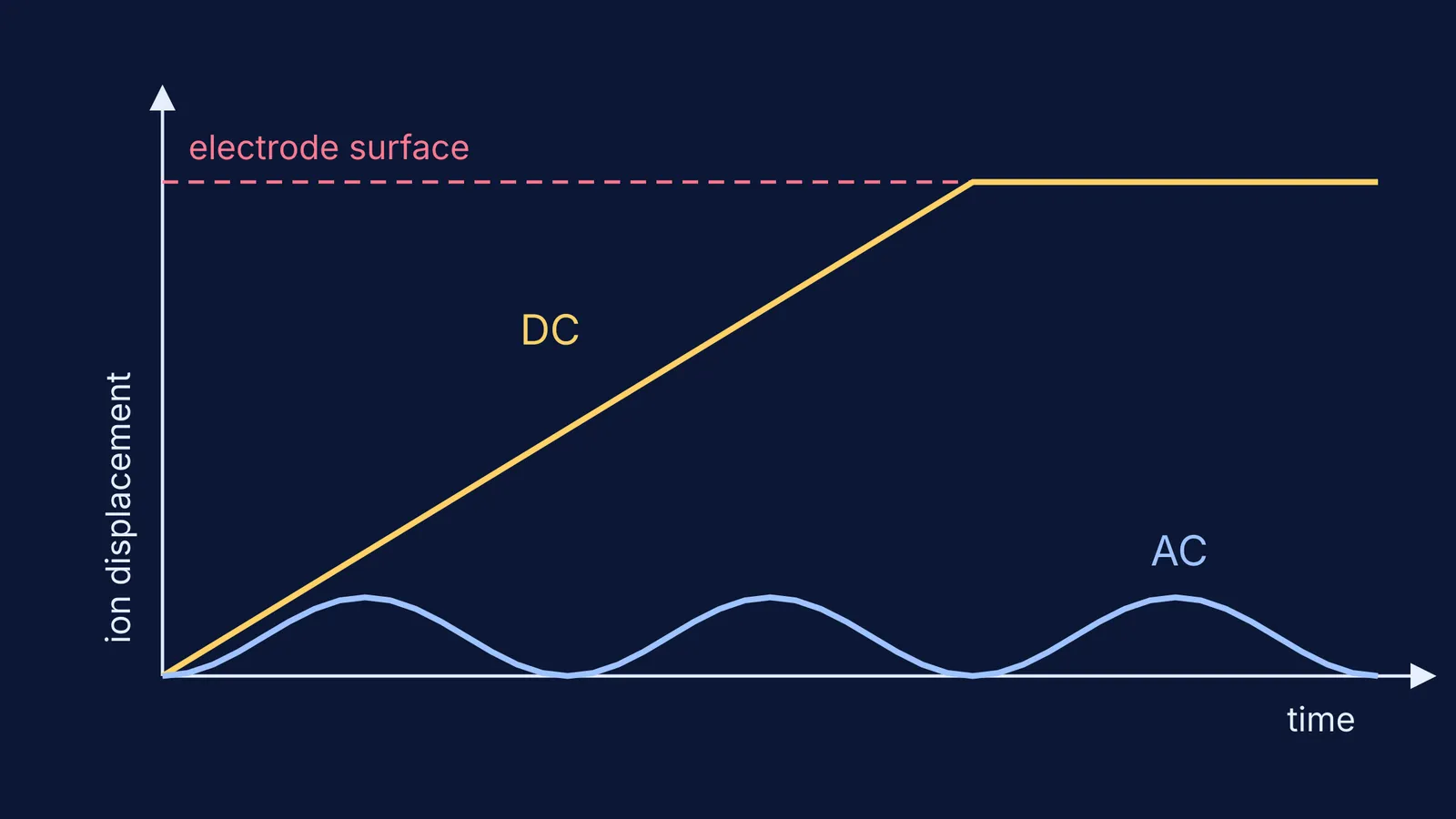
When a direct current is applied, cations move steadily to the cathode and anions to the anode. The same guide says this can lead to an accumulation of ions near the electrode surface and to chemical reactions there, and that this electrolysis affects the composition of the solution and therefore the conductivity.
So DC causes two separate errors:
Composition changes. Electrolysis products form at each electrode, so the liquid near the electrodes is no longer the liquid you meant to measure.
Polarization. Ions crowd the electrode surface and form a layer that adds extra resistance. BioLogic's application note on conductivity describes the same effect for DC: charge carriers accumulate at the electrodes, extra capacitances appear, and part of the applied voltage is lost before it reaches the sample.
Both effects build up while current flows one way.
How does alternating current solve the problem?
According to Mettler Toledo's guide.pdf), with alternating current the ions do not migrate in one direction but oscillate about their positions with the rhythm of the applied frequency. Before ions can travel far enough to pile up at an electrode, the field flips and pulls them back.
AC does not remove polarization completely, so the guide lists three fixes:
A higher measuring frequency, which gives ions less time to build up a double layer.
A better electrode surface. A larger area lowers current density, and porous platinized platinum has the lowest polarization resistance, smooth uncoated platinum a very high one.
A 4-pole cell, where the voltage is measured by inner poles that carry very little current.
Frequency is a trade-off. The guide notes that low frequencies are used for low-conductivity samples and high frequencies for high-conductivity samples, and modern meters adjust the frequency automatically.
What does the conductivity cell do?
AC fixes the chemistry; the cell fixes the geometry. A meter measures resistance R, or conductance G = 1/R, which depends on the electrodes' size and spacing.
The cell constant is the ratio of the distance between the electrodes to their area, K = l/A, as defined in Mettler Toledo's guide.pdf). Conductivity, which does not depend on the cell, is then κ = G × K.
You rarely measure l and A with a ruler. The same guide says a nominal cell constant from manufacturing is accurate to only ±20%, so the exact constant is found by calibration with a standard solution of known conductivity.
Worked example: from meter reading to conductivity
Suppose you calibrate with a 1413 µS/cm standard at 25 °C, one of the conductivity standards listed in Mettler Toledo's guide.pdf). The other numbers below are made up for practice.
The cell, filled with the standard, reads R = 700 Ω.
Cell constant: K = κ × R = (1413 × 10⁻⁶ S cm⁻¹) × 700 Ω = 0.989 cm⁻¹.
Rinse the cell, fill it with your sample at the same temperature, and read R = 2500 Ω.
Conductivity: κ = K / R = 0.989 / 2500 = 3.96 × 10⁻⁴ S cm⁻¹, about 396 µS/cm.
Check units at step 2: S cm⁻¹ × Ω gives cm⁻¹, because S × Ω = 1. Watch for slips between S m⁻¹ and S cm⁻¹. For more practice, the Fermi Problem Library has worked problems with a step-by-step solver that explains the reasoning rather than printing an answer.
Can DC ever be used to measure conductivity?
Yes, with care: the real problem is what happens at the electrodes. In a 1994 paper in the Journal of Research of NIST, Wu, Koch and colleagues measured standard KCl solutions with a DC method. They kept the current low to minimise electrolysis, used silver/silver chloride electrodes instead of platinum to minimise electrolysis and polarization, measured voltage with separate potential leads, and used a U-shaped capillary to keep electrolysis products away from the measured section.
For a school lab or an ordinary meter, AC and a calibrated cell remain the practical answer.
A quick checklist for exam answers
Say why DC fails: electrolysis changes the composition, and polarization adds resistance.
Say what AC does: ions oscillate instead of drifting, so there is no net build-up.
Name the cell and its constant: K = l/A, and κ = G × K.
For accuracy questions, mention platinized electrodes or calibration.
If cell constant and conductance still feel shaky, the Fermi Concept Library gives each chemistry concept its own lesson and its place in the map.


